
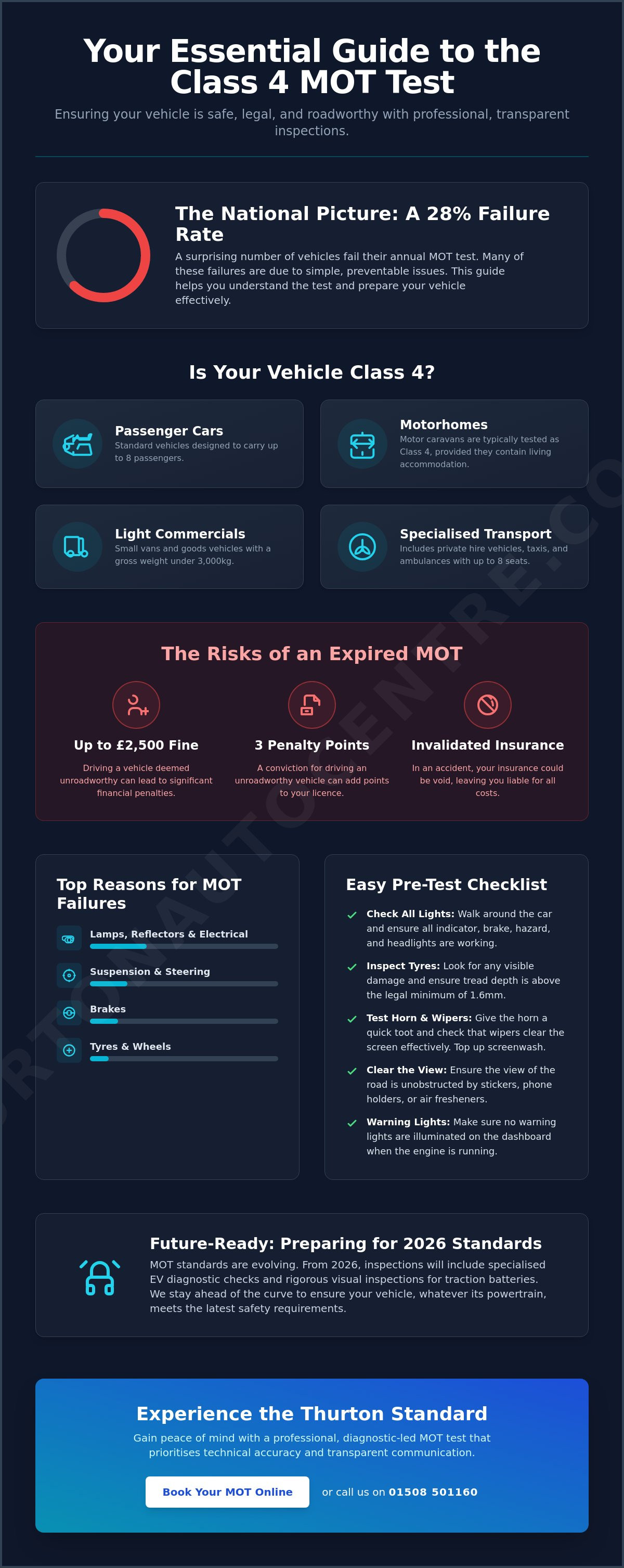
With a national failure rate of 28% recorded in the most recent analysis, the annual inspection often feels more like a gamble than a safety check. For many drivers across Norfolk and Suffolk, the prospect of a class 4 mot brings a familiar sense of unease. You might worry about the technical nuances of legal requirements for motorhomes versus cars, or perhaps you harbour a healthy distrust of garages that lack a disciplined, transparent approach. It's understandable to seek clarity, precision, and accountability when it comes to your vehicle's roadworthiness.
This guide ensures you understand exactly what a Class 4 assessment entails and which vehicles require this specific grade of testing. We provide a process-driven alternative to standard providers, where technical skill is never compromised for mere ease of access. We will preview the latest 2026 standards, including specialised EV diagnostic checks and the rigorous visual inspections now required for traction batteries. By following our methodical overview, you will gain total confidence in your vehicle's safety and a clear path to a straightforward, expert booking.
Key Takeaways
- Understand the technical scope of the class 4 mot and why it remains the essential safety benchmark for most passenger vehicles and motorhomes.
- Learn how a disciplined, diagnostic-led inspection identifies critical safety issues in lighting, signalling, and electrical systems before they become hazardous.
- Clarify the legal distinctions between vehicle categories to ensure you book the correct test for your specific car, motorhome, or light goods vehicle.
- Discover a methodical pre-test checklist designed to eliminate the simple, preventable errors that account for a high percentage of annual failures.
- Experience the peace of mind offered by a specialist service that prioritises technical accuracy and transparent communication throughout the testing process.
Defining the Class 4 MOT: Scope, Legality, and Purpose
The annual vehicle inspection is not merely a bureaucratic hurdle to be cleared once a year. It is a vital technical audit designed to protect drivers, passengers, and the environment. For the majority of motorists in Norfolk and Suffolk, the class 4 mot is the standard requirement for roadworthiness. It serves as a rigorous safety benchmark, mandated by the Driver and Vehicle Standards Agency (DVSA) to ensure every vehicle on the road maintains a baseline level of mechanical integrity. Precise. Reliable. Accountable. These values guide our systematic approach to every inspection we perform.
Operating a vehicle without a valid certificate is a serious legal breach with far-reaching implications. Beyond the immediate risk to your safety, the consequences are financially and legally significant. You could face a fine of up to £1,000. If the vehicle is deemed unroadworthy, this fine can escalate to £2,500, and you may receive three penalty points on your licence. Perhaps most critically, a lapsed MOT usually invalidates your motor insurance, leaving you personally liable for any damages or injuries sustained during an incident. It's simply not worth the risk to your safety or your finances.
Which Vehicles Fall Under Class 4?
Confusion often surrounds vehicle classification, particularly for owners of larger leisure vehicles or specialised transport. The class 4 mot applies to a broad spectrum of transport, including:
- Passenger Cars: Standard vehicles designed to carry up to eight passengers.
- Motorhomes: Motor caravans are generally tested under Class 4, regardless of their size, provided they meet specific criteria for a living space.
- Light Commercials: Small vans and dual-purpose vehicles with a gross weight under 3,000kg.
- Specialised Transport: Private hire vehicles and ambulances with up to eight seats.
The Legal Requirement and 2026 Standards
New vehicles require their initial inspection on the third anniversary of their registration date. Following this milestone, annual inspections become mandatory to remain road-legal in the UK. While some garages might offer a "rough-and-ready" look over the car, our methodical expert perspective sees the MOT as an essential component of preventative maintenance. Compliance ensures that your vehicle is not just legal, but genuinely safe for the road. As standards evolve in 2026, the focus on technical accuracy has never been higher. We don't just look for faults; we apply a systematic diagnostic approach to ensure your vehicle remains fit for purpose on the challenging roads of East Anglia. If you have questions about your vehicle's specific requirements, you can contact our team on 01508501160 for professional guidance.
The Technical Anatomy: What Our Technicians Inspect
A professional class 4 mot is far more than a cursory glance under the bonnet. It is a systematic diagnostic audit that demands technical precision and a disciplined eye. At our facility, we treat the inspection as a rigorous technical assessment where every component is weighed against stringent national roadworthiness standards. Our process is transparent, evidence-based, and focused entirely on the mechanical integrity of your vehicle. Disciplined. Transparent. Precise.
Lamps, reflectors, and electrical equipment account for a significant portion of all MOT failures, making them a primary focus of our inspection. We don't just check if the bulbs work; we evaluate the security of the housings, the correct colour of the light emitted, and the precision of the beam aim. Misaligned headlights or oxidised lenses often lead to failure because they compromise the safety of every road user by causing glare or reducing visibility. Similarly, we scrutinise steering and suspension systems. Our technicians look for worn bushes, leaking shock absorbers, and any play in the steering rack that could undermine your vehicle’s structural handling capability and safety during emergency manoeuvres.
Braking systems and tyres are the final pillars of our primary safety check. We use advanced rolling road technology to measure braking efficiency and balance across each axle. This identifies issues like excessive disc wear or hydraulic leaks that might not be obvious during standard driving. For tyres and wheels, we verify that tread depth meets the legal 1.6mm minimum and check for structural bulges or cuts that could lead to a high-speed blowout. If you're unsure about your vehicle's current condition, you can easily secure an appointment via our online booking portal.
Visibility and Environmental Standards
Your field of vision is critical for reactive driving. We inspect the windscreen for chips or cracks, particularly in the area directly in front of the driver, whilst ensuring wiper blades effectively clear the glass without smearing. Environmental compliance is equally vital. We utilise specialised diagnostic equipment to verify that exhaust emissions fall within legal thresholds, ensuring your engine is burning fuel efficiently. We also confirm the fuel system is leak-free and the fuel cap seals correctly to prevent hazardous vapours from escaping into the atmosphere.
Body, Structure, and General Items
The structural integrity of the chassis is non-negotiable. We inspect for excessive corrosion or poorly executed repairs in load-bearing areas, particularly near suspension mounting points, to ensure the vehicle can withstand the stresses of the road. Inside the cabin, we verify the functionality of seat belts and supplemental restraint systems (SRS), ensuring these life-saving components engage correctly during an impact. Finally, we confirm that registration plates and the Vehicle Identification Number (VIN) are clearly legible, maintaining the professional accountability required for a road-legal class 4 mot.
Identifying Your Vehicle Class: Is Your Car or Motorhome a Class 4?
Identifying the correct classification is the first step in a successful inspection process. Whilst many drivers assume all standard vehicles fall under the class 4 mot, the nuances of design gross weight and vehicle use can create confusion. Booking the wrong class doesn't just lead to administrative delays; it may result in a facility being unable to perform the test if their equipment isn't specified for heavier loads. We prioritise technical accuracy from the moment of booking, ensuring your vehicle is matched to the correct testing standards. Disciplined. Informed. Systematic.
The distinction between Class 4 and Class 7 is a common point of uncertainty, particularly for owners of light commercial vehicles. The threshold is generally a design gross weight of 3,000kg. If a goods vehicle exceeds this limit, it transitions into Class 7, requiring specialised testing bays with higher lifting capacities and different braking test parameters. For small business owners and fleet managers in the region, understanding these limits is essential for maintaining a road-legal operation and ensuring your vehicle is tested in a facility equipped for the task.
The Motorhome and Campervan Distinction
Leisure vehicles present a unique case that requires a specialist eye. Most motorhomes, regardless of their weight, are tested under the class 4 mot framework, provided they meet the specific criteria for "living accommodation." This includes permanently fitted seats, a table, sleeping berths, and cooking facilities. Because these vehicles often have larger dimensions than standard cars, they require a testing centre with the physical capacity to house them safely. We provide Specialist Motorhome Care that accounts for these nuances, often recommending a habitation survey alongside the MOT to ensure the safety of your internal gas and electrical systems whilst on the road.
Dual-Purpose Vehicles and Light Vans
In the rural communities of Norfolk and Suffolk, dual-purpose vehicles like 4x4s and pick-up trucks are staples of daily life. A vehicle is classified as dual-purpose if it is designed to carry both passengers and goods, has an unladen weight not exceeding 2,040kg, and features either four-wheel drive or specific seating and window configurations. If your light van or pick-up stays below the 3,000kg gross weight limit, it remains in Class 4. For professional advice on your vehicle’s specific classification, our team is available on 01508501160 to ensure your booking is accurate and your vehicle remains compliant.
Preventing Common Failures: A Methodical Pre-Test Checklist
According to data from the DVSA, nearly 40% of initial MOT failures are caused by minor, easily rectifiable faults. This statistic represents a significant amount of avoidable stress and potential retest fees for motorists across Norfolk. By adopting a disciplined, proactive approach to your vehicle's health, you ensure that the class 4 mot serves as a validation of safety rather than a list of unexpected repairs. We encourage every owner to conduct a basic pre-test survey. This allows our technicians to focus their specialised expertise on deeper mechanical diagnostics rather than simple maintenance tasks. Proactive. Efficient. Systematic.
Conducting these checks doesn't require mechanical training; it requires a methodical eye. When you address the "easy wins" before arriving at the testing centre, you significantly reduce the risk of a "Refusal to Test" or a failure on technicalities. This transparent approach to maintenance keeps your vehicle on the road and your costs predictable. It's about maintaining a standard of excellence for your car or motorhome throughout the year, not just in the days leading up to your anniversary date.
The Five-Minute Exterior Survey
A quick visual audit of your vehicle’s exterior can prevent the most frequent failure points. Lighting and signalling issues are the primary culprits in nearly 11% of all failures. We recommend the following steps:
- Test all bulbs: Enlist a friend to verify that brake lights, indicators, and number plate lights are fully functional.
- Inspect wiper blades: Ensure the rubber hasn't split or perished; they should clear the screen without smearing or leaving gaps.
- Top up screenwash: An empty reservoir is a common reason for failure that is entirely within your control to fix.
- Examine tyres: Check for a minimum tread depth of 1.6mm across the central three-quarters of the tyre, and look for obvious bulges or cuts in the sidewalls.
Interior and Operational Checks
The interior inspection is equally vital for passenger safety and legal compliance. All seat belts must click securely into the buckle and retract smoothly without signs of fraying or damage. The horn should produce a clear, consistent tone that is loud enough to warn other road users. Finally, pay close attention to your dashboard. If any warning lights remain illuminated after the engine starts, particularly those for ABS, SRS, or Engine Management, your vehicle may require Advanced Vehicle Diagnostics before the test begins. Addressing these indicators early ensures your class 4 mot proceeds without technical interruption. Once you've completed your survey, you can secure your appointment via our online booking system to experience our professional, process-driven service.
The Thurton Standard: Professional MOT Testing and Precision Repairs
Thurton Auto Centre represents a disciplined, premium alternative to standard providers in the region. We understand that motorists in Norwich, Loddon, and across South Norfolk seek more than a mere pass certificate; they seek technical mastery and evidence-based results. Our technicians are highly trained specialists who maintain an uncompromising attitude toward quality. Every class 4 mot we conduct is performed with clinical precision, ensuring that your vehicle’s safety is never left to chance. We pride ourselves on a process-driven approach that prioritises clarity over high-pressure sales tactics. Disciplined. Transparent. Sophisticated.
Choosing a specialist facility means you benefit from a higher tier of service. We don't just identify faults; we provide professional diagnostics that explain the "how" and "why" behind every result. This transparency reinforces our image as a modern, well-organised operation dedicated to road safety. Whether you drive a standard passenger car or a sophisticated motorhome, our facility is equipped to handle the specific technical demands of your vehicle class. We position ourselves as the trusted specialist for those who value reliability and technical competence above mere ease of access.
Beyond the Certificate: Comprehensive Care
A failure doesn't have to be a source of frustration. If your vehicle fails to meet the required standards, we implement a methodical repair and retest process. Because we value accountability, we provide a clear justification for any necessary work, allowing you to make informed decisions about your vehicle's maintenance. Many of our clients choose to integrate their Class 4 MOT Testing at Thurton with their annual car or motorhome servicing. This combined approach offers total peace of mind, as it ensures both legal compliance and mechanical longevity in one disciplined visit. Our goal is to provide a sense of security that your vehicle is genuinely safe, legal, and fit for purpose.
Book Your Professional Inspection Today
Experience the security that comes from trusting a methodical expert. Our operation is designed to be efficient for the quick reader and thorough for those seeking deeper technical reassurance. We invite you to call us directly on 01508501160 to discuss your vehicle’s specific requirements or to clarify any legal nuances regarding its classification. Alternatively, you can secure your appointment through our Online Booking Portal at your convenience. Trust your safety to a specialist who values systems, accuracy, and high standards above all else. We look forward to providing the professional oversight your vehicle deserves.
Secure Your Roadworthiness with Technical Precision
Maintaining your vehicle's roadworthiness shouldn't be a source of anxiety. By understanding the specific criteria of the class 4 mot and adopting a proactive maintenance routine, you ensure your car, van, or motorhome remains safe for the diverse roads of Norfolk and Suffolk. We've explored the technical anatomy of the inspection, the nuances of vehicle classification, and the simple pre-test steps that prevent many common failures. This knowledge empowers you to approach your annual test with clarity and confidence.
As an independent, family-owned centre, we provide a disciplined and transparent alternative to standard providers. Our technicians bring specialist expertise to every assessment, ensuring that technical accuracy is never compromised for the sake of speed. We are committed to providing the technical mastery and clear communication you need to drive with total peace of mind. Our methodical standards ensure that every component is checked against the highest safety benchmarks.
Take the next step in securing your vehicle’s safety by choosing a process-driven specialist you can trust. You can Book Your Professional Class 4 MOT Online today or contact our team directly on 01508501160 for expert guidance. We look forward to helping you stay safe and legal on the road.
Frequently Asked Questions
How long does a Class 4 MOT test take at Thurton Auto Centre?
A standard inspection typically takes between 45 and 60 minutes to complete. We follow a disciplined, systematic process to ensure every component is scrutinised according to current DVSA standards. Whilst the physical test is efficient, we always allow sufficient time for a transparent review of the results with you. This ensures you leave with a clear understanding of your vehicle's mechanical integrity.
Can I drive my car if it fails its Class 4 MOT?
You can only drive your vehicle after a failure if your existing MOT certificate is still valid and no "dangerous" faults were identified during the inspection. If your previous certificate has expired or the vehicle has been issued a "dangerous" defect notice, it's illegal to drive it on public roads. Safety and legal compliance remain our absolute priorities for every motorist we serve.
Is a motorhome always a Class 4 vehicle?
Most motorhomes fall under the class 4 mot category regardless of their gross weight, provided they are officially classified as "motor caravans." To meet this definition, the vehicle must feature fixed living accommodation, including seating, a table, and cooking facilities. Our specialists ensure your leisure vehicle is tested against the correct technical criteria, providing the expertise required for these specialised inspections.
What is the difference between a Class 4 and a Class 7 MOT?
The distinction is primarily based on the vehicle's design gross weight and its intended use. Class 4 covers passenger cars and small vans up to 3,000kg; Class 7 is for commercial goods vehicles weighing between 3,001kg and 3,500kg. As of June 2026, zero-emission goods vehicles between 3,501kg and 4,250kg are also classified as Class 7, requiring a different grade of testing equipment and bay specifications.
How much does a Class 4 MOT cost in 2026?
The fee for a class 4 mot is legally capped by the DVSA and is entirely exempt from VAT. While prices can vary amongst providers, we maintain a competitive structure that reflects our premium, methodical service. Our focus remains on providing technical accuracy and a sophisticated diagnostic approach rather than just a basic pass certificate. For our latest rates, please contact our team directly on 01508501160.
What happens if my vehicle fails on a major or dangerous item?
A "major" failure indicates a significant fault that must be repaired, though you may drive the vehicle to a repair centre if your current MOT remains valid. A "dangerous" failure means the vehicle poses an immediate risk and must not be driven until the defect is rectified. In both scenarios, we provide a transparent diagnostic report and a disciplined plan for precision repairs to restore your safety.
Do I need to bring any documents to my MOT appointment?
You generally don't need to bring any paperwork to your appointment, as we access your vehicle's history via the centralised DVSA database. However, it's helpful to bring your V5C registration document if the vehicle is being tested for the first time or if you've recently changed your registration plate. This ensures our records are perfectly aligned with the official identification data for your car or motorhome.
Can I have my MOT carried out early?
You can have your inspection carried out up to one month, minus one day, before your current certificate expires whilst still preserving your original renewal date. This proactive approach allows a strategic window to address any identified issues without the pressure of an immediate expiry. Testing early provides peace of mind, ensuring your vehicle remains road-legal and safe well before the deadline passes.
Disclaimer
Terms and Conditions
Who we are and how to contact us
https://wwwthurtonautocentre.co.uk is a site operated by Thurton Auto centre. We are a limited company registered in England and Wales under company number 15780586 and have our registered office at The Garage, Norwich Road, Thurton, Norwich, Norfolk, NR14 6AW. Our main trading address is The Garage, Norwich Road, Thurton, Norwich, Norfolk, NR14 6AW.
To contact us, please email info@thurtonautocentre.co.uk or telephone our customer service line on01508 501160or write to us at The Garage, Norwich Road, Thurton, Norwich, Norfolk, NR14 6AW
Information on this site
The content on our site is provided for general information only. It is not intended to amount to advice on which you should rely. You must obtain professional or specialist advice before taking, or refraining from, any action on the basis of the content on our site.
Although we make reasonable efforts to update the information on our site, we make no representations, warranties or guarantees, whether express or implied, that the content on our site is accurate, complete or up to date.
Any descriptions or illustrations on our site are for illustrative purposes only, and are published for the sole purpose of giving an approximate idea of the vehicles described in them. They will not form part of any contract or have any contractual force. We have made every effort to display the colours accurately, but we cannot guarantee that a device's display of the colours accurately reflects the colour of the vehicles.
We reserve the right to amend the specification of any vehicle described on this site if required to do so by any applicable statutory or regulatory requirement, to implement minor technical adjustments and improvements, or if the amendment will not materially affect its nature or quality.
Our site is only for users in the UK
Our site is directed to people residing in the United Kingdom. We do not represent that content available on or through our site is appropriate for use or available in other locations. You may use this site to reserve a vehicle or test drive from an address outside the United Kingdom, but we do not deliver vehicles outside the United Kingdom, and any test drives must take place at the address in the United Kingdom which we specify.
Events outside our control
We will not be liable or responsible for any failure to perform, or delay in performance of, any of our obligations under the Contract that is caused by any act or event beyond our reasonable control (Event Outside Our Control).
If an Event Outside Our Control takes place that affects the performance of our obligations under the Contract, we will contact you as soon as possible to let you know and we will take steps to minimise the effect of the delay. We will arrange a new date for the test drive after the Event Outside Our Control is over. Provided we do this we will not be liable for delays caused by the event, but if the Event Outside Our Control has continued, or seems likely to continue, for more than 30 days, you may contact us to cancel the Order and receive a refund of any reservation or booking fee you have paid.
How you may use material on our site
We are the owner or the licensee of all intellectual property rights in our site, and in the material published on it. Those works are protected by copyright laws and treaties around the world. All such rights are reserved.
You may print off one copy, and may download extracts, of any page(s) from our site for your personal use and you may draw the attention of others within your organisation to content posted on our site.
You must not modify the paper or digital copies of any materials you have printed off or downloaded in any way, and you must not use any illustrations, photographs, video or audio sequences or any graphics separately from any accompanying text.
Our status (and that of any identified contributors) as the authors of content on our site must always be acknowledged.
You must not use any part of the content on our site for commercial purposes without obtaining a licence to do so from us or our licensors.
You print off, copy or download any part of our site in breach of these terms of use, your right to use our site will cease immediately and you must, at our option, return or destroy any copies of the materials you have made.
We are not responsible for websites we link to
Where our site contains links to other sites and resources provided by third parties, these links are provided for your information only. Such links should not be interpreted as approval by us of those linked websites or information you may obtain from them.
We have no control over the contents of those sites or resources.
Our responsibility for loss or damage suffered by you
Whether you are a consumer or a business user:
We do not exclude or limit in any way our liability to you where it would be unlawful to do so. This includes liability for death or personal injury c