
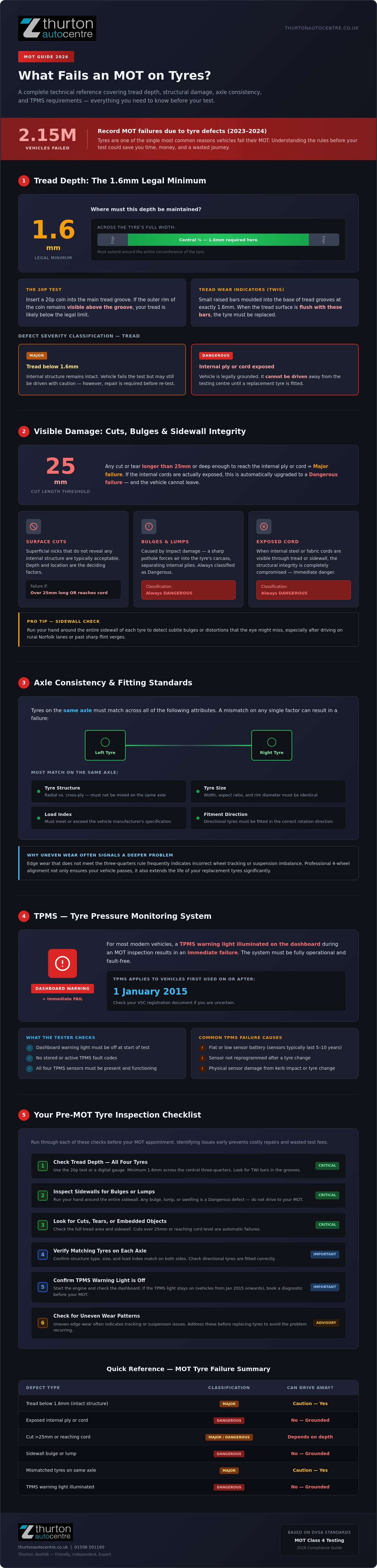
Did you know that a record 2.15 million vehicles failed their MOT due to tyre defects in the 2023-2024 period? It's a staggering statistic that underscores a significant point of anxiety for drivers, especially those navigating the demanding conditions of rural Norfolk lanes. We understand the concern regarding unexpected repair costs and the confusion surrounding evolving legal standards. Pinpointing exactly what fails an mot on tyres is not just about passing a test; it's about establishing a disciplined, systematic approach to vehicle safety and technical accountability.
We believe that clarity and evidence lead to peace of mind. This professional guide details the precise technical standards required for 2026 compliance, from the 1.6mm tread depth rule to the latest TPMS diagnostic requirements. You'll learn how to identify critical failure points, such as structural bulges or age-related deterioration, before you reach the testing centre. By following our methodical inspection checklist, you can gain a clear understanding of your vehicle's legality and ensure your car remains a reliable, high-performance asset on the road.
Key Takeaways
- Understand the mandatory 1.6mm tread depth limit and how the DVSA distinguishes between Major and Dangerous failures during a test.
- Learn to identify structural abnormalities such as lumps, bulges, or cuts exceeding 25mm, which are primary factors in what fails an mot on tyres.
- Recognise the importance of axle consistency, ensuring that tyre structures, sizes, and load indices match to maintain vehicle stability and legality.
- Discover why a functioning Tyre Pressure Monitoring System (TPMS) is critical, as a dashboard warning light results in an immediate failure for most modern vehicles.
- Gain confidence by adopting a methodical pre-MOT inspection routine to address potential issues before they become costly repairs.
The Legal Minimum: Tread Depth and the 1.6mm Rule
While the 1.6mm limit is a well-known benchmark, the specific application of this rule is often misunderstood by motorists. The DVSA mandate is precise: you must maintain a minimum depth of 1.6mm across the central three-quarters of the tyre's breadth, extending around its entire circumference. This standard is non-negotiable for a pass. Understanding the nuances of what fails an mot on tyres involves more than just checking for "bald" spots; it requires a systematic evaluation of the primary grooves where the most significant water displacement occurs. Our team prioritises technical accuracy, ensuring every measurement is recorded with the precision required for a formal MOT Class 4 test.
For a preliminary diagnostic at home, many drivers utilise the 20p test. By inserting the coin into the main tread grooves, you can quickly assess the depth; if the outer rim of the coin remains visible, the tyre is likely below the legal threshold. However, for a more definitive assessment, you should locate the Tread Wear Indicators (TWIs). These small, raised bars are moulded into the base of the main tread grooves at exactly 1.6mm. Once the tread surface becomes flush with these indicators, the tyre's legal life has concluded. We utilise calibrated digital gauges to provide the technical reassurance that your vehicle meets every statutory requirement.
Understanding the Central Three-Quarters Rule
This specific rule exists because the central portion of the tyre handles the majority of the vehicle's grip and stability. Edge wear, while often not an immediate failure if the central three-quarters remains deep enough, acts as a critical indicator of underlying mechanical issues. We frequently identify that uneven wear patterns are a symptom of incorrect tracking or suspension imbalances. Addressing these through professional 4-wheel alignment at our specialist service centre not only ensures a pass but also prolongs the lifespan of your new tyres.
Major vs Dangerous Tread Defects
The severity of a defect determines your vehicle's immediate legality and your ability to continue your journey. A "Major" failure is recorded when the tread is below the 1.6mm limit but the internal structure remains intact. Conversely, a Dangerous tread defect is defined as one where the internal ply or cord is exposed. Identifying a Dangerous defect means the vehicle is legally grounded and cannot be driven away from the testing site until a replacement is fitted. Our methodical experts provide clear, transparent results, ensuring you understand the evidence behind every diagnostic conclusion we reach.
Visible Damage: Cuts, Bulges, and Sidewall Integrity
The visual condition of a tyre's structure is just as critical as the tread depth discussed previously. Whilst tread wear is gradual, physical damage often occurs instantaneously, especially when navigating the flint-strewn lanes and deep potholes common across Norfolk and Suffolk. Determining what fails an mot on tyres requires a sophisticated eye for detail, as seemingly minor nicks can mask catastrophic internal weaknesses. Our technicians conduct a transparent, evidence-based assessment of every tyre to ensure your vehicle remains safe, legal, and roadworthy.
A primary failure point involves cuts and tears in the rubber. According to professional inspection protocols, any cut longer than 25mm, or deep enough to reach the internal ply or cord, will result in a Major failure. If those internal cords are actually exposed, the defect is upgraded to Dangerous, meaning the vehicle cannot be legally driven away from our MOT testing centre. This strict classification is a necessary safeguard against the risk of high-speed blowouts.
Spotting Structural Bulges and Impact Damage
Impact damage, often sustained from hitting a sharp pothole in Loddon or Poringland, can lead to internal ply separation. This manifests as a lump or bulge on the sidewall, indicating that air has escaped into the tyre's carcass. These irregularities are inherently unstable. We recommend a methodical physical check: running your hand over the sidewall to detect subtle distortions that the eye might miss. Because a bulge represents an imminent risk of structural failure, it is always recorded as a Dangerous defect.
Cuts and Tears: When is it a Failure?
The distinction between a superficial surface nick and a structural failure depends on depth and location. Surface nicks that do not reveal any internal structure are typically acceptable, but our professionals use systematic probing to check for hidden cord damage. It's particularly important to inspect the inner sidewall, which is frequently damaged by kerbing but remains hidden from the owner's view. If you have recently navigated rough terrain, you can book an inspection online to have your tyres professionally verified before your test date.
Axle Consistency and Fitting Standards
Beyond the physical condition of the individual rubber, the relationship between tyres on the same axle is a critical factor in determining what fails an mot on tyres. A vehicle's stability and braking efficiency rely on uniform performance across each pair of wheels. Professional standards require that all tyres on a single axle share the same structure and size. If a radial tyre is fitted on the near-side and a cross-ply on the off-side, the resulting imbalance in sidewall flexibility creates a significant safety hazard. This structural mismatch is an automatic Major failure.
Load indices and speed ratings also demand scrutiny, especially for commercial vehicles and large SUVs. Whilst it's not always a failure to have different brands, the tyres must be capable of handling the vehicle's maximum weight. Additionally, directional tyres must be fitted according to the rotation arrows on the sidewall. A tyre fitted "backwards" cannot disperse water effectively, leading to increased aquaplaning risks and a failed test certificate. We ensure every fitting is disciplined, accurate, and safe at our local MOT centre.
Mixing Tyre Structures: Radial vs Cross-Ply
Mixing different tyre constructions is a Major MOT failure because it compromises the vehicle’s handling characteristics. Radial tyres, which are standard on modern cars, have plies that run at 90 degrees to the direction of travel, whereas cross-ply tyres have a different diagonal arrangement. When these are mismatched on the same axle, the vehicle may pull or behave unpredictably during emergency braking. Our technicians verify every tyre marking during the inspection to ensure your vehicle remains balanced, predictable, and roadworthy.
Leisure Vehicle Tyre Ageing and Cracking
Motorhome and campervan owners face a unique challenge that differs from standard car maintenance. These vehicles often spend long periods stationary, which leads to tyres failing on age-related cracking long before the tread wears down. UV exposure and lack of movement cause the rubber compounds to harden and perish. For specific heavy vehicles, there's a mandatory 10-year rule for front-axle tyres. We recommend integrating tyre health checks into your regular motorhome habitation checks. Identifying "crazing" or deep cracks in the sidewall early prevents a Major failure and ensures your leisure time isn't interrupted by a dangerous blowout.
TPMS and Modern Electronic Monitoring
The evolution of vehicle safety has shifted the focus from purely mechanical components to sophisticated electronic monitoring. Today, understanding what fails an mot on tyres requires an awareness of the Tyre Pressure Monitoring System (TPMS). Since 2015, any vehicle first used on or after 1 January 2012 must have a fully operational TPMS. Recent regulatory updates from August 2025 provide specific exemptions for motor caravans with a gross vehicle weight exceeding 2,500kg, but for the vast majority of passenger cars, an illuminated warning light remains an automatic Major failure. This standard underscores the critical link between correct inflation, tyre longevity, and road safety.
A common point of confusion for many drivers is the distinction between a simple low-pressure warning and a genuine system malfunction. A pressure warning suggests one or more tyres have dropped below the safe threshold; a malfunction light often flashes before remaining solid, indicating the system itself can no longer provide accurate data. Both scenarios prevent the issuance of a pass certificate. We prioritise technical transparency, ensuring our customers understand that these sensors are not just advisory, but a core legal requirement for modern motoring.
Common Causes of TPMS MOT Failures
Sensor battery depletion is a frequent issue we encounter, particularly in cars approaching their eighth or ninth year of service. These internal batteries are sealed units; once they fail, the entire sensor usually requires replacement. Corroded valve stems also compromise system integrity, leading to slow leaks or electronic failure. By utilising advanced vehicle diagnostics, our technicians can quickly pinpoint which specific sensor is at fault, saving time and preventing unnecessary repairs.
Correct Inflation and Sensor Calibration
Correct inflation is vital. An obviously under-inflated tyre is a failure point in its own right, regardless of whether the sensor has flagged it. It's essential to reset the TPMS calibration after every tyre replacement or pressure adjustment. If the system isn't synchronised to the correct pressures, the warning light will persist, leading to a failed test. We ensure your system is accurately calibrated, tested, and verified. If you've noticed a persistent warning light, you can book your inspection online to resolve the issue before your MOT date arrives.
The Thurton Standard: Professional Tyre Maintenance
At Thurton Auto Centre, we view tyre maintenance as a discipline of precision. Whilst the technicalities of what fails an mot on tyres are complex, our role is to ensure those failure points never manifest during your test. A systematic pre-MOT check is the most efficient way to secure a first-time pass. By identifying subtle tread wear, structural vulnerabilities, or electronic sensor issues early, we provide a transparent, evidence-based path to compliance. We don't just inspect; we provide the technical reassurance that your vehicle is fit for the road.
Our commitment to vehicle health extends beyond simple replacement. We strongly advocate for 4-wheel alignment as a standard component of professional care. Misaligned wheels accelerate tread depletion and compromise safety, especially when navigating the challenging surfaces of Norfolk's rural lanes. By correcting these mechanical deviations, we prolong tyre life, enhance fuel economy, and restore handling accuracy. It's a methodical approach that protects your investment and your safety.
Precision Tyre Fitting and Balancing
Our fitting process is built on technical mastery. Every tyre we handle is subjected to a rigorous procedure: inspection, mounting, and balancing. Wheel balancing is critical. It eliminates the minute vibrations that cause premature wear on suspension components and ensures a sophisticated, smooth driving experience. For those seeking high-level care and specialized expertise, our tyres and brakes services provide the professional grades of service required for modern vehicle safety.
Book Your MOT with the Methodical Experts
Efficiency. Clarity. Reliability. These are the values that define our operations in Thurton. Combining your MOT with a professional service is a logical choice for the disciplined driver, ensuring all safety systems are evaluated simultaneously by specialists. We maintain an uncompromising attitude toward quality, recommending only the repairs necessary to keep you legal and safe. To secure your inspection or to discuss your vehicle’s specific requirements with a trusted professional, contact our office line on 01508501160.
Secure Your Road Safety for 2026
Maintaining a vehicle to professional standards requires a disciplined focus on both mechanical and electronic integrity. By understanding what fails an mot on tyres, you've taken the first step toward avoiding the high failure rates seen in recent years. From the 1.6mm tread depth mandate to the precise calibration of your TPMS sensors, every detail contributes to your vehicle's legality and performance. A methodical approach to these standards ensures you remain safe on the road whilst avoiding the anxiety of unexpected repair costs.
As a provider of independent family-owned expertise, we pride ourselves on delivering a transparent and reliable service. Our MOT Class 4 testing specialists utilise advanced 4-wheel alignment technology to ensure your tyres are not just legal, but optimised for longevity. We invite you to Book your professional MOT at Thurton Auto Centre today to benefit from our specialist knowledge and rigorous inspection processes. We look forward to providing the technical peace of mind you need for the miles ahead.
Frequently Asked Questions
Is the spare tyre checked as part of the MOT?
The spare tyre is not a mandatory part of the MOT inspection and will not be checked if it is stowed in its carrier or the boot. However, if the spare is actually fitted to the vehicle at the time of the test, it must meet all legal requirements. It's a disciplined habit to maintain your spare's pressure and condition so it remains a reliable asset during an emergency.
Will a slow puncture cause an MOT failure?
A slow puncture will lead to a failure if it results in an obviously under-inflated tyre at the time of the inspection. Any embedded object, such as a nail or screw, identified in the tread will also trigger a failure. This is often what fails an mot on tyres when minor leaks are ignored. We recommend a professional repair before your test to ensure compliance and safety.
Can I fail an MOT if my tyres are the wrong size?
Yes, tyres must be of a size and load index appropriate for the vehicle's weight and design. If a tyre is fitted that is clearly unsuitable for the vehicle's performance requirements, it will result in a failure. Mismatched tyre sizes on the same axle are particularly hazardous as they compromise stability. Our technicians verify every marking to ensure your vehicle remains balanced and legal.
How old can tyres be before they fail an MOT?
There is currently no maximum age limit for tyres on private passenger vehicles to pass an MOT as of July 2026. However, front-axle tyres on specific heavy vehicles over 3,500kg must be less than 10 years old. Regardless of the manufacture date, any tyre showing significant age-related perishing or deep structural cracking will be failed. We prioritise safety by identifying these risks before they become dangerous.
What is the difference between a Major and a Dangerous tyre defect?
A Major defect results in a test failure but allows the vehicle to be driven to a repair centre. A Dangerous defect, such as exposed internal cords, grounds the vehicle immediately. You cannot legally drive a vehicle with a Dangerous defect away from the testing centre. This distinction is critical for road safety and highlights the importance of identifying what fails an mot on tyres during your pre-test checks.
Does the MOT check the tyre pressure in all four tyres?
The MOT examiner does not use a pressure gauge to check every tyre but will fail the vehicle if a tyre is "obviously under-inflated." Correct pressure is vital for maintaining the tyre's structural integrity and ensuring the TPMS operates as intended. We ensure every vehicle we inspect has its pressures calibrated to the manufacturer's precise specifications to promote even tread wear and optimal fuel efficiency.
Can mismatched tyre brands on the same axle cause a failure?
Mismatched tyre brands on the same axle are not an MOT failure, provided the tyres share the same size and construction. You can legally have different brands on the near-side and off-side. However, they must both be the same structure, such as radial-ply. Mixing radial and cross-ply tyres on the same axle is a Major defect because it creates unpredictable and unsafe handling characteristics during braking.
What happens if my TPMS light comes on during the MOT?
An illuminated Tyre Pressure Monitoring System (TPMS) warning light results in an automatic Major failure for vehicles first used after 1 January 2012. The system must be fully operational and correctly calibrated to pass. If the light is on, it suggests either a pressure issue or a system malfunction. Our diagnostic equipment can quickly identify the specific sensor fault to restore your vehicle's legal status and safety monitoring.
Disclaimer
Terms and Conditions
Who we are and how to contact us
https://wwwthurtonautocentre.co.uk is a site operated by Thurton Auto centre. We are a limited company registered in England and Wales under company number 15780586 and have our registered office at The Garage, Norwich Road, Thurton, Norwich, Norfolk, NR14 6AW. Our main trading address is The Garage, Norwich Road, Thurton, Norwich, Norfolk, NR14 6AW.
To contact us, please email info@thurtonautocentre.co.uk or telephone our customer service line on01508 501160or write to us at The Garage, Norwich Road, Thurton, Norwich, Norfolk, NR14 6AW
Information on this site
The content on our site is provided for general information only. It is not intended to amount to advice on which you should rely. You must obtain professional or specialist advice before taking, or refraining from, any action on the basis of the content on our site.
Although we make reasonable efforts to update the information on our site, we make no representations, warranties or guarantees, whether express or implied, that the content on our site is accurate, complete or up to date.
Any descriptions or illustrations on our site are for illustrative purposes only, and are published for the sole purpose of giving an approximate idea of the vehicles described in them. They will not form part of any contract or have any contractual force. We have made every effort to display the colours accurately, but we cannot guarantee that a device's display of the colours accurately reflects the colour of the vehicles.
We reserve the right to amend the specification of any vehicle described on this site if required to do so by any applicable statutory or regulatory requirement, to implement minor technical adjustments and improvements, or if the amendment will not materially affect its nature or quality.
Our site is only for users in the UK
Our site is directed to people residing in the United Kingdom. We do not represent that content available on or through our site is appropriate for use or available in other locations. You may use this site to reserve a vehicle or test drive from an address outside the United Kingdom, but we do not deliver vehicles outside the United Kingdom, and any test drives must take place at the address in the United Kingdom which we specify.
Events outside our control
We will not be liable or responsible for any failure to perform, or delay in performance of, any of our obligations under the Contract that is caused by any act or event beyond our reasonable control (Event Outside Our Control).
If an Event Outside Our Control takes place that affects the performance of our obligations under the Contract, we will contact you as soon as possible to let you know and we will take steps to minimise the effect of the delay. We will arrange a new date for the test drive after the Event Outside Our Control is over. Provided we do this we will not be liable for delays caused by the event, but if the Event Outside Our Control has continued, or seems likely to continue, for more than 30 days, you may contact us to cancel the Order and receive a refund of any reservation or booking fee you have paid.
How you may use material on our site
We are the owner or the licensee of all intellectual property rights in our site, and in the material published on it. Those works are protected by copyright laws and treaties around the world. All such rights are reserved.
You may print off one copy, and may download extracts, of any page(s) from our site for your personal use and you may draw the attention of others within your organisation to content posted on our site.
You must not modify the paper or digital copies of any materials you have printed off or downloaded in any way, and you must not use any illustrations, photographs, video or audio sequences or any graphics separately from any accompanying text.
Our status (and that of any identified contributors) as the authors of content on our site must always be acknowledged.
You must not use any part of the content on our site for commercial purposes without obtaining a licence to do so from us or our licensors.
You print off, copy or download any part of our site in breach of these terms of use, your right to use our site will cease immediately and you must, at our option, return or destroy any copies of the materials you have made.
We are not responsible for websites we link to
Where our site contains links to other sites and resources provided by third parties, these links are provided for your information only. Such links should not be interpreted as approval by us of those linked websites or information you may obtain from them.
We have no control over the contents of those sites or resources.
Our responsibility for loss or damage suffered by you
Whether you are a consumer or a business user:
We do not exclude or limit in any way our liability to you where it would be unlawful to do so. This includes liability for death or personal injury c