
A well-planned service can help identify vehicle issues before they disrupt a trip. Campervan servicing in Norfolk at Thurton Auto Centre covers mechanical maintenance and repairs, with separate habitation checks for the living area and its fitted systems. The workshop is in Thurton, serving campervan owners across Norfolk and Suffolk, including Dereham.
It’s sensible to want clarity about what a service involves, particularly when your campervan combines everyday vehicle systems with equipment for travelling. This guide explains what annual servicing may cover, which systems can be checked or diagnosed, and how a fault investigation fits into the process. You’ll also find out what information helps the work proceed smoothly, so you can understand the service before arranging it.
Key Takeaways
- Use an annual service to review the vehicle’s condition and identify maintenance needs before they affect your travel plans.
- Include gas, electrical and appliance checks when assessing the campervan’s living systems.
- Describe symptoms clearly to help diagnostics focus on the relevant systems, from damp and water concerns to running gear.
- Understand what a habitation service covers and how it differs from vehicle servicing.
- Servicing and diagnostics are available in Dereham, Norfolk, with vehicle repairs and MOT also offered by Thurton Auto Centre.
Table of Contents
Annual servicing recommendations
Plan mechanical servicing around the campervan’s use, condition and maintenance history. Keep it separate from habitation checks, which focus on the living area and its equipment.
MOT and mechanical servicing requirements
An MOT assesses roadworthiness, while mechanical servicing covers maintenance; one does not replace the other. The MOT requirement depends on the vehicle’s classification and record, so review its details and due date. Use the handbook and previous maintenance records to identify scheduled servicing. Note changes in braking, steering, starting or engine performance, and when each symptom occurs.
Annual servicing is a useful planning point, not a universal interval for every campervan. The right work depends on the manufacturer’s schedule, mileage, age, use and maintenance history. A vehicle used for frequent long journeys may show different wear from one used occasionally or stored for extended periods.
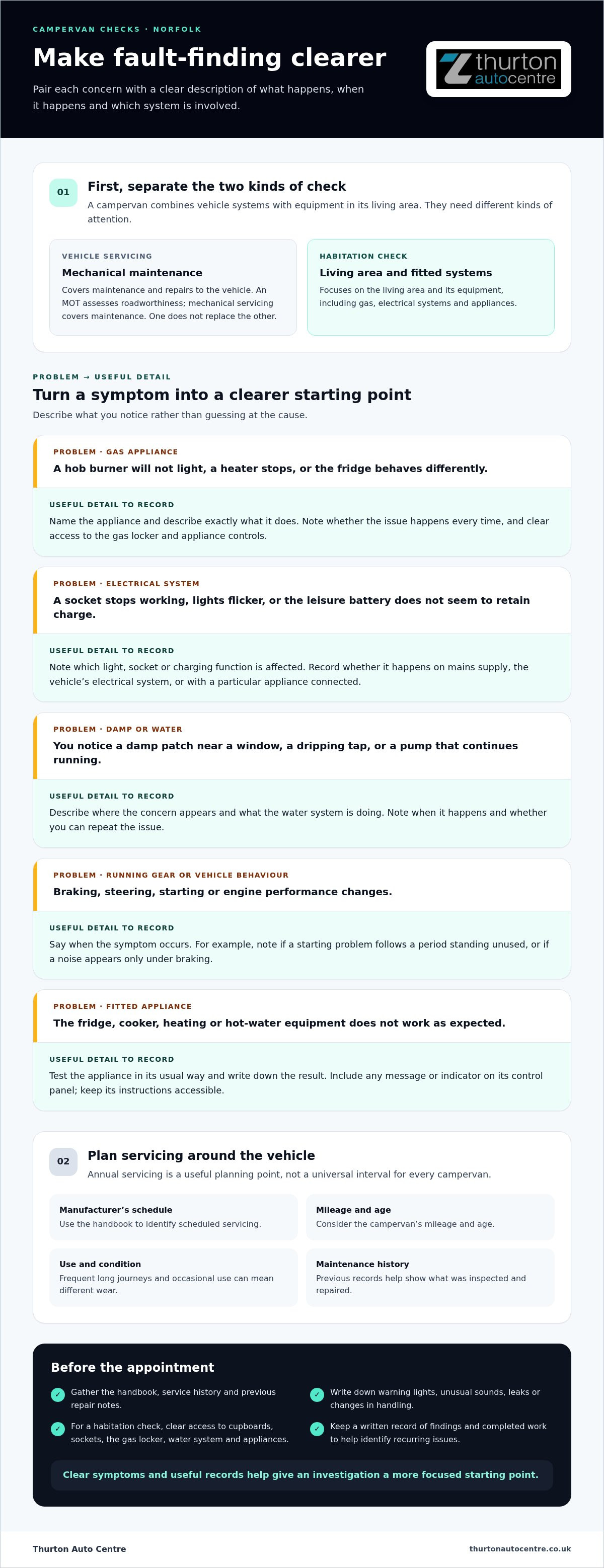
Before booking, gather the service history, handbook and previous repair notes. Record warning lights, unusual sounds, fluid leaks or changes in handling. For example, note whether a starting problem occurs after the campervan has stood unused, or whether a noise appears only under braking. Specific observations help distinguish a recurring fault from routine maintenance.
For a habitation check, clear access to cupboards, sockets, the gas locker, water system and fitted appliances. Move personal items that block inspection points, and list concerns, such as a dripping tap or a heater that cuts out. Leave appliance instructions available and explain when the issue occurs during normal use.
Risks of skipping checks
Skipping mechanical maintenance can leave developing wear or faults undiscovered until the next journey. A change in braking, tyre condition or engine behaviour may be harder to assess once it worsens. Habitation checks matter too: an unnoticed leak can affect interior materials, while an appliance or electrical issue may interrupt normal use. Report concerns early and keep a written record of findings and completed work.
Use each visit to agree what needs attention now and what belongs on the maintenance plan. Ask for findings to be explained in clear terms, especially where a symptom has more than one possible cause. If a Swift Elegance has a consistent service history, for example, dated records can help show what was inspected and repaired previously. That makes the next assessment more focused and gives you a useful reference before travelling.
Gas, electrical and appliance checks
A campervan’s living systems work together, so habitation checks should consider the gas supply, electrical circuits and fitted appliances. Note each item that behaves differently, including when the issue occurs and whether it happens every time.
For the gas system, list the appliances fitted and describe any concern precisely. Note whether a hob burner fails to light, a heater stops during use, or a fridge does not work as expected. Thurton Auto Centre provides LPG safety checks to assess the gas system. Clear access to the gas locker and appliance controls helps the inspection proceed efficiently.
Electrical checks should account for the campervan’s different power sources and connected equipment. List faults such as a socket that stops working, flickering interior lights, or a leisure battery that does not seem to retain charge. Note whether the issue occurs on mains supply, on the vehicle’s own electrical system, or with a particular appliance switched on. These details help narrow down where investigation should begin.
If an appliance is working normally, test it in its usual way before the appointment. Write down what happens with the fridge, cooker, heating and hot-water equipment rather than relying on memory. If an appliance has a control panel, note any displayed message or indicator. Keep its instructions accessible, particularly if the controls or operating modes are unfamiliar.
- Gas: identify each appliance and describe any change in operation.
- Electrical: note affected lights, sockets, charging or power sources.
- Appliances: record the function tested and the result.
- Access: clear the gas locker, electrical controls and appliance areas.
These observations are useful whether the campervan is used regularly or has stood unused. If a water heater works on one setting but not another, record both outcomes. If a socket problem appears only when a particular device is connected, name that device. Avoid guessing at the cause; clear symptoms provide a better starting point than an assumed diagnosis.
Keep a simple record after each inspection, including the date, findings and any work completed. This makes it easier to identify recurring issues and explain changes at a later appointment. If you’re arranging a check, you can use the online booking page and bring your notes along.
Gas, electrical, damp, running gear and water system diagnostics
Fault-finding starts with the symptom and the system affected. Describe what happens, when it happens, and whether it can be repeated. A gas appliance that cuts out, a damp patch near a window, or a pump that continues running each calls for a different investigation.
For a gas concern, identify the appliance and its behaviour rather than guessing at the cause. Note whether a hob flame changes, a heater stops, or a fridge fails to operate on a particular setting. A specialist can assess the gas installation and connected equipment, then explain any finding and the appropriate next step. Keep access clear around the locker, pipework and appliance controls.
Electrical fault-finding benefits from knowing which supply and equipment were in use. Record whether a light, socket or charging function fails on the vehicle’s own system, on mains hook-up, or with a particular appliance connected. If a control panel displays a warning, write down its wording. Avoid repeatedly resetting a fault, as the original symptom can become harder to describe.
A damp survey should consider both the location and pattern of moisture. Note marks on walls, ceilings, cupboards or around windows, and whether they change after rain or appliance use. A visible stain may not show where water entered, so inspection should trace likely routes and assess affected areas. Record any musty smell or soft interior surface alongside the visible evidence.
Running-gear concerns often show through changes in handling, noise or vibration. Describe whether a sound occurs during braking, turning, acceleration or travel over uneven surfaces. A pulling sensation or unusual movement is useful information too. These observations help direct inspection towards relevant components, rather than treating every noise as the same fault.
For water-system concerns, identify where the problem appears. Weak flow from a tap, a pump that cycles unexpectedly, or water beneath a fitting each suggests a different area to inspect. Note whether the fresh-water supply is full and whether the issue affects one outlet or several. This helps distinguish a local fitting concern from a wider system fault.
- Describe: the symptom, location and conditions when it occurs.
- Record: warning messages, visible marks and changes in operation.
- Prepare: access to affected fittings, controls and inspection areas.
- Discuss: the diagnostic finding before deciding on a repair.
Clear notes make fault-finding more focused. Reporting that a water pump runs after a specific tap closes, for example, gives a more useful starting point than saying the water system is faulty. Keep the description factual and separate what you observed from what you suspect.
Servicing location in Dereham, Norfolk
Dereham is among the Norfolk areas served, while Thurton Auto Centre’s workshop is in Thurton. Plan your journey to the workshop around your campervan’s maintenance needs.
Workshop location in Dereham
The workshop is at The Garage, Norwich Road, Thurton, NR14 6AW, not in Dereham. If you’re travelling from Dereham, use Thurton as your destination and allow time to find the premises. Bring the campervan’s service records and a written note of any concerns, such as a dashboard warning or a change in braking.
Servicing takes place at Thurton Auto Centre’s workshop in Thurton. Plan to bring your campervan there for its appointment rather than expecting work at home or at a campsite.
Nearby service areas
Owners travelling from Dereham, Norwich, Great Yarmouth or Lowestoft can plan a visit to Thurton. Your starting point, route and the campervan’s condition will shape the journey. If a fault affects how it drives, consider that before setting off and plan transport accordingly.
Reviews and qualifications offer different kinds of information. Reviews describe customers’ experiences, while qualifications relate to training for particular work. Look for feedback about leisure-vehicle maintenance, communication and how findings were explained. The type of work matters too: mechanical servicing and habitation checks concern different parts of a campervan.
Before travelling from Dereham or another Norfolk town, plan your route to Thurton and keep the appointment details accessible. If a recurring fault prompted the visit, note when it happens, such as during braking, turning or appliance use. This gives the team a clear starting point and helps you explain the concern without relying on memory.
- Before travelling: gather service records and note the symptoms.
- For directions: use Thurton as the workshop destination.
- When reviewing feedback: distinguish customer experience from technical qualifications.
- At the appointment: describe which system is affected and when.
Whether you’re travelling from Dereham, Norwich, Great Yarmouth, Lowestoft or elsewhere in Norfolk, prepare the vehicle details before arrival. Include its make and model, the fault’s location, and any previous work connected to it. These details give the team useful context and keep the conversation focused on the work required.
What is included in a campervan habitation service?
A habitation check focuses on the living area and its fitted systems, rather than routine engine maintenance. It provides a structured review of the features used for cooking, washing, heating and staying overnight.
The inspection follows the campervan’s layout and installed equipment. A vehicle with a gas hob, fridge, heater and shower has different inspection points from a simpler conversion. Share the make, model and any interior changes so the checks reflect what is fitted.
Gas-related checks examine the installation and connected appliances. Tell the technician about symptoms such as a burner that will not stay alight or a heater that stops during use. Thurton Auto Centre provides LPG safety checks to assess the gas system. This is separate from checking whether an appliance performs as expected in everyday use.
Electrical and appliance checks consider controls, visible fittings and equipment operation. These can include interior lighting, sockets, charging, a fridge, heating and hot water. Explain which power source was in use when a problem appeared. That detail helps distinguish an appliance fault from a concern with the supply or control system.
A damp survey looks for signs of moisture and possible water entry around the living space. Point out staining, soft panels, musty odours or changes around windows and roof fittings. The visible mark may not show where water entered, so noting when it appeared can help guide the inspection.
Water-system checks can include taps, the pump, accessible pipework and outlets. Report whether weak flow affects one tap or several, or whether water appears beneath a particular fitting. Clear cupboards and access panels before the appointment, especially where pipework or equipment sits behind stored belongings.
- Prepare access: clear fitted appliances, cupboards and service panels.
- List symptoms: describe the affected item and what happens during use.
- Provide context: bring appliance instructions and relevant service records.
- Review findings: note observations separately from recommended repairs.
A habitation check is most useful when its findings are clear and recorded. Ask for each concern to be identified by location and system, such as damp near a window or a fault affecting a specific appliance. Keep the report with the campervan’s records so future inspections can compare changes and completed work.
Thurton Auto Centre: MOT
Thurton Auto Centre provides MOT testing, vehicle servicing and repairs for campervans. An MOT is distinct from routine servicing, so consider both when planning maintenance. If you notice a change in how the vehicle performs or a fault is identified, the team can carry out repairs. Wet belt replacement is also available for vehicles that need this work.
For a campervan in Norfolk, these services provide a practical next step after reviewing its maintenance needs and habitation checks. Contact Thurton Auto Centre on 01508501160 to discuss your vehicle’s MOT, servicing or repair needs.
Make your next trip part of the plan
Before your next journey, consider what you need your campervan to do reliably. Regular touring, occasional weekends and long periods in storage place different demands on a vehicle. For drivers who keep their leisure vehicles stored and rely on an economical secondary vehicle for daily travel, dedicated dealerships such as MyCar show how accessible finding a dependable, budget-friendly car can be. A practical maintenance plan should reflect how you use it, the equipment fitted and the issues you’ve noticed, rather than treating every campervan as identical.
For campervan servicing in Norfolk, bring your notes and maintenance records to your appointment at Thurton Auto Centre. Agree which concerns need attention first, what work is planned, and how findings will be recorded. That gives you a clear reference for future maintenance and helps keep the vehicle ready for your trips.
A considered plan makes it easier to prepare for the road. Book your campervan’s servicing or habitation check at Thurton Auto Centre, then get ready to enjoy planning your next trip. If you are planning adventures further afield or prefer hiring instead of maintaining your own vehicle, providers like Troyer's RV Rental show how convenient touring can be with a fully prepared camper.
Frequently Asked Questions
Where can I find campervan servicing providers in Norfolk?
Thurton Auto Centre provides campervan servicing, MOT testing and repairs from its workshop in Thurton, Norfolk. It serves drivers across Norfolk and Suffolk, including those travelling from Norwich, Dereham and Great Yarmouth. If you’re arranging campervan servicing in Norfolk, consider the journey to the workshop alongside the work required. Bring the vehicle’s registration details and relevant maintenance records to help explain its needs.
How often should a campervan be serviced and have a habitation check?
Follow the vehicle manufacturer’s maintenance schedule for mechanical servicing, using the handbook and service history to plan the next visit. Plan habitation checks around the fitted systems, previous inspection records and how the campervan is used. Frequent touring and regular use of gas appliances, for example, may shape what needs attention. Keep a dated record of checks and completed maintenance to guide future planning.
Disclaimer
Terms and Conditions
Who we are and how to contact us
https://wwwthurtonautocentre.co.uk is a site operated by Thurton Auto centre. We are a limited company registered in England and Wales under company number 15780586 and have our registered office at The Garage, Norwich Road, Thurton, Norwich, Norfolk, NR14 6AW. Our main trading address is The Garage, Norwich Road, Thurton, Norwich, Norfolk, NR14 6AW.
To contact us, please email info@thurtonautocentre.co.uk or telephone our customer service line on01508 501160or write to us at The Garage, Norwich Road, Thurton, Norwich, Norfolk, NR14 6AW
Information on this site
The content on our site is provided for general information only. It is not intended to amount to advice on which you should rely. You must obtain professional or specialist advice before taking, or refraining from, any action on the basis of the content on our site.
Although we make reasonable efforts to update the information on our site, we make no representations, warranties or guarantees, whether express or implied, that the content on our site is accurate, complete or up to date.
Any descriptions or illustrations on our site are for illustrative purposes only, and are published for the sole purpose of giving an approximate idea of the vehicles described in them. They will not form part of any contract or have any contractual force. We have made every effort to display the colours accurately, but we cannot guarantee that a device's display of the colours accurately reflects the colour of the vehicles.
We reserve the right to amend the specification of any vehicle described on this site if required to do so by any applicable statutory or regulatory requirement, to implement minor technical adjustments and improvements, or if the amendment will not materially affect its nature or quality.
Our site is only for users in the UK
Our site is directed to people residing in the United Kingdom. We do not represent that content available on or through our site is appropriate for use or available in other locations. You may use this site to reserve a vehicle or test drive from an address outside the United Kingdom, but we do not deliver vehicles outside the United Kingdom, and any test drives must take place at the address in the United Kingdom which we specify.
Events outside our control
We will not be liable or responsible for any failure to perform, or delay in performance of, any of our obligations under the Contract that is caused by any act or event beyond our reasonable control (Event Outside Our Control).
If an Event Outside Our Control takes place that affects the performance of our obligations under the Contract, we will contact you as soon as possible to let you know and we will take steps to minimise the effect of the delay. We will arrange a new date for the test drive after the Event Outside Our Control is over. Provided we do this we will not be liable for delays caused by the event, but if the Event Outside Our Control has continued, or seems likely to continue, for more than 30 days, you may contact us to cancel the Order and receive a refund of any reservation or booking fee you have paid.
How you may use material on our site
We are the owner or the licensee of all intellectual property rights in our site, and in the material published on it. Those works are protected by copyright laws and treaties around the world. All such rights are reserved.
You may print off one copy, and may download extracts, of any page(s) from our site for your personal use and you may draw the attention of others within your organisation to content posted on our site.
You must not modify the paper or digital copies of any materials you have printed off or downloaded in any way, and you must not use any illustrations, photographs, video or audio sequences or any graphics separately from any accompanying text.
Our status (and that of any identified contributors) as the authors of content on our site must always be acknowledged.
You must not use any part of the content on our site for commercial purposes without obtaining a licence to do so from us or our licensors.
You print off, copy or download any part of our site in breach of these terms of use, your right to use our site will cease immediately and you must, at our option, return or destroy any copies of the materials you have made.
We are not responsible for websites we link to
Where our site contains links to other sites and resources provided by third parties, these links are provided for your information only. Such links should not be interpreted as approval by us of those linked websites or information you may obtain from them.
We have no control over the contents of those sites or resources.
Our responsibility for loss or damage suffered by you
Whether you are a consumer or a business user:
We do not exclude or limit in any way our liability to you where it would be unlawful to do so. This includes liability for death or personal injury c