
Could a car that feels perfectly normal still fail its MOT? Yes. Some common MOT failure points, such as faulty lights, worn tyres or damaged wipers, are easy to overlook in everyday driving. A quick check before test day can help you spot obvious problems, although some faults need a proper inspection to identify.
A careful walk-around is useful preparation, not a substitute for an MOT. The test checks whether your vehicle meets the required standards at the time of inspection; it is not a full mechanical health check. Focus on visible items you can check safely, and note any changes in how the vehicle sounds or behaves.
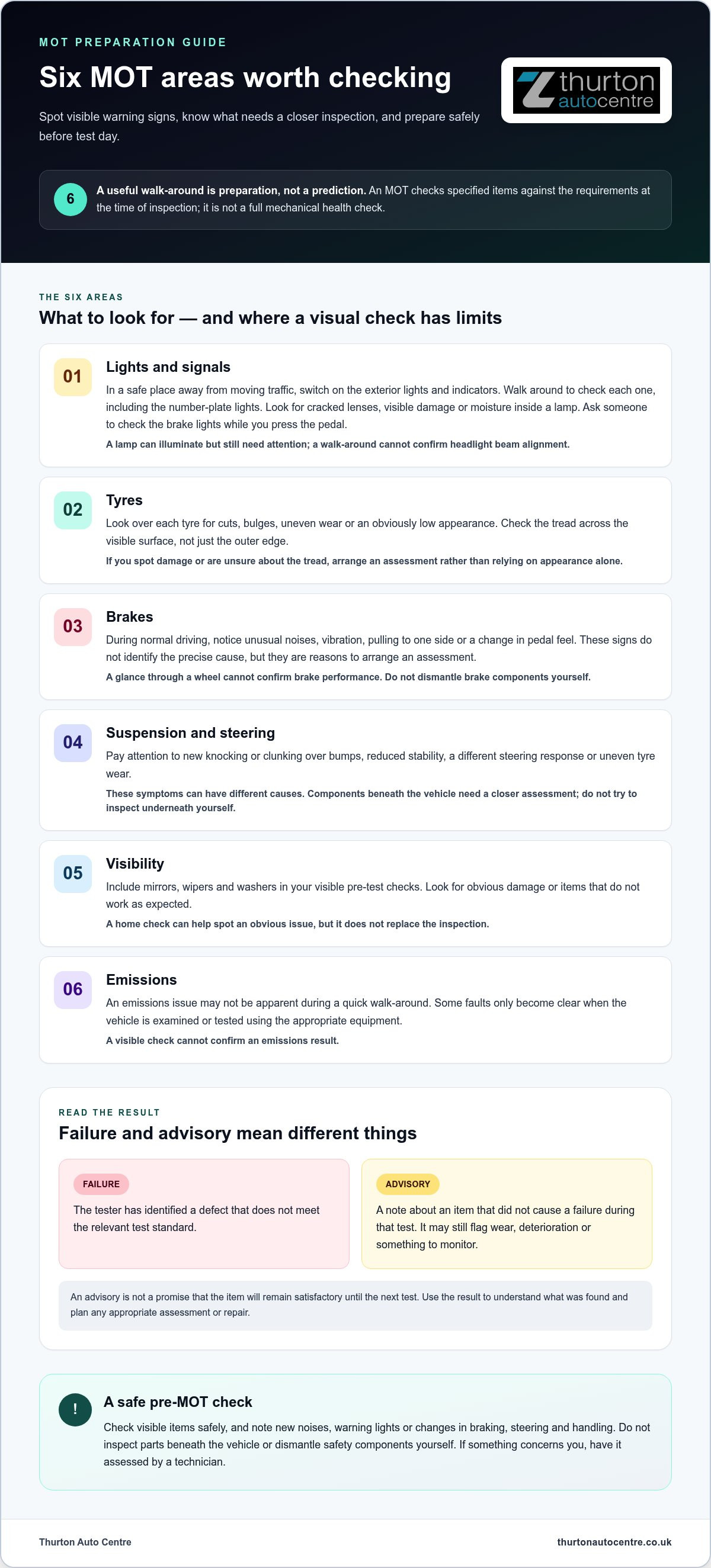
This guide covers common areas that can lead to an MOT failure, including lighting, visibility, tyres, brakes, suspension and emissions. You’ll find practical checks you can make at home, warning signs that need professional assessment, and steps to take if your car fails. Thurton Auto Centre carries out MOT testing and vehicle repairs, helping drivers in Thurton and across Norfolk and Suffolk understand the findings and plan the next step.
Key Takeaways
- Check visible items such as lights, tyres, mirrors, wipers and washers before test day.
- Take note of new noises, warning lights or changes in braking, steering and handling.
- Do not try to inspect parts beneath the vehicle or dismantle safety components yourself.
- An MOT checks specified test items, rather than providing a full mechanical health check.
- If your car fails, use the result to identify each defect and establish the appropriate repair or next test step.
Table of Contents
- Common MOT failure points: which faults appear most often?
- Lights, brakes and tyres: visible MOT failure points to check
- Suspension, visibility and emissions: less obvious MOT failure points
- A safe pre-MOT check: what drivers can inspect themselves
- If your car fails: understand the result and arrange the next step
Common MOT failure points: which faults appear most often?
MOT failures can involve obvious defects as well as faults that need a closer inspection. A lamp that does not work may be easy to spot during a walk-around. A problem with the suspension, steering or emissions may not be apparent until the vehicle is examined or tested using the appropriate equipment.
Lighting, brakes, tyres, suspension, visibility and emissions are all useful areas to review. There is no single fault that every driver should expect: the relevant issue depends on the vehicle’s condition and what the tester finds. A visible symptom can flag a concern, but it may not reveal the cause or whether the item meets the test requirements.
An MOT checks specified items against the test requirements. It does not cover every mechanical system in depth, so a pass is not confirmation that every component is free from wear or that no maintenance is due. Thurton Auto Centre carries out Class 4 MOT testing, assessing vehicles against the applicable inspection requirements.
Why do failure rankings and percentages vary?
Rankings depend on which vehicles and test results are included, the reporting period and how defects are grouped. One source may count each recorded defect, while another may combine items differently or use a different set of results. That means percentages from separate sources are not necessarily directly comparable, and they cannot predict what will fail on an individual vehicle.
For example, RAC material gives a 29.6% lighting-and-signalling figure in one extract, while its article dated 2022 gives 18.9%. The reporting context differs or is unclear, so these figures should not be treated as a current ranking or evidence of a change over time. For practical preparation, use the categories as a prompt to check your vehicle rather than relying on a percentage to predict its result.
What is the difference between a failure and an advisory?
A failure means the tester has identified a defect that does not meet the relevant test standard. An advisory is recorded to draw attention to an item that has not caused a failure during that test. It can still indicate wear, deterioration or a condition that may need attention later.
Read advisories as useful condition notes, not as a promise that the item will remain satisfactory until the next test. For example, a note about developing wear can help you keep track of a component and plan an assessment. The result records what was found during the inspection; it does not replace ongoing maintenance or a broader check of the vehicle.
Lights, brakes and tyres: visible MOT failure points to check
Lights and tyres are among the more accessible items to look over before an MOT, but a visual check has limits. You can spot a lamp that does not work or a tyre with obvious damage. Looking at the vehicle will not confirm that its brakes perform correctly or that a headlight beam is aligned as required. Working lights, sound tyres and effective brakes are central safety checks.
How can you check your lights and signals?
Park on level ground in a safe place away from moving traffic. Switch on the exterior lights and indicators, then walk around the vehicle to check that each illuminates. Look for cracked lenses, visible damage or moisture inside a lamp, and check the number-plate lights as well. Ask someone to press the brake pedal while you observe the brake lights. If you are alone, use a safe reflection or get help rather than guessing.
A lamp can illuminate but still need attention if the lens is damaged or the light is poorly aligned. A walk-around cannot confirm the direction of the headlight beam, which is assessed during the inspection. Treat your check as a way to catch obvious faults, not as a prediction of the MOT result.
Which tyre and brake warning signs should you notice?
Look over each tyre for cuts, bulges, uneven wear or an obviously low appearance. Check the tread across the visible surface, not just the outer edge. If you spot damage or are unsure about the tread condition, arrange an assessment instead of relying on appearance alone to decide whether the tyre meets the test requirements.
Brakes need more than a glance through a wheel. During normal driving, pay attention to unusual noises, vibration, the vehicle pulling to one side or a change in pedal feel. These signs do not identify the precise cause, but they are reasons to arrange an assessment. Do not dismantle brake components yourself or assume that familiar-feeling brakes will pass. A technician can inspect the system and assess its performance using the appropriate procedure.
Visible checks are useful preparation, not a substitute for inspection. If you have noticed a concern with the tyres or brakes, Thurton Auto Centre provides vehicle repairs and brake servicing to help establish what needs attention. You can also book an MOT appointment when you are ready.
Suspension, visibility and emissions: less obvious MOT failure points
Some common MOT failure points do not show up during a quick walk-around. Suspension and steering components sit beneath the vehicle, and their condition cannot be confirmed just by looking at the car while it is parked. You may notice a change in the way the vehicle sounds or behaves, but identifying the cause requires a closer assessment.
What suspension or steering symptoms deserve attention?
Listen for new knocking or clunking over bumps, and notice whether the car feels less stable or responds differently through the steering. Uneven tyre wear can also be a reason to investigate, although it does not identify the cause by itself. Several faults can produce similar symptoms, so do not assume a particular component has failed based on one sign.
A pothole impact is another reason to pay attention to how the vehicle feels afterwards. If the steering pulls, the ride changes or an unfamiliar noise develops, arrange an assessment rather than waiting for the MOT to establish what is wrong. Symptoms can identify a concern, but inspection establishes the defect. A technician can examine the relevant parts and determine whether the issue falls within the MOT inspection requirements or needs repair for another reason.
How can visibility and emissions affect an MOT?
Check the windscreen from the driver’s position. Look for damage or dirt that affects your view, and make sure the wipers clear the glass effectively rather than leaving uncleared areas. Test the washers and check that the mirrors are present, secure and usable. These simple checks can flag a problem, but the MOT assesses the relevant items against its inspection criteria.
Exhaust and emissions concerns can be less obvious. A change in exhaust noise, visible damage to exhaust components or unusual smoke may be a reason to seek advice, but none of these observations alone confirms the test result or pinpoints the fault. Emissions are assessed as part of the applicable inspection, and a check at home cannot reproduce that assessment. Do not rely on a dashboard light alone to judge emissions condition. Its meaning depends on the vehicle and the underlying system, which may need diagnosis.
Make a note of when a noise, handling change or exhaust concern occurs. Does it happen over bumps, during braking or as the engine warms up? Clear observations can help a technician investigate methodically. Do not attempt to inspect underneath a vehicle unless it is properly supported and you are qualified to do so. A stationary check has limits, so professional assessment is sensible when symptoms persist, affect control or remain unexplained.
A safe pre-MOT check: what drivers can inspect themselves
A short, systematic check can help you spot visible concerns before test day. Choose a level, safe place away from traffic, with enough room to walk around the vehicle. These steps are for observation only: a driver’s check cannot replicate the MOT inspection or confirm that the vehicle will pass.
A simple walk-around before test day
Work through these checks in order and note anything that looks or behaves differently from normal:
- 1. Lights and indicators: Switch on the exterior lights and indicators, then walk around the vehicle to check that they illuminate. Look for damaged lenses. Ask someone to check the brake lights while you press the pedal, and check that the number-plate lights work.
- 2. Tyres: Look at each tyre for obvious cuts, bulges, uneven wear or a visibly low appearance. Do not reach into unsafe spaces or attempt to inspect a tyre from beneath the vehicle. A visual check can flag concerns, but it cannot confirm that the tyre meets the inspection requirements.
- 3. Mirrors and number plates: Check that the mirrors appear secure and give a clear view. Make sure the number plates are present, clean enough to read and not visibly damaged or obscured.
- 4. Wipers, washers and windscreen: From the driver’s seat, operate the wipers and washers. Check that the blades move and washer fluid reaches the windscreen, then make sure you have a clear view through the glass.
- 5. General visible condition: Look for loose or damaged bodywork and fresh fluid beneath the vehicle. Notice warning lights that stay illuminated or new changes in sound or behaviour, but do not try to diagnose their cause yourself.
Stop if a check would involve lifting the vehicle, removing a component, reaching underneath it or entering an area where you could be injured. Leave those inspections to a technician with suitable equipment and training. A walk-around can identify an obvious concern, but it cannot assess hidden components or measure vehicle performance.
When should a symptom be assessed professionally?
Arrange an assessment if a warning light persists, braking feels unusual, or steering or handling has changed. Suspension, brake and emissions concerns can require diagnostic equipment or a workshop inspection, even when there is little to see from outside. Record what you have noticed and when it happens; that information can help guide a methodical investigation.
If you see signs of structural damage or corrosion, particularly around the chassis, do not attempt a repair based on appearance alone. The vehicle may need specialist assessment and, where appropriate, chassis welding and MOT failure repairs. For test details, see the information on Class 4 MOT testing. Preparation helps you identify questions, but it does not predict the result.
If your car fails: understand the result and arrange the next step
A failed MOT can feel frustrating, but the result gives you a clear starting point. Read the report carefully and note each recorded defect, along with any advisories. The findings describe what the tester identified during the inspection. They do not automatically specify the repair required or rule out other issues that may need investigation.
What should you do after a defect is recorded?
Take the results one item at a time. Separate defects from advisories, and identify which part of the vehicle each note refers to. If the wording is unclear, ask for an explanation before deciding what work is needed. Advisories are useful condition information too, so keep them in mind even if they are not the reason for the failure.
- Identify the affected item: Note the component and the issue described in the report.
- Arrange an assessment: Have the recorded fault examined so its cause and a suitable repair can be established.
- Review the work required: The solution depends on the defect. A lighting issue, a brake concern and structural damage each need a different assessment and repair.
- Clarify the next test step: Once the repair has been addressed, establish what needs to happen next based on the result and current DVSA guidance. Do not assume that a repair automatically guarantees a pass.
This measured approach is more useful than replacing parts based on a guess. A reported symptom may point towards an area to investigate, but the inspection findings and a proper assessment should guide the repair. Common MOT failure points can involve visible items as well as faults that need workshop diagnosis, so the right next step depends on what is recorded.
How can a local MOT centre help with the next step?
Thurton Auto Centre carries out MOT testing and vehicle repairs. If your result records a defect, we can assess the relevant issue and explain what work is appropriate. Chassis welding is available where a structural chassis defect requires attention. The focus is on understanding the finding and carrying out relevant work, not promising a particular test result.
Thurton Auto Centre serves motorists in Thurton and surrounding parts of Norfolk and Suffolk, including Norwich, Great Yarmouth, Framlingham, Yelverton, Diss, Dereham, Loddon, Poringland, Beccles, Bungay, Lowestoft, Acle, Blofield, Wymondham and Keswick. Drivers across East Anglia can keep the MOT report to hand when arranging the next step, so the recorded findings can inform the assessment and any repair.
Take a confident next step with your MOT
Knowing the common MOT failure points can make the test feel less uncertain, but preparation is about awareness, not predicting the result. Use what you have noticed about your vehicle to make informed decisions. If something affects its behaviour, get it understood rather than dismissing it until test day.
It also helps to think beyond a single appointment. Keep a clear record of changes, questions and previous advisories so you can explain what you have noticed. If an issue is identified, address the finding on its own terms and let the relevant assessment guide what happens next. Careful preparation and clear information can make the process more straightforward.
Ready to arrange your test? Book an MOT with Thurton Auto Centre and take the next step with a clearer idea of what to expect.
Frequently Asked Questions
Is an MOT advisory the same as a failure?
No. An advisory flags an item for attention, but it is not itself a failure in that test. Treat it as useful information about the vehicle’s condition, rather than a reason to wait until the next MOT before taking action. If a note describes developing wear, keep it with your vehicle records and arrange an assessment sooner if you notice a change in how the car drives.
How much do common MOT failure repairs cost?
There is no single reliable cost for common MOT failure repairs. The amount depends on the fault, the vehicle and the work required, so a general figure could be misleading. Before agreeing to a repair, make sure the defect has been assessed and ask for a clear explanation of the proposed work. Online averages are not a quote for your car, as similar symptoms can have different causes. If repair estimates exceed what the vehicle is worth, owners often consider salvage or disposal; for instance, vehicle buying services like Melbourne-based Rapid Car Removal demonstrate how unwanted cars and 4WDs can be sold for cash—find out more to see how cash-for-car valuations work when repairs are no longer economical.
Can I check my MOT history before booking a test?
Yes. Use the GOV.UK vehicle enquiry service to check your car’s MOT history and expiry details using its registration. Previous results can help you spot recurring advisories or defects and give you useful context before booking. They cannot establish the vehicle’s current condition: a previous pass does not confirm that every component remains satisfactory, and past findings cannot predict the result of its next inspection.
Does an MOT test include a full mechanical service?
No. An MOT checks specified aspects of roadworthiness rather than carrying out routine servicing or examining every mechanical system in depth. A vehicle can pass while still needing maintenance, and a symptom you have noticed may not be covered by the test. For specialised marques, routine servicing often demands detailed diagnostic procedures; dedicated European vehicle specialists like Ace Auto Clinic illustrate how targeted mechanical care addresses underlying wear before it leads to inspection failures. If the engine behaves differently or a noise persists, describe it separately so it can be assessed as its own concern.
What happens if a defect is found during an MOT?
The result records the test outcome, defects identified and any advisories. Read each entry carefully, then establish what assessment or repair is appropriate before deciding on the next step. The process depends on the specific result and circumstances, so do not rely on assumptions about retest arrangements or timings. Check the current DVSA guidance for the applicable requirements, and keep the result available when discussing the findings.
Can a simple pre-MOT check guarantee that my car will pass?
No. A basic check can help you notice a problem, but it cannot establish that every test item meets the required standard. Some common MOT failure points involve conditions that need specialist inspection or testing, and a fault may develop after you have checked the car. Use your observations to raise specific concerns, especially if the car’s behaviour has changed, rather than treating them as a prediction of the result.
Disclaimer
Terms and Conditions
Who we are and how to contact us
https://wwwthurtonautocentre.co.uk is a site operated by Thurton Auto centre. We are a limited company registered in England and Wales under company number 15780586 and have our registered office at The Garage, Norwich Road, Thurton, Norwich, Norfolk, NR14 6AW. Our main trading address is The Garage, Norwich Road, Thurton, Norwich, Norfolk, NR14 6AW.
To contact us, please email info@thurtonautocentre.co.uk or telephone our customer service line on01508 501160or write to us at The Garage, Norwich Road, Thurton, Norwich, Norfolk, NR14 6AW
Information on this site
The content on our site is provided for general information only. It is not intended to amount to advice on which you should rely. You must obtain professional or specialist advice before taking, or refraining from, any action on the basis of the content on our site.
Although we make reasonable efforts to update the information on our site, we make no representations, warranties or guarantees, whether express or implied, that the content on our site is accurate, complete or up to date.
Any descriptions or illustrations on our site are for illustrative purposes only, and are published for the sole purpose of giving an approximate idea of the vehicles described in them. They will not form part of any contract or have any contractual force. We have made every effort to display the colours accurately, but we cannot guarantee that a device's display of the colours accurately reflects the colour of the vehicles.
We reserve the right to amend the specification of any vehicle described on this site if required to do so by any applicable statutory or regulatory requirement, to implement minor technical adjustments and improvements, or if the amendment will not materially affect its nature or quality.
Our site is only for users in the UK
Our site is directed to people residing in the United Kingdom. We do not represent that content available on or through our site is appropriate for use or available in other locations. You may use this site to reserve a vehicle or test drive from an address outside the United Kingdom, but we do not deliver vehicles outside the United Kingdom, and any test drives must take place at the address in the United Kingdom which we specify.
Events outside our control
We will not be liable or responsible for any failure to perform, or delay in performance of, any of our obligations under the Contract that is caused by any act or event beyond our reasonable control (Event Outside Our Control).
If an Event Outside Our Control takes place that affects the performance of our obligations under the Contract, we will contact you as soon as possible to let you know and we will take steps to minimise the effect of the delay. We will arrange a new date for the test drive after the Event Outside Our Control is over. Provided we do this we will not be liable for delays caused by the event, but if the Event Outside Our Control has continued, or seems likely to continue, for more than 30 days, you may contact us to cancel the Order and receive a refund of any reservation or booking fee you have paid.
How you may use material on our site
We are the owner or the licensee of all intellectual property rights in our site, and in the material published on it. Those works are protected by copyright laws and treaties around the world. All such rights are reserved.
You may print off one copy, and may download extracts, of any page(s) from our site for your personal use and you may draw the attention of others within your organisation to content posted on our site.
You must not modify the paper or digital copies of any materials you have printed off or downloaded in any way, and you must not use any illustrations, photographs, video or audio sequences or any graphics separately from any accompanying text.
Our status (and that of any identified contributors) as the authors of content on our site must always be acknowledged.
You must not use any part of the content on our site for commercial purposes without obtaining a licence to do so from us or our licensors.
You print off, copy or download any part of our site in breach of these terms of use, your right to use our site will cease immediately and you must, at our option, return or destroy any copies of the materials you have made.
We are not responsible for websites we link to
Where our site contains links to other sites and resources provided by third parties, these links are provided for your information only. Such links should not be interpreted as approval by us of those linked websites or information you may obtain from them.
We have no control over the contents of those sites or resources.
Our responsibility for loss or damage suffered by you
Whether you are a consumer or a business user:
We do not exclude or limit in any way our liability to you where it would be unlawful to do so. This includes liability for death or personal injury c