
Following the manufacturer’s official service manual for your wet belt might be the most expensive gamble you ever take with your engine. While a handbook might suggest a lifespan of a decade, real-world evidence from our Norfolk workshop tells a different, more urgent story. You are likely searching for clarity on exactly how long does a wet belt last because you have encountered conflicting advice whilst facing the daunting prospect of a £3,000 engine replacement bill.
We recognise the anxiety that comes with technical uncertainty, especially when the health of your vehicle is at stake. You deserve a methodical approach built on accuracy, safety, and precision. This article provides the evidence-based clarity you need to understand the critical difference between theoretical intervals and real-world longevity. We will examine the specific symptoms of a failing belt, the latest revised manufacturer schedules for EcoBoost and PureTech engines, and how our specialist team at Thurton Auto Centre provides the professional-grade care your engine requires to stay on the road safely.
Key Takeaways
- Learn the critical distinction between manufacturer intervals and specialist recommendations to accurately determine how long does a wet belt last under real-world conditions.
- Understand the hidden impact of oil contamination and thermal stress, and how these factors can prematurely degrade your engine's internal belt.
- Identify the subtle warning signs and performance cues that indicate your wet belt is delaminating before it leads to catastrophic engine failure.
- Discover the disciplined maintenance routines and specific oil grades required to protect the structural integrity of your timing system.
- Explore why replacing a wet belt is a specialist precision procedure that demands a clinical environment and technical mastery.
Table of Contents
- Understanding the Wet Belt: Official Lifespan vs Real-World Longevity
- Primary Factors That Accelerate Wet Belt Degradation
- Identifying the Warning Signs: Is Your Wet Belt Reaching the End of Its Life?
- Best Practice Maintenance: How to Extend Your Timing Belt’s Durability
- Specialist Wet Belt Replacement at Thurton Auto Centre
Understanding the Wet Belt: Official Lifespan vs Real-World Longevity
A wet belt, or oil-immersed timing belt, represents a significant shift in internal combustion engineering. Unlike traditional dry belts that operate in a sealed housing away from engine lubricants, these components run directly through the engine oil. This design is central to modern engine downsizing, particularly in the Ford 1.0 EcoBoost and the Stellantis 1.2 PureTech units found in Peugeot, Citroën, and Vauxhall vehicles. Whilst the technology aims to improve efficiency, it has created a complex question for owners: how long does a wet belt last when subjected to the rigours of daily driving?
The Evolution of Timing Belts: Why "Wet" is Different
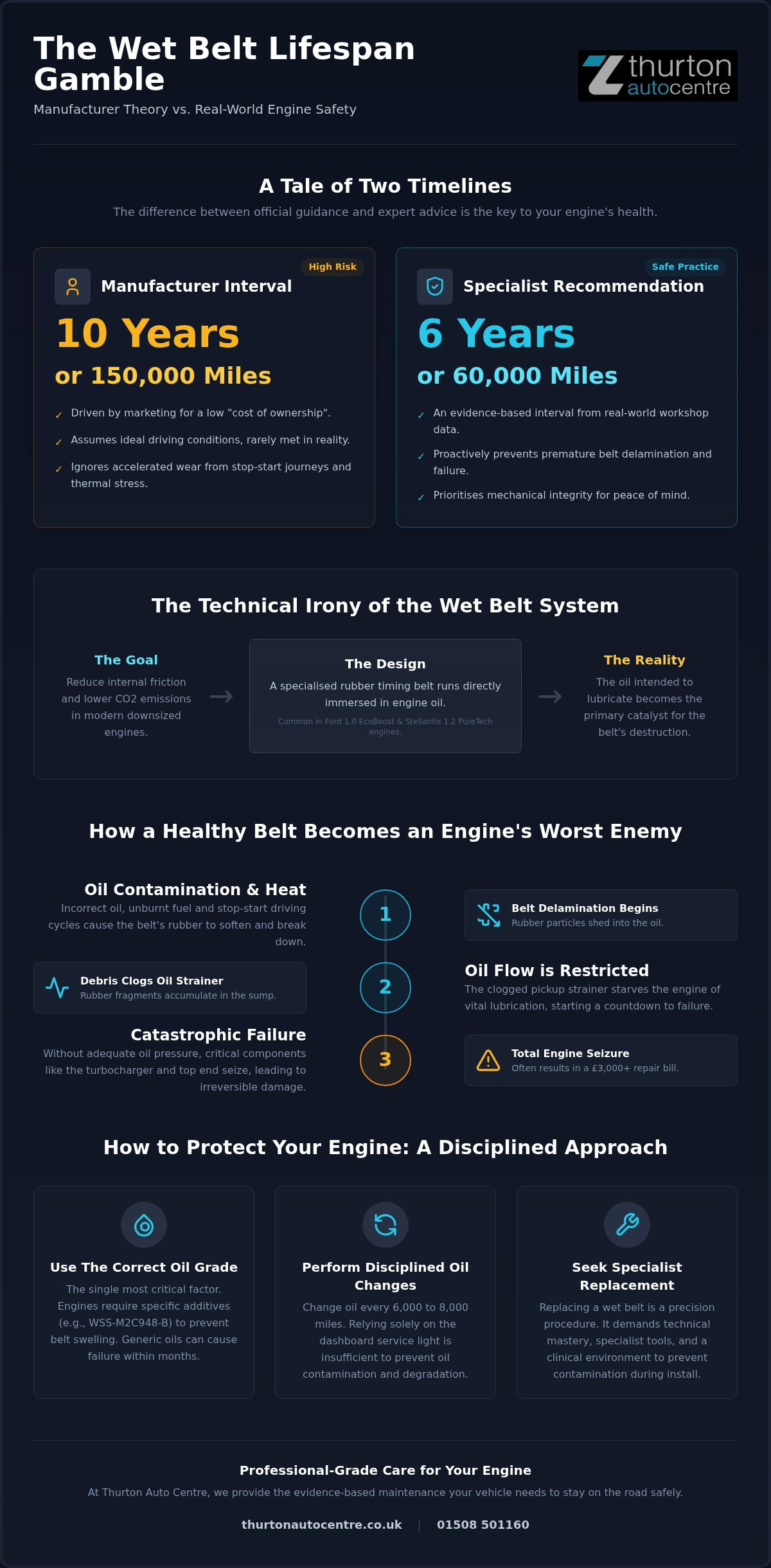
Manufacturers transitioned to oil-bathed systems to reduce internal friction and lower CO2 emissions. These belts are engineered from specialised compounds, such as hydrogenated nitrile butadiene rubber, which are designed to withstand chemical saturation. However, a technical irony exists at the heart of this system. The engine oil intended to facilitate smooth operation often becomes the primary catalyst for the belt's destruction. Over time, chemical reactions and heat cause the belt material to soften and delaminate. This process sheds rubber debris directly into the oil supply, which can lead to oil pump blockages and total engine seizure.
Manufacturer Intervals: A Theoretical Maximum
Official handbooks often suggest optimistic replacement intervals, sometimes reaching 10 years or 150,000 miles. These figures are frequently driven by marketing requirements to project a low "cost of ownership" for fleet buyers. Such projections assume ideal driving conditions that rarely exist on the congested roads of Norfolk and Suffolk. Frequent stop-start journeys, fuel dilution, and thermal cycling accelerate the degradation of the rubber far beyond these theoretical limits. The Safety Buffer is the critical gap between manufacturer theory and mechanical reality.
By 2026, data from independent specialists has confirmed that waiting for the official interval is a high-risk strategy. At Thurton Auto Centre, we have observed premature failures in engines that were supposedly years away from a scheduled change. To ensure the safety and reliability of your vehicle, we implement a disciplined, evidence-based recommendation. We advise a wet belt replacement every 6 years or 60,000 miles. This proactive approach prioritises mechanical integrity over theoretical maximums, providing the peace of mind that comes from technical mastery and rigorous maintenance standards.
Primary Factors That Accelerate Wet Belt Degradation
While mechanical wear is a factor in any engine, the question of how long does a wet belt last is primarily answered by oil chemistry and thermal cycles. Because the belt is constantly submerged, any change in the oil’s composition directly affects the structural integrity of the rubber. When unburnt fuel or moisture enters the lubrication system, it triggers a process known as delamination. This is where the belt’s structural teeth begin to soften and shed small particles of rubber. These fragments don't simply disappear; they accumulate in the oil sump and eventually clog the oil pickup strainer.
This blockage initiates a devastating chain reaction. As the strainer becomes restricted, the engine’s top end and turbocharger are starved of vital lubrication. You may not notice a performance dip until the damage is irreversible. Proactive maintenance is the only way to interrupt this cycle before it leads to a catastrophic failure.
The Critical Role of Oil Specification
Using the incorrect oil grade is the single most common cause of rapid wet belt failure. Modern engines like the 1.2 PureTech or 1.0 EcoBoost require very specific chemical additives to maintain belt tension and prevent swelling. For instance, the latest FPW9.55535/03 or WSS-M2C948-B specifications include friction modifiers that are compatible with the belt’s rubber compound. Standard "off-the-shelf" oils often lack these, causing the belt to expand and weaken within months.
To maximise durability, we recommend a disciplined regime of oil changes every 6,000 to 8,000 miles. Relying solely on the dashboard service light is often insufficient for vehicles used in demanding environments. If you are unsure about your vehicle's current oil health, you can book a professional diagnostic inspection at our centre to ensure your lubrication system is within safe parameters.
Driving Habits and Environmental Stress
Stop-start urban driving, common across Norfolk and Suffolk, increases the mechanical load on the belt significantly. Frequent "cold starts" prevent the engine oil from reaching its optimal operating temperature, which allows water vapour and fuel to settle in the sump. This dilution thins the oil and accelerates the chemical breakdown of the belt material.
Motorhomes and leisure vehicles face a unique set of risks. Long periods of inactivity can cause the belt to take a "set" or become brittle in specific areas of tension. When the engine is finally started after weeks of sitting idle, the sudden stress on these weakened sections can cause immediate failure. For these vehicles, regular specialist servicing is not just a recommendation; it is a necessity for safe travel.
Identifying the Warning Signs: Is Your Wet Belt Reaching the End of Its Life?
Identifying the onset of belt failure requires a disciplined, clinical approach. Unlike traditional systems where a worn belt might produce a distinct squeal or chirp, wet belts often degrade silently within the engine's lubrication system. Understanding how long does a wet belt last depends heavily on your ability to spot subtle shifts in engine performance before they escalate into terminal mechanical failure. At Thurton Auto Centre, our diagnostic process is designed to find these hidden vulnerabilities using precision tools rather than mere visual estimation.
Visual Inspection: What a Technician Looks For
In many EcoBoost and PureTech engines, a technician can perform a preliminary assessment through the oil filler aperture. We look for surface cracking or a glazed, shiny appearance on the back of the belt. However, a visual check from the top is often insufficient for a full diagnosis. A belt can look healthy whilst its structural integrity is compromised; the most dangerous degradation often occurs on the teeth that remain hidden from view. We utilise specialised "go/no-go" gauges to measure belt expansion accurately, providing an evidence-based result that protects your engine from guesswork.
The "Blocked Strainer" Red Flag
As the belt delaminates, rubber fragments are carried by the oil into the sump. These particles accumulate in the oil pump pickup strainer, gradually starving the engine of vital lubrication. This blockage creates a high-risk environment for the turbocharger and camshafts, which are the first components to suffer when oil flow is restricted. Our vehicle diagnostics can identify early pressure fluctuations that indicate a developing blockage. If you experience a momentary flicker of the oil light or a slight change in engine tone under load, the system is already under extreme stress.
The appearance of a persistent "Oil Pressure Low" warning is a terminal symptom. By the time this light remains illuminated, the internal damage is often irreversible, leading to the catastrophic engine failure that every owner fears. To safeguard your vehicle, use this service history checklist to audit your maintenance records:
- Service Gaps: Any period exceeding 12 months or 10,000 miles without an oil change significantly increases the risk of belt softening.
- Oil Specification: Verify that previous invoices explicitly state the manufacturer-approved oil grade, such as the mandatory 5W-30 or 0W-20 specifications.
- Filter Consistency: Ensure the oil filter was replaced at every interval, as a saturated filter can no longer effectively trap belt debris.
A methodical review of these records, combined with professional diagnostics, is the only reliable way to manage the lifespan of your timing system. If your history is incomplete, a physical inspection is the only responsible course of action.
Best Practice Maintenance: How to Extend Your Timing Belt’s Durability
Maintaining the integrity of an oil-immersed system is a matter of discipline rather than chance. Whilst many factors dictate how long does a wet belt last, a proactive maintenance regime can significantly defer the risk of catastrophic failure. This involves moving beyond the basic requirements and adopting a more rigorous, technical standard of care.
One of the most effective preventative measures for high-mileage engines is a professional "sump drop" inspection. This process involves the physical removal of the oil sump to inspect the oil pickup strainer for rubber debris. It is a clinical, diagnostic step that provides absolute certainty regarding the internal health of your engine. Integrating these checks into your regular vehicle servicing ensures that any signs of delamination are caught in their infancy.
The Importance of Genuine Parts
We maintain an uncompromising stance on the quality of components used during any replacement or repair. Aftermarket belts frequently lack the specialised chemical coating required to survive prolonged oil immersion, leading to accelerated swelling and failure. A methodical approach also demands a "complete kit" replacement. This includes the belt, tensioner, and idler pulleys. Replacing only the belt whilst leaving worn pulleys in place is a false economy that compromises the safety of the entire timing system.
Shortening the Service Interval
For vehicles used in "severe service" conditions, such as those used for towing, heavy loads, or frequent short urban trips, a revised schedule is essential. We propose shortening the oil change interval to every 6,000 miles. When you consider that a preventative oil change is a sound investment against a £3,000 engine failure, the logic of proactive care is clear. Keeping meticulous, professional records of this maintenance preserves the resale value of your vehicle. It provides evidence to future buyers that you have prioritised the technical health of the engine, regardless of how long does a wet belt last according to the manufacturer's handbook.
Specialist Wet Belt Replacement at Thurton Auto Centre
Precision. Transparency. Accountability. These three values define our approach to engine maintenance at Thurton Auto Centre. We recognise that the question of how long does a wet belt last is often accompanied by significant financial concern. As an independent, family-owned operation, we prioritise technical depth over high-pressure sales. Our Fit for Purpose Promise serves as a guarantee that every mechanical procedure we perform meets the highest standards of safety and mechanical integrity. We serve the motorists of Norfolk and Suffolk with a disciplined, process-driven methodology that provides genuine peace of mind.
Why a Specialist is Required for This Procedure
Replacing an oil-immersed belt is a precision procedure that exceeds the scope of a standard garage. Engines such as the 1.0 EcoBoost and 1.2 PureTech require specialised manufacturer-grade locking tools to ensure the timing remains absolute. Without these tools, even a minor deviation can lead to poor fuel economy, rough idling, or terminal valve damage. Our approach involves more than just a part swap. We maintain a clean-room environment to prevent contamination and insist on cleaning the entire oil circuit, including the sump and pickup strainer, to remove every trace of delaminated rubber.
A failure to address the debris left behind by an old belt is the most common cause of "new" belt failure. By choosing our dedicated wet belt replacements service, you ensure that your engine is restored to its optimal technical state using clinical diagnostic standards and professional-grade lubricants.
Booking Your Appointment in Norfolk
We provide a local, expert alternative to expensive main dealer networks for residents in Loddon, Poringland, and across Norwich. Our proximity to these hubs allows for convenient access to specialist care without the impersonal atmosphere of a franchise. We believe in clear communication and will always provide a detailed justification for the work we perform on your vehicle. Determining how long does a wet belt last in your specific vehicle starts with a professional assessment by our AWS-accredited team.
Securing a technical assessment is a straightforward process. Our team is ready to guide you through the diagnostic steps and provide an evidence-based recommendation for your timing system. You can book your wet belt assessment online today or speak directly with our specialists by calling the office on 01508501160.
Protecting Your Engine Through Specialist Precision
Navigating the technical complexities of oil-immersed timing systems requires a shift from following optimistic manufacturer handbooks to adopting a disciplined, evidence-based maintenance strategy. We have explored how chemical degradation and thermal stress dictate how long does a wet belt last, often shortening its life significantly compared to theoretical projections. By prioritising regular oil changes with the correct professional-grade lubricants and identifying early warning signs, you can prevent the devastating chain reaction of a blocked oil pump.
As an AWS Accredited Centre and a family-owned independent authority, Thurton Auto Centre provides the technical mastery your vehicle deserves. Our investment in specialist Ford and Peugeot wet belt tooling ensures that every replacement is a precision procedure, performed in a clinical environment to guarantee mechanical integrity. We are committed to transparency and safety, providing Norfolk and Suffolk motorists with a reliable alternative to main dealer networks.
Take the proactive step today to ensure your vehicle remains safe and efficient for the road ahead. Our team is ready to provide the professional guidance and technical expertise you need for total peace of mind.
Frequently Asked Questions
Is a wet belt the same as a timing belt?
A wet belt is a specific variation of a timing belt that operates inside the engine's lubrication system. While it performs the same task of synchronising the crankshaft and camshaft, its oil-immersed design requires different materials and maintenance standards. This technology was introduced to reduce friction and improve fuel efficiency, but it demands a much more disciplined approach to servicing than traditional dry timing belt systems.
Which cars are most commonly fitted with wet belts?
These systems are primarily found in small-displacement, turbocharged engines designed for efficiency. The most common examples include the Ford 1.0 EcoBoost and the 1.2 PureTech units used across Peugeot, Citroën, and Vauxhall models. Additionally, the Ford 2.0 EcoBlue engine found in many Transit vans also utilises this technology. If you own one of these models, understanding how long does a wet belt last is vital for your vehicle's safety.
What happens if my wet belt snaps whilst driving?
If a belt snaps whilst driving, the engine will suffer immediate and catastrophic internal damage. Because these are "interference" engines, the pistons will strike the valves, leading to bent components and potential cylinder head destruction. The vehicle will lose power instantly, and the cost of repair often exceeds the value of a high-mileage car. Proactive replacement is the only way to avoid this terminal mechanical event.
Can I check the condition of my wet belt myself?
You can perform a basic visual check through the oil filler cap on some engines, but this is rarely a definitive diagnostic. A belt may look intact from above whilst the structural teeth are delaminating out of sight. A professional assessment using a specialised belt width gauge is the only reliable method. This tool measures swelling that is invisible to the naked eye but indicates the belt is nearing failure.
How much does a wet belt replacement cost in Norfolk?
Costs vary significantly based on the specific engine and the extent of the debris cleanup required. Industry data for 2026 suggests that a professional replacement in the UK typically ranges from £800 to £1,800. This includes the specialised timing kit and a comprehensive oil system flush. Whilst this is a significant investment, it is considerably more affordable than the £3,000 plus required for a total engine replacement.
Why does oil make the belt fail if it is designed to be in it?
The belt is designed to resist pure engine oil, but it cannot withstand the chemical by-products of combustion. Over time, unburnt fuel and moisture mix with the oil, creating an acidic environment that attacks the rubber compound. This causes the material to swell and eventually shed fragments. Knowing how long does a wet belt last depends on maintaining oil purity through frequent, professional-grade servicing and specialised filter changes.
Does a wet belt failure mean I need a whole new engine?
A failure frequently leads to a total engine replacement, though a rebuild is sometimes possible if the damage is caught early. If the belt sheds debris that blocks the oil pump, the resulting starvation can destroy the turbocharger and crankshaft bearings before the belt even snaps. In many cases, the labour costs involved in a full internal rebuild make a replacement engine the most cost-effective solution for the owner.
How long does the replacement procedure take at Thurton Auto Centre?
Replacing a wet belt is a complex, precision procedure that typically requires between one and two full working days. This timeframe allows our technicians to perform a methodical strip-down, a thorough cleaning of the oil pickup system, and a precise re-timing of the engine using specialist locking tools. We prioritise accuracy over speed to ensure the safety and long-term reliability of your vehicle's most critical internal system.
Disclaimer
Terms and Conditions
Who we are and how to contact us
https://wwwthurtonautocentre.co.uk is a site operated by Thurton Auto centre. We are a limited company registered in England and Wales under company number 15780586 and have our registered office at The Garage, Norwich Road, Thurton, Norwich, Norfolk, NR14 6AW. Our main trading address is The Garage, Norwich Road, Thurton, Norwich, Norfolk, NR14 6AW.
To contact us, please email info@thurtonautocentre.co.uk or telephone our customer service line on01508 501160or write to us at The Garage, Norwich Road, Thurton, Norwich, Norfolk, NR14 6AW
Information on this site
The content on our site is provided for general information only. It is not intended to amount to advice on which you should rely. You must obtain professional or specialist advice before taking, or refraining from, any action on the basis of the content on our site.
Although we make reasonable efforts to update the information on our site, we make no representations, warranties or guarantees, whether express or implied, that the content on our site is accurate, complete or up to date.
Any descriptions or illustrations on our site are for illustrative purposes only, and are published for the sole purpose of giving an approximate idea of the vehicles described in them. They will not form part of any contract or have any contractual force. We have made every effort to display the colours accurately, but we cannot guarantee that a device's display of the colours accurately reflects the colour of the vehicles.
We reserve the right to amend the specification of any vehicle described on this site if required to do so by any applicable statutory or regulatory requirement, to implement minor technical adjustments and improvements, or if the amendment will not materially affect its nature or quality.
Our site is only for users in the UK
Our site is directed to people residing in the United Kingdom. We do not represent that content available on or through our site is appropriate for use or available in other locations. You may use this site to reserve a vehicle or test drive from an address outside the United Kingdom, but we do not deliver vehicles outside the United Kingdom, and any test drives must take place at the address in the United Kingdom which we specify.
Events outside our control
We will not be liable or responsible for any failure to perform, or delay in performance of, any of our obligations under the Contract that is caused by any act or event beyond our reasonable control (Event Outside Our Control).
If an Event Outside Our Control takes place that affects the performance of our obligations under the Contract, we will contact you as soon as possible to let you know and we will take steps to minimise the effect of the delay. We will arrange a new date for the test drive after the Event Outside Our Control is over. Provided we do this we will not be liable for delays caused by the event, but if the Event Outside Our Control has continued, or seems likely to continue, for more than 30 days, you may contact us to cancel the Order and receive a refund of any reservation or booking fee you have paid.
How you may use material on our site
We are the owner or the licensee of all intellectual property rights in our site, and in the material published on it. Those works are protected by copyright laws and treaties around the world. All such rights are reserved.
You may print off one copy, and may download extracts, of any page(s) from our site for your personal use and you may draw the attention of others within your organisation to content posted on our site.
You must not modify the paper or digital copies of any materials you have printed off or downloaded in any way, and you must not use any illustrations, photographs, video or audio sequences or any graphics separately from any accompanying text.
Our status (and that of any identified contributors) as the authors of content on our site must always be acknowledged.
You must not use any part of the content on our site for commercial purposes without obtaining a licence to do so from us or our licensors.
You print off, copy or download any part of our site in breach of these terms of use, your right to use our site will cease immediately and you must, at our option, return or destroy any copies of the materials you have made.
We are not responsible for websites we link to
Where our site contains links to other sites and resources provided by third parties, these links are provided for your information only. Such links should not be interpreted as approval by us of those linked websites or information you may obtain from them.
We have no control over the contents of those sites or resources.
Our responsibility for loss or damage suffered by you
Whether you are a consumer or a business user:
We do not exclude or limit in any way our liability to you where it would be unlawful to do so. This includes liability for death or personal injury c