
In the high-velocity market of 2026, a damp meter reading exceeding 30% isn't just a number; it's a signal of probable structural failure that can instantly devalue your leisure investment. Many owners feel a sense of dread when they discover moisture, fearing that a simple resealing job won't be enough to save the vehicle's integrity. If you've spotted soft wallboards or a musty scent, you're likely facing the complex reality of motorhome damp repair. It's a technical challenge that requires more than a quick fix; it demands a clinical, methodical, and permanent restoration to return your vehicle to its original factory standards.
We understand that the transition from a dry, reliable home-on-wheels to a vehicle requiring specialist intervention is stressful. You deserve clarity, transparency, and a professional solution rather than a cosmetic patch. This guide outlines our disciplined approach to identifying, treating, and repairing water ingress to ensure your motorhome remains safe and roadworthy for years to come. We will examine the critical thresholds of moisture levels, the difference between surface sealing and structural reconstruction, and how professional certification can protect your resale value.
Key Takeaways
- Understand why the British climate and coastal conditions accelerate seal failure, leading to the silent migration of moisture into your vehicle's structure.
- Learn why professional diagnostics using calibrated moisture meters are essential for mapping the full extent of hidden damage beyond what is visible to the eye.
- Discover why a permanent motorhome damp repair requires a methodical strip-down and timber replacement rather than simply applying new sealant over existing ingress.
- Identify the differences between cosmetic wallboard issues and deep-seated structural rot to help you make informed decisions about repair scopes and investment.
- Establish a proactive maintenance routine, including annual habitation checks and humidity management, to protect your vehicle's resale value and long-term roadworthiness.
The Science of Water Ingress: Why Motorhomes Are Vulnerable
Water ingress is rarely a sudden event; it's a silent, persistent migration of moisture into the vehicle's core structure. Unlike a domestic roof leak, moisture in a leisure vehicle often remains invisible until the damage is significant. This process begins when external seals lose their elasticity, allowing rainwater to penetrate the composite panels. Understanding the fundamentals of vehicle construction is essential for identifying why these units are so susceptible. Most motorhomes utilise a sandwich of aluminium or GRP skins bonded to a timber or high-density foam skeleton, creating numerous joints that must remain perfectly watertight to maintain structural integrity.
The UK climate presents a unique challenge for longevity. In coastal areas like Great Yarmouth, the combination of high humidity and salt-laden air accelerates the degradation of polyurethane seals. These seals are under constant stress from thermal expansion and contraction. As the vehicle sits in storage, temperature fluctuations cause the body panels to move; this movement eventually creates microscopic fissures in the sealant. Once a seal is compromised, moisture doesn't just sit on the surface. It's pulled deep into the structure through capillary action, a physical phenomenon that draws water through tight spaces and into the timber frame, often far from the original entry point.
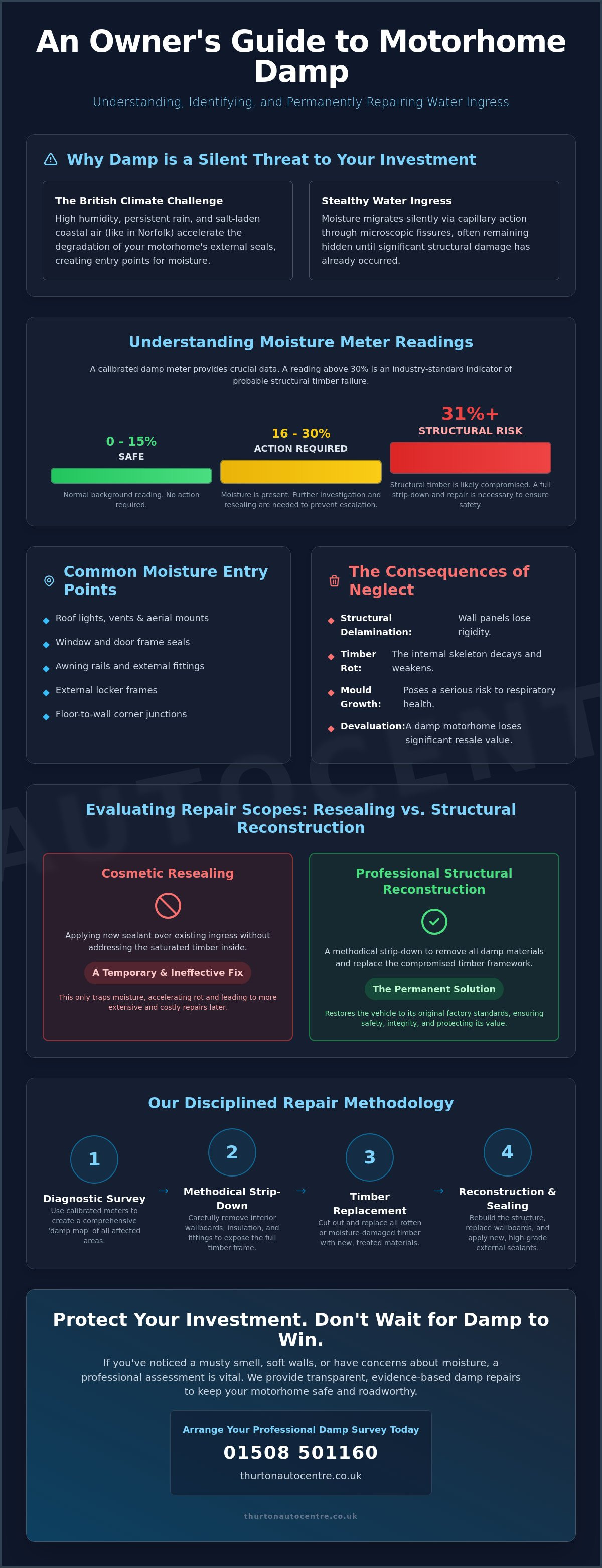
Seeking a professional motorhome damp repair is the only way to ensure the structural skeleton is preserved once moisture has taken hold. When moisture readings reach the 31% threshold, the industry standard indicates that structural damage is likely. At this stage, the timber has begun to lose its load-bearing capacity, making a methodical intervention necessary to restore roadworthiness and protect your investment.
Common Entry Points for Moisture
Roof lights and aerial mounts are the primary culprits for vertical ingress, as they penetrate the highest point of the roof where water frequently pools. Window seals and awning rails are also high-risk areas; horizontal movement during transit puts immense stress on these joints. Finally, external locker frames and floor-to-wall junctions are often overlooked during DIY checks, yet they're frequent sites for moisture to settle and begin the decay process.
The Consequences of Neglected Damp
If left unchecked, moisture leads to structural delamination, where the adhesive bond in the sandwich panel fails and the walls lose their rigidity. Timber rot, both wet and dry, eventually destroys the internal skeleton of the vehicle. Beyond the structural risks, there are health implications to consider. Mould spores thrive in confined leisure spaces, posing a risk to respiratory health. A professional motorhome damp repair addresses these risks by removing the source of the mould and replacing compromised materials with professional-grade alternatives.
The Anatomy of a Professional Damp Survey
A visual inspection is simply insufficient for identifying the early stages of structural rot. By the time a wallboard feels soft to the touch or a musty odour becomes apparent, the moisture has likely been present for months, if not years. A professional survey adopts a clinical diagnostic approach to map the "damp footprint" across the interior. This process isn't about guesswork; it's about using evidence-based data to determine the precise boundaries of water ingress. Documenting these results through a comprehensive moisture map allows us to prioritise repair urgency and provides you with a transparent record of the vehicle's condition.
Regular monitoring is the most effective way to prevent catastrophic failure. We recommend a motorhome habitation check as a preventative baseline. This annual assessment includes a thorough damp test, ensuring that any minor seal failures are identified before they escalate into a requirement for a full motorhome damp repair. Maintaining this record is vital for your vehicle's history, especially when ensuring it remains fit for purpose and safe for your family to use throughout the season.
Calibrated Diagnostics vs. Guesswork
We utilise both pin-type and pinless moisture meters to ensure accuracy. Pin-type meters measure electrical resistance between two points, providing a deep-core reading of the timber's moisture content. Pinless meters use capacitance to scan large surface areas without leaving marks. A specialist must also account for "false positives" caused by metal foil insulation or internal condensation. In complex cases, thermal imaging is used to identify cold spots where moisture is trapped behind panels, allowing for a non-invasive look into the vehicle's skeleton.
Interpreting the Percentage Readings
The data gathered during a survey is categorised into specific zones of concern. Readings between 0 and 15% are considered normal for a healthy leisure vehicle, representing the natural ambient moisture found in timber. The 16% to 20% range is a cautionary zone. Whilst not yet a structural failure, it indicates that seals may be beginning to weep and requires close monitoring or preventative resealing. Any reading exceeding 21% is evidence of active ingress. At this stage, a professional motorhome damp repair is necessary to stop the spread of moisture and protect the underlying frame from rot. If you've concerns about a specific area in your vehicle, you can schedule a professional diagnostic survey to gain a clear, factual assessment of its structural health.
Evaluating Repair Scopes: Resealing vs. Structural Reconstruction
One of the most dangerous mistakes an owner can make is falling into the "Sealant Trap." This occurs when a DIY enthusiast or an inexperienced workshop applies a fresh bead of silicone over a suspected leak without addressing the moisture already trapped within the panel. Sealing the exterior whilst the core remains saturated doesn't solve the problem; it accelerates it. By preventing the moisture from evaporating, you create a perfect anaerobic environment for timber rot to flourish. A professional motorhome damp repair must always begin by identifying whether the damage is purely cosmetic or deeply structural.
At Thurton Auto Centre, our philosophy is disciplined, transparent, and rigorous: we treat the source, then the symptom. If we find that moisture has breached the external seals but has not yet compromised the timber skeleton, a comprehensive resealing programme may be sufficient. However, if the internal wallboards are spongy or the timber frame has lost its density, a more invasive reconstruction is required. Early intervention is the primary factor in controlling costs. A simple seal replacement is a fraction of the expense of a full "strip-down" repair, which involves removing furniture and replacing the vehicle's skeleton.
When Resealing is Sufficient
Proactive external resealing is a critical maintenance task designed to prevent ingress before it starts. This isn't a simple case of "topping up" old sealant. Our process involves the meticulous, clinical, and absolute removal of degraded polyurethane, followed by a clinical cleaning of the substrate to ensure the new bond is absolute. By maintaining these external barriers, you protect the structural integrity of your vehicle and avoid the need for more complex interventions. You can learn more about our methodical approach to external resealing services here.
When Structural Repair is Mandatory
There are clear indicators that a motorhome damp repair must transition from a surface fix to a structural reconstruction. If you notice "spongy" wall sections or floor areas that deflect under foot, the timber frame has likely failed. In these instances, a controlled disassembly is necessary. We must remove internal furniture and appliances to expose the skeleton and replace saturated insulation and rotten timber sections. Because the materials used in these repairs are moisture-sensitive, all structural work is performed in our climate-controlled centre to ensure the new components remain dry and the adhesive bonds are permanent.
The Professional Repair Methodology: From Strip-Down to Restoration
A successful motorhome damp repair is a linear, disciplined process that cannot be rushed. It moves from diagnostics to full restoration through five distinct phases, ensuring the structural integrity of your vehicle is not just restored, but often improved. We approach every repair with clinical precision, treating the vehicle skeleton as a precision-engineered asset. This systematic methodology ensures that the "silent migration" of moisture is halted and the affected areas are returned to factory standards or better.
- Step 1: Controlled Disassembly. We carefully remove internal furniture, appliances, and soft furnishings to expose the full extent of the "damp footprint" mapped during the initial survey. This allows for an unobstructed view of the internal skeleton.
- Step 2: Excavation. Saturated wallboards, soggy insulation, and compromised timber sections are removed. We continue this process until we reach healthy, dry structure, ensuring no hidden rot remains.
- Step 3: Clinical Drying Phase. Utilising industrial dehumidification and heat, we extract deep-seated moisture from the remaining framework. This is a scientific requirement that cannot be bypassed.
- Step 4: Structural Reconstruction. New timbers and closed-cell insulation are fitted. We use professional-grade adhesives and fasteners to rebuild the "sandwich" panel integrity.
- Step 5: Refinishing and Resealing. Interior wallboards are replaced to match the existing decor, furniture is reinstalled, and the exterior is fully resealed to provide a permanent barrier against the elements.
The Drying Phase: A Critical Requirement
Rushing the rebuild is a critical error often made by less experienced providers. If you reconstruct over timber that still holds moisture, you're simply trapping the problem, which leads to secondary rot and mould growth. We monitor moisture levels daily in our climate-controlled centre, only proceeding when the structure returns to the 0-15% range. Our workshop's controlled airflow and temperature are essential for achieving this baseline, providing a level of accuracy that isn't possible in a standard garage environment.
Reconstruction and Material Standards
We prioritise materials that exceed original manufacturing specifications. By using marine-grade timbers and closed-cell insulation, we create a structure that is more resilient to future moisture than the day it left the factory. We apply high-modulus sealants that maintain their bond whilst under the constant vibration and stress of road travel. This ensures the motorhome damp repair provides long-term peace of mind. Every completed repair is validated to ensure it meets our rigorous habitation check standards before the vehicle is returned to you.
If you've discovered moisture in your vehicle, don't wait for the damage to spread. You can book a professional inspection online or call our specialist team on 01508501160 to discuss your repair requirements.
Long-term Protection: Maintenance Strategies for Norfolk Owners
Living in East Anglia exposes leisure vehicles to specific environmental stressors that can compromise structural integrity over time. The salt-laden air from the Norfolk coast, combined with high humidity levels in the Broads, often accelerates the perishing of polyurethane seals. Prevention is always more cost-effective than restoration. By prioritising annual motorhome damp surveys, you can identify microscopic seal failures before they evolve into a requirement for a full motorhome damp repair. Catching an issue at the cautionary 16% moisture level allows for simple maintenance, whereas ignoring it until it exceeds 30% necessitates major reconstruction.
Proper storage is equally critical for long-term protection. Whilst it's tempting to use a standard plastic tarpaulin for winter protection, these often trap moisture against the bodywork. This creates a "greenhouse effect" that encourages mould and accelerates timber rot. We advocate for breathable covers or, ideally, storage in a well-ventilated, dry environment. Managing internal humidity whilst the vehicle is stationary is essential; we recommend using moisture traps and ensuring all internal locker doors are left ajar to promote consistent airflow throughout the skeleton of the vehicle.
Our "Fit for Purpose" promise reflects our disciplined approach to vehicle health. We believe every motorhome should be structurally sound and technically ready for the road at all times. Integrating these essential damp checks into a comprehensive motorhome care plan provides a systematic way to track your vehicle's health. This methodical oversight ensures no maintenance milestone is missed, protecting both your safety and your financial investment.
Seasonal Maintenance Checklist
- Post-Storm Inspections: After heavy Norfolk rainfall or winter gales, check roof lights and aerial mounts for signs of pooling or seal lifting.
- Drainage Maintenance: Clear gutter rails and drainage channels of leaves and debris to prevent standing water from sitting against critical joints.
- UV Monitoring: High UV exposure during summer months can cause window seals to shrink or crack; inspect these annually for signs of brittleness or gaps.
Protecting Resale Value
In the current high-velocity market, buyers across Norwich and Suffolk are increasingly sophisticated. They prioritise vehicles with a documented service history and recent, professional damp certification. A "dry" habitation report is not just a safety document; it's a financial asset that protects your resale value. Providing evidence of a professional motorhome damp repair, should one have been necessary, demonstrates to a future owner that the vehicle has been maintained to a specialist, clinical standard. This transparency builds trust and ensures you receive the maximum return on your investment when it's time to upgrade.
If you have concerns about your vehicle's structural integrity or wish to schedule a preventative check, contact Thurton Auto Centre on 01508501160 to book your survey.
Securing Your Motorhome's Structural Future
Protecting your leisure investment requires a commitment to clinical standards and evidence-based maintenance. As we've explored, a successful motorhome damp repair isn't merely about aesthetic restoration; it's a technical reconstruction that ensures your vehicle remains fit for purpose. By utilising specialist diagnostic equipment and our climate-controlled facility, our technicians provide a level of precision that safeguards both your safety and your vehicle's resale value. This methodical approach is the only way to ensure moisture is permanently eradicated from the skeleton of your home-on-wheels.
As an NCC Approved Workshop Scheme (AWS) accredited centre, we've served the Norfolk and Suffolk community for over a decade with disciplined expertise. We prioritise transparency, accuracy, and reliability in every project we undertake. Don't let unseen moisture compromise your future adventures or devalue your asset. You can Book Your Professional Motorhome Damp Survey at Thurton Auto Centre today or speak with our friendly specialist team directly on 01508501160. We look forward to helping you keep your motorhome dry, safe, and ready for the road ahead.
Frequently Asked Questions
How much does a typical motorhome damp repair cost?
The cost of a repair varies significantly based on the severity of the water ingress and the extent of structural timber replacement required. A minor external resealing job is naturally more affordable than a full reconstruction that involves removing internal furniture and appliances. Because every case is unique, a professional diagnostic survey is essential to provide an accurate, transparent estimate for your specific motorhome damp repair requirements.
Can I still use my motorhome if it has high moisture readings?
You should exercise caution if your vehicle shows readings above 31%, as this indicates probable structural failure. Whilst the vehicle may appear roadworthy, the integrity of the wall-to-floor junctions could be compromised, posing a safety risk during transit. Furthermore, high moisture levels encourage the growth of mould spores, which can lead to respiratory issues in the confined living spaces of a leisure vehicle.
How long does a professional damp repair take to complete?
A professional motorhome damp repair typically takes between several days and a few weeks, depending on the necessary drying phase. We cannot rush the reconstruction; the internal skeleton must be clinically dried using industrial dehumidifiers until it returns to a safe 0-15% range. If extensive timber replacement and furniture removal are required, the process is more labour-intensive and follows a disciplined, multi-stage methodology.
Will my motorhome insurance cover the cost of damp repairs?
Most standard insurance policies do not cover damp repairs, as they often classify water ingress as a maintenance issue or "gradual deterioration." However, if the damp is a direct result of sudden accidental damage, such as a collision that breached a seal, you may have grounds for a claim. It is essential to review your specific policy wording or consult your provider to understand your coverage.
What are the first signs of damp I should look for as an owner?
Look for "pumping" wallboards that feel soft or spongy when pressed, or a distinct, musty odour that persists even after ventilation. Other early indicators include black spotting on vinyl wall coverings, staining around roof lights, or window seals that appear to have shrunk away from the frame. If you notice these symptoms, a professional survey is required to map the extent of the hidden moisture.
Is it worth repairing damp in an older motorhome or caravan?
Repairing an older vehicle is often a sound investment if it is otherwise mechanically reliable and fits your travel requirements. In the current high-velocity used market, a "dry" habitation certificate significantly enhances resale value and buyer confidence. We weigh the cost of the repair against the vehicle's market value to help you make an informed, transparent decision about its structural future.
Can I carry out my own damp survey with a cheap moisture meter?
Cheap, DIY moisture meters often provide inaccurate or surface-only readings that fail to detect deep-seated structural rot. Professional surveys utilise calibrated, dual-mode equipment to distinguish between surface condensation and core timber saturation. Relying on a basic tool may give you a false sense of security, allowing a minor leak to develop into a catastrophic structural failure over time.
What is the difference between a habitation check and a damp survey?
A habitation check is a comprehensive annual service that covers gas, electric, and water systems alongside a basic damp test. In contrast, a damp survey is a dedicated, clinical diagnostic process focused entirely on mapping water ingress and structural integrity. Whilst a habitation check is a vital preventative baseline, a damp survey provides the forensic detail needed to plan a complex structural restoration.
Disclaimer
Terms and Conditions
Who we are and how to contact us
https://wwwthurtonautocentre.co.uk is a site operated by Thurton Auto centre. We are a limited company registered in England and Wales under company number 15780586 and have our registered office at The Garage, Norwich Road, Thurton, Norwich, Norfolk, NR14 6AW. Our main trading address is The Garage, Norwich Road, Thurton, Norwich, Norfolk, NR14 6AW.
To contact us, please email info@thurtonautocentre.co.uk or telephone our customer service line on01508 501160or write to us at The Garage, Norwich Road, Thurton, Norwich, Norfolk, NR14 6AW
Information on this site
The content on our site is provided for general information only. It is not intended to amount to advice on which you should rely. You must obtain professional or specialist advice before taking, or refraining from, any action on the basis of the content on our site.
Although we make reasonable efforts to update the information on our site, we make no representations, warranties or guarantees, whether express or implied, that the content on our site is accurate, complete or up to date.
Any descriptions or illustrations on our site are for illustrative purposes only, and are published for the sole purpose of giving an approximate idea of the vehicles described in them. They will not form part of any contract or have any contractual force. We have made every effort to display the colours accurately, but we cannot guarantee that a device's display of the colours accurately reflects the colour of the vehicles.
We reserve the right to amend the specification of any vehicle described on this site if required to do so by any applicable statutory or regulatory requirement, to implement minor technical adjustments and improvements, or if the amendment will not materially affect its nature or quality.
Our site is only for users in the UK
Our site is directed to people residing in the United Kingdom. We do not represent that content available on or through our site is appropriate for use or available in other locations. You may use this site to reserve a vehicle or test drive from an address outside the United Kingdom, but we do not deliver vehicles outside the United Kingdom, and any test drives must take place at the address in the United Kingdom which we specify.
Events outside our control
We will not be liable or responsible for any failure to perform, or delay in performance of, any of our obligations under the Contract that is caused by any act or event beyond our reasonable control (Event Outside Our Control).
If an Event Outside Our Control takes place that affects the performance of our obligations under the Contract, we will contact you as soon as possible to let you know and we will take steps to minimise the effect of the delay. We will arrange a new date for the test drive after the Event Outside Our Control is over. Provided we do this we will not be liable for delays caused by the event, but if the Event Outside Our Control has continued, or seems likely to continue, for more than 30 days, you may contact us to cancel the Order and receive a refund of any reservation or booking fee you have paid.
How you may use material on our site
We are the owner or the licensee of all intellectual property rights in our site, and in the material published on it. Those works are protected by copyright laws and treaties around the world. All such rights are reserved.
You may print off one copy, and may download extracts, of any page(s) from our site for your personal use and you may draw the attention of others within your organisation to content posted on our site.
You must not modify the paper or digital copies of any materials you have printed off or downloaded in any way, and you must not use any illustrations, photographs, video or audio sequences or any graphics separately from any accompanying text.
Our status (and that of any identified contributors) as the authors of content on our site must always be acknowledged.
You must not use any part of the content on our site for commercial purposes without obtaining a licence to do so from us or our licensors.
You print off, copy or download any part of our site in breach of these terms of use, your right to use our site will cease immediately and you must, at our option, return or destroy any copies of the materials you have made.
We are not responsible for websites we link to
Where our site contains links to other sites and resources provided by third parties, these links are provided for your information only. Such links should not be interpreted as approval by us of those linked websites or information you may obtain from them.
We have no control over the contents of those sites or resources.
Our responsibility for loss or damage suffered by you
Whether you are a consumer or a business user:
We do not exclude or limit in any way our liability to you where it would be unlawful to do so. This includes liability for death or personal injury c