
A microscopic fragment of rubber, no larger than a grain of sand, could be the silent architect of your vehicle's total mechanical failure. This is not merely a risk of a belt snapping; it is a debris crisis where degrading material gradually clogs your engine's internal oil system. Whilst original manufacturer guidelines often suggested these components could last a decade, real-world evidence confirms that waiting that long is a gamble few can afford to lose. If you own a vehicle with this technology, understanding the necessity of a professional wet belt replacement is the single most important step you can take to protect your engine's integrity.
Reliable. Technical. Competent. It is perfectly natural to feel anxious about conflicting service intervals or the complexity of such a specialised procedure. You deserve a service that is disciplined, transparent, and sophisticated. This guide serves as a definitive technical resource to help you identify the risks of belt degradation and understand the methodical approach required to prevent catastrophic oil starvation. We will examine the revised, evidence-based replacement intervals for Ford and Stellantis engines, providing you with the clarity and support needed to maintain your vehicle with absolute confidence.
Key Takeaways
- Understand the mechanical shift from dry chains to belt-in-oil systems and the specific risks this design poses to your engine's internal health.
- Identify how chemical degradation leads to delaminated fibres, which can block oil galleries and cause catastrophic engine failure.
- Learn why evidence-based intervals are safer than original manufacturer advice when scheduling a wet belt replacement for Ford or PSA engines.
- Discover the specialised timing tools and clinical cleaning procedures required to ensure a precise, reliable, and technically competent result.
- Recognise how local driving conditions and frequent short journeys can accelerate belt wear, requiring a more vigilant approach to engine care.
##Table of Contents
Understanding the Wet Belt System: Innovation vs. Maintenance Risk
The Debris Crisis: How Wet Belt Degradation Leads to Oil Starvation
Identifying Critical Warning Signs and Recommended Replacement Intervals
The Technical Requirements of a Specialist Wet Belt Replacement
##Understanding the Wet Belt System: Innovation vs. Maintenance Risk
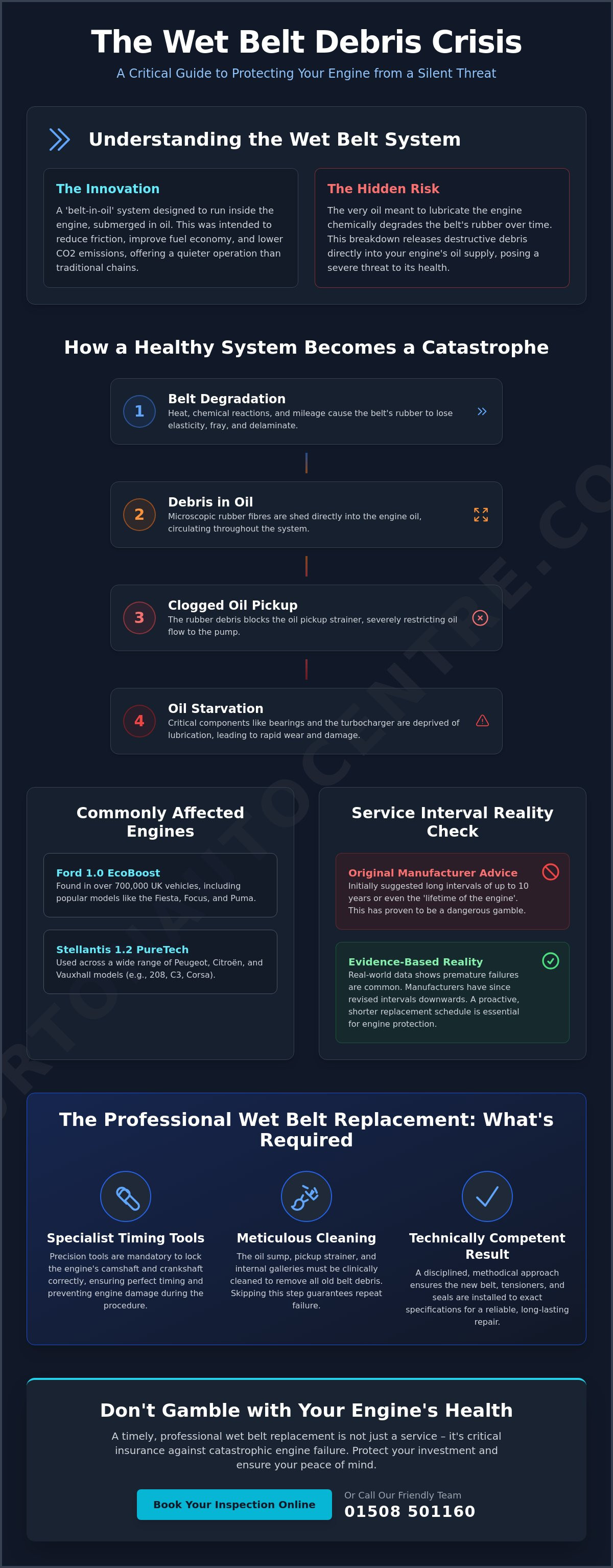
The wet belt, technically known as a 'belt-in-oil' system, represents a significant shift in automotive engineering. Unlike a traditional timing belt that operates in a dry environment, this component is submerged within the engine's lubrication system. Manufacturers designed this system to reduce internal friction, improve fuel economy, and lower CO2 emissions. It is a clever innovation on paper. However, the reality for many drivers in Norfolk has been more complex. This design creates a fundamental paradox: the very oil meant to lubricate the engine eventually begins to chemically degrade the belt's structural integrity.
When the rubber material begins to break down, it releases debris directly into the oil supply. This is why a timely wet belt replacement is no longer just a recommendation; it is a vital preventative measure. We see this most frequently in the Ford 1.0 EcoBoost and PSA 1.2 PureTech engines, where the interaction between the belt material and the engine oil is critical to the vehicle's survival. Disciplined, transparent, and sophisticated; our approach to this technology prioritises your engine's long-term health over mere convenience.
The Mechanical Evolution of Timing Systems
Traditional timing systems relied on either a dry rubber belt or a metal chain. Dry belts are simple but require regular changes; chains are durable but generate more friction and noise. The wet belt was intended to offer the best of both worlds: the quiet, low-friction operation of rubber with the supposed longevity of a chain. By running the belt in a mist of oil, engineers reduced the energy required to turn the engine. While this helps meet strict environmental standards, it places an immense burden on the quality of the oil and the condition of the belt material itself. If the oil is not changed exactly to specification, or if the belt is left too long, the material begins to delaminate.
Affected Vehicles and Engine Variants
If you drive a modern Ford, Peugeot, Citroën, or Vauxhall, your vehicle might be equipped with this system. The 1.0-litre Ford EcoBoost, found in over 700,000 UK vehicles, is perhaps the most well-known example. Similarly, the 1.2 PureTech engine used across the Stellantis range (Peugeot and Citroën) relies on this technology. Many owners were originally told these belts were designed for the 'life of the engine' or carried 10-year service intervals. Real-world data has since challenged these claims. Manufacturers have significantly revised these intervals downwards as the industry acknowledges the risk of premature failure. For anyone concerned about their vehicle's history, seeking a professional wet belt replacement is the most reliable way to ensure peace of mind and mechanical security.
##The Debris Crisis: How Wet Belt Degradation Leads to Oil Starvation
The chemical interaction between engine oil and the timing belt is a slow, invisible process that occurs deep within the crankcase. Over thousands of miles, the rubber compounds lose their elasticity and begin to fray. This isn't just a mechanical wear issue; it's a chemical breakdown. As the belt delaminates, tiny rubber fibres are shed directly into the oil supply, circulating through the engine's most sensitive internal galleries. This creates a debris crisis that often goes unnoticed until the damage is irreversible. Degradation. Delamination. Disaster. These three stages define the lifecycle of a neglected system, making a professional wet belt replacement a critical intervention for vehicle longevity.
The oil pickup strainer is your engine's primary gatekeeper. It's a fine mesh screen designed to catch contaminants before they reach the oil pump. In engines requiring a wet belt replacement, this strainer becomes a trap for rubber debris. Once the mesh is sufficiently clogged, oil pressure drops and flow is restricted. The "silent killer" aspect of this failure is that by the time the oil pressure warning light illuminates on your dashboard, the engine's bearings and turbocharger have likely already suffered significant starvation. Precision. Reliability. Technical competence. These are the standards required to diagnose and rectify such a systemic threat.
The Process of Delamination
Heat, friction, and chemical contaminants are the primary catalysts for belt decay. If the incorrect oil grade is used, or if service intervals are extended beyond safe limits, the chemical breakdown accelerates rapidly. During a clinical sump inspection, our technicians often find a thick sludge of rubber particles settled at the bottom. This visual evidence confirms the severity of the situation. This degradation doesn't just affect the belt's strength; it turns the entire lubrication system into a carrier for abrasive particles that can ruin a belt's structural integrity and lead to total mechanical failure.
Oil Starvation and Vacuum Pump Failure
When debris blocks the oil galleries, the top of the engine is the first to suffer. The camshafts and vacuum pump rely on a constant, pressurised flow of oil to function correctly. A secondary, often overlooked risk is the failure of the vacuum pump, which provides the necessary power for braking assistance. A sudden loss of oil pressure doesn't just threaten the engine; it can compromise your vehicle's stopping ability. This is why a simple belt change is insufficient. A professional service must include a methodical cleaning of the entire oil system to remove every trace of rubber debris. If you're concerned about your vehicle's internal health, you can book a specialist diagnostic check online to ensure your system remains clear and functional.
##Identifying Critical Warning Signs and Recommended Replacement Intervals
Driving conditions in Norwich and Great Yarmouth provide a stern test for any engine. Frequent stop-start traffic prevents engine oil from reaching optimal operating temperatures, which often leads to fuel dilution. When unburnt fuel mixes with the oil, it becomes chemically aggressive and attacks the rubber compounds of the timing belt. This is why the original manufacturer suggestions of ten years or 150,000 miles are increasingly viewed as unsafe by independent specialists. For those navigating Norfolk's urban roads, a wet belt replacement should be considered a priority long before those theoretical limits are reached.
The safety threshold we recommend is significantly more cautious. Evidence-based results from our workshop suggest that a five-year or 60,000-mile interval is the most responsible approach to protecting your engine's integrity. Waiting for a dashboard warning light is a high-risk strategy. By the time a sensor detects a problem, the mechanical degradation is usually advanced. Disciplined. Transparent. Sophisticated. Our approach prioritises preventative action over reactive repair, ensuring your vehicle remains reliable and safe for the road ahead.
Manufacturer vs. Specialist Recommendations
There is a growing discrepancy between official service schedules and real-world specialist advice. While some manufacturers have recently revised their intervals downwards, many owners are still operating under outdated information. Short journeys are particularly damaging for oil-submerged belts. Without long motorway runs to burn off contaminants, the oil becomes a saturated chemical bath that accelerates the delamination process. At Thurton Auto Centre, we take a methodical stance on maintenance. We believe that clear communication regarding these risks is essential for customer peace of mind. We advocate for shorter intervals because the cost of a preventative wet belt replacement is a fraction of the expense required to rectify a total engine failure.
Physical Symptoms of Belt Distress
While much of the decay happens out of sight, there are physical indicators of distress. On some engines, such as the PSA 1.2 PureTech, it is possible to inspect the belt's surface through the oil filler cap. If the belt appears swollen, frayed, or has visible cracks, it requires immediate attention. Other symptoms include a distinct ticking noise from the engine casing or a rough idle caused by slight shifts in timing synchronisation. If your vehicle enters 'limp mode' or displays a check engine light, it may be struggling with timing errors or oil starvation. These signs are urgent. You should seek professional vehicle diagnostics immediately to assess the internal state of your timing system before further driving causes terminal damage.
##The Technical Requirements of a Specialist Wet Belt Replacement
Replacing a wet belt is a high-complexity operation that demands a level of technical rigour far beyond standard maintenance. It's not merely a component swap; it's a clinical procedure that requires an uncompromising attitude toward quality. At Thurton Auto Centre, we recognise that a successful wet belt replacement requires specific environmental controls and specialised equipment that many general repair centres simply don't possess. The process involves dismantling significant portions of the engine's front and top covers, exposing sensitive internal components to the workshop environment. This is why we maintain a disciplined, transparent, and sophisticated workspace to ensure no contaminants enter the system during the work.
A methodical approach is the only way to guarantee the long-term integrity of your engine. We don't rely on guesswork or generic procedures. Instead, we follow a process-driven strategy that addresses the unique vulnerabilities of belt-in-oil technology. From the initial diagnostic assessment to the final system flush, every step is designed to provide peace of mind through superior knowledge and rigorous standards. Disciplined. Transparent. Sophisticated. These are the values that guide our technicians through every specialised repair.
Precision Tooling and Methodology
The crankshaft pulley on many EcoBoost and PureTech engines is secured with extreme torque, often requiring a specialised torque multiplier to ensure it's tightened to the exact manufacturer specification. Generic locking kits often lead to timing inaccuracies, which can result in poor performance or even catastrophic valve damage. We use engine-specific timing locking tools to maintain perfect synchronisation between the camshafts and the crankshaft throughout the procedure. Our methodology also includes a thorough cleaning of the Variable Valve Timing (VVT) solenoids. These components are often the first to be affected by the debris crisis, and their failure can lead to persistent rough idling or significant power loss.
The Comprehensive Cleaning Protocol
A professional wet belt replacement is incomplete without a "sump-off" inspection. We physically remove the oil sump to examine the oil pickup strainer for any residual rubber fibres. Simply changing the belt while leaving debris in the pan is a recipe for future oil starvation. We also replace the oil pump belt alongside the main timing belt, as these components often age at the same rate. Following the physical replacement, we perform a dedicated system flush and refill the engine using only the exact, manufacturer-specified oil. Whether it's the WSS-M2C948-B specification for Ford or the FPW9.55535/03 (5W-30) oil mandatory for many PureTech engines, ensuring chemical compatibility is vital for the new belt's survival. If your vehicle is approaching its service threshold, you can book your specialised wet belt replacement online or call our team on 01508501160 today to secure your engine's future.
##Methodical Wet Belt Care at Thurton Auto Centre
Thurton Auto Centre operates with a clear focus on technical accountability and evidence-based results. We understand that a wet belt replacement is a significant investment in your vehicle's future, and we treat the process with the clinical precision it deserves. Our technicians are trained to handle the specific intricacies of Ford EcoBoost and PSA PureTech engines, ensuring that every bolt is torqued and every gallery is cleaned to a professional standard. Disciplined. Transparent. Sophisticated. These values aren't just words; they are the foundation of our daily operations in South Norfolk.
Choosing an independent specialist means you benefit from a level of attention that national chains often struggle to provide. We prioritise your engine's safety over high-pressure sales, offering a service that is both thorough and responsibly priced. By focusing on the "how" of the work performed, we provide a premium alternative to standard providers, maintaining a serious demeanor that underscores the importance of precision engineering. Our goal is to provide you with an emotional sense of security, knowing your vehicle has been handled by experts who value systems and accuracy above all else.
The Thurton Technical Standard
Our process-driven workflow begins with a comprehensive diagnostic assessment and ends with a rigorous final road test. We believe in absolute transparency, which is why we document the condition of the removed belt to show you exactly why the intervention was necessary. This evidence-based approach ensures you understand the mechanical risk that was mitigated. For long-term protection, we also offer the option of integrating specialised engine maintenance into our Car Care Plans. This methodical approach allows you to spread the cost of essential servicing whilst ensuring your timing system is monitored by specialists who know exactly what to look for.
Your Local Specialist in South Norfolk
We are conveniently located to serve drivers throughout the region, including Norwich, Loddon, Beccles, and Bungay. As a dedicated independent business, we take pride in our technical mastery and our uncompromising attitude toward quality. You don't have to travel to a main dealer to receive a specialist level of care; our workshop is equipped with the same high-grade timing tools and diagnostic equipment found in manufacturer centres. Secure your engine's future today by arranging a specialist wet belt replacement consultation. For expert advice or to book your appointment, please contact our team on 01508501160.
##Securing Your Engine's Future with Specialist Care
Protecting your vehicle from a debris crisis requires more than just a standard service; it demands a disciplined, evidence-based approach that prioritises preventative action over reactive repair. By adhering to a cautious five-year or 60,000-mile safety threshold, you can effectively mitigate the risk of oil starvation and catastrophic mechanical failure. A professional wet belt replacement is the only definitive way to ensure your Ford or PSA engine remains reliable and functional for the road ahead.
At Thurton Auto Centre, we combine independent Ford and PSA engine expertise with the technical rigour of a specialist workshop. Our methodical process includes the use of engine-specific timing locking tools and a comprehensive oil system cleaning to remove every trace of harmful rubber fibres. We value transparency and technical mastery, providing you with the peace of mind that your vehicle is in the hands of methodical experts who don't compromise on quality.
Book Your Specialist Wet Belt Inspection at Thurton Auto Centre today or call our friendly team on 01508501160 to discuss your requirements. We're here to help you maintain your vehicle with absolute confidence and look forward to seeing you at our centre soon.
##Frequently Asked Questions
What exactly is a wet belt and which cars have them?
A wet belt is a timing belt that operates inside the engine's oil system to reduce internal friction and lower CO2 emissions. This technology is primarily found in the Ford 1.0 EcoBoost and the PSA 1.2 PureTech engines, which are used across many Peugeot, Citroën, and Vauxhall models. Whilst efficient, these belts are vulnerable to chemical degradation if the engine oil isn't maintained to a clinical standard.
How much does a wet belt replacement cost in the UK?
Industry data suggests that the cost at an independent garage typically ranges from £1100 to £1,350, whilst main dealer prices can exceed £2,250. For a Ford Transit EcoBlue, the average cost is approximately £1425 plus VAT. These figures reflect the high level of technical complexity, the extensive labour involved, and the specialised precision tooling required to perform the task safely and accurately.
Can I check the condition of my wet belt myself?
On certain models, such as the 1.2 PureTech engine, you can perform a basic visual inspection by looking through the oil filler cap. You're looking for signs of swelling, fraying, or surface cracks on the rubber material. However, many systems are completely enclosed, meaning a professional diagnostic inspection is the only reliable way to verify the internal health of the timing system and the oil pickup pipe.
Why is a wet belt more expensive to replace than a standard cambelt?
The increased cost is due to the extreme technical rigour and specialised equipment required for the procedure. Unlike a standard dry belt, a wet belt replacement requires the removal of the oil sump to physically clean rubber debris from the pickup pipe. Technicians must also use engine-specific locking tools and torque multipliers to ensure the crankshaft pulley is secured to exacting manufacturer specifications.
What happens if my wet belt snaps or delaminates whilst driving?
If a belt fails, it often leads to catastrophic engine failure and an immediate loss of power. The shed fibres block the oil pump's pickup pipe, causing oil starvation that ruins the turbocharger and internal bearings. Repairing such damage can cost upwards of £4,000, making preventative maintenance a far more logical and cost-effective strategy for any responsible vehicle owner in Norfolk.
How often should I change the oil in a wet belt engine?
Most specialists recommend changing your oil every 6,000 to 8,000 miles or at least once a year to protect the system. Frequent oil changes prevent the buildup of fuel contaminants that chemically attack the belt's rubber compounds. Using the exact manufacturer-specified oil is non-negotiable; for example, many PureTech engines now strictly require the FPW9.55535/03 (5W-30) specification to ensure long-term structural integrity.
Does Thurton Auto Centre provide a warranty on wet belt replacements?
We pride ourselves on technical mastery and an uncompromising attitude toward quality in every task we perform. Every wet belt replacement at our centre is conducted by disciplined specialists using industry-standard methodologies and
OEM components and a 12 month warranty on parts and labour. We value transparency and provide clear documentation of the work performed. For specific details regarding our service standards and accountability, please call our office on 01508501160.
Disclaimer
Terms and Conditions
Who we are and how to contact us
https://wwwthurtonautocentre.co.uk is a site operated by Thurton Auto centre. We are a limited company registered in England and Wales under company number 15780586 and have our registered office at The Garage, Norwich Road, Thurton, Norwich, Norfolk, NR14 6AW. Our main trading address is The Garage, Norwich Road, Thurton, Norwich, Norfolk, NR14 6AW.
To contact us, please email info@thurtonautocentre.co.uk or telephone our customer service line on01508 501160or write to us at The Garage, Norwich Road, Thurton, Norwich, Norfolk, NR14 6AW
Information on this site
The content on our site is provided for general information only. It is not intended to amount to advice on which you should rely. You must obtain professional or specialist advice before taking, or refraining from, any action on the basis of the content on our site.
Although we make reasonable efforts to update the information on our site, we make no representations, warranties or guarantees, whether express or implied, that the content on our site is accurate, complete or up to date.
Any descriptions or illustrations on our site are for illustrative purposes only, and are published for the sole purpose of giving an approximate idea of the vehicles described in them. They will not form part of any contract or have any contractual force. We have made every effort to display the colours accurately, but we cannot guarantee that a device's display of the colours accurately reflects the colour of the vehicles.
We reserve the right to amend the specification of any vehicle described on this site if required to do so by any applicable statutory or regulatory requirement, to implement minor technical adjustments and improvements, or if the amendment will not materially affect its nature or quality.
Our site is only for users in the UK
Our site is directed to people residing in the United Kingdom. We do not represent that content available on or through our site is appropriate for use or available in other locations. You may use this site to reserve a vehicle or test drive from an address outside the United Kingdom, but we do not deliver vehicles outside the United Kingdom, and any test drives must take place at the address in the United Kingdom which we specify.
Events outside our control
We will not be liable or responsible for any failure to perform, or delay in performance of, any of our obligations under the Contract that is caused by any act or event beyond our reasonable control (Event Outside Our Control).
If an Event Outside Our Control takes place that affects the performance of our obligations under the Contract, we will contact you as soon as possible to let you know and we will take steps to minimise the effect of the delay. We will arrange a new date for the test drive after the Event Outside Our Control is over. Provided we do this we will not be liable for delays caused by the event, but if the Event Outside Our Control has continued, or seems likely to continue, for more than 30 days, you may contact us to cancel the Order and receive a refund of any reservation or booking fee you have paid.
How you may use material on our site
We are the owner or the licensee of all intellectual property rights in our site, and in the material published on it. Those works are protected by copyright laws and treaties around the world. All such rights are reserved.
You may print off one copy, and may download extracts, of any page(s) from our site for your personal use and you may draw the attention of others within your organisation to content posted on our site.
You must not modify the paper or digital copies of any materials you have printed off or downloaded in any way, and you must not use any illustrations, photographs, video or audio sequences or any graphics separately from any accompanying text.
Our status (and that of any identified contributors) as the authors of content on our site must always be acknowledged.
You must not use any part of the content on our site for commercial purposes without obtaining a licence to do so from us or our licensors.
You print off, copy or download any part of our site in breach of these terms of use, your right to use our site will cease immediately and you must, at our option, return or destroy any copies of the materials you have made.
We are not responsible for websites we link to
Where our site contains links to other sites and resources provided by third parties, these links are provided for your information only. Such links should not be interpreted as approval by us of those linked websites or information you may obtain from them.
We have no control over the contents of those sites or resources.
Our responsibility for loss or damage suffered by you
Whether you are a consumer or a business user:
We do not exclude or limit in any way our liability to you where it would be unlawful to do so. This includes liability for death or personal injury c