
You turn the key and hear a slow crank, or perhaps repeated clicks, but the car starts on the next attempt. These can be signs of a failing car battery. However, similar symptoms can point to the starter motor or charging system, so replacing the battery without a proper check may not solve the problem.
If your car starts inconsistently, it’s sensible to look for a clear answer before deciding what to do. This guide explains common battery warning signs, how they can differ from faults elsewhere, and when to arrange a professional assessment. It also covers what details to share when making an enquiry, so you can describe the symptoms clearly.
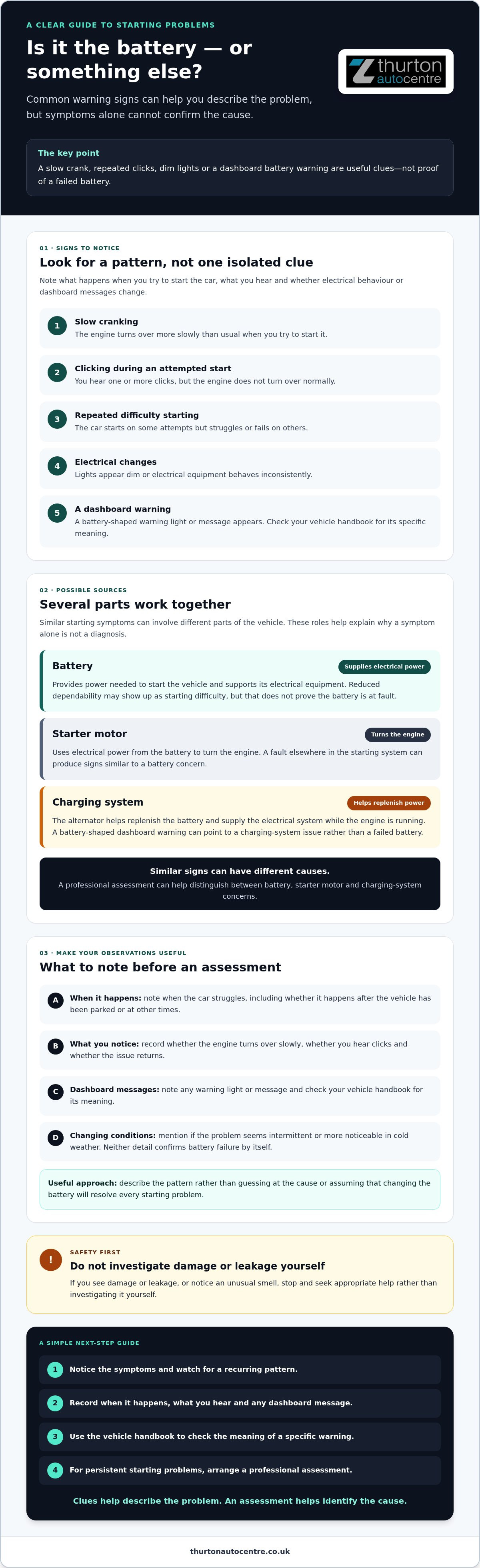
Look for patterns rather than relying on a single clue. Sluggish starting, repeated clicks, dim lights or a dashboard battery warning light can each help build a picture, but none confirms the cause by itself. A battery warning light, in particular, can indicate a charging-system issue rather than a failed battery. An assessment can help distinguish between possibilities and guide the next step.
Key Takeaways
- Learn which signs of a failing car battery to watch for, and why symptoms alone can’t confirm the cause.
- Compare possible battery, starter motor and charging-system issues before deciding what to do next.
- Note when the problem occurs and check your vehicle handbook to prepare useful details for an assessment.
- If you see damage or leakage, or notice an unusual smell, stop and seek appropriate help rather than investigating yourself.
- For persistent starting problems, a professional assessment can help distinguish battery concerns from other vehicle faults.
Table of Contents
What are the common signs of a failing car battery?
A car that struggles to start may have a battery problem, but that isn’t the only possible cause. Slow cranking, clicking and repeated difficulty starting are useful clues, not proof. Faults in the starter motor or charging system can produce similar symptoms. Look for a pattern and describe what you notice rather than deciding to replace the battery after one difficult start.
- Slow cranking: the engine turns over more slowly than usual when you try to start it.
- Clicking during an attempted start: you hear one or more clicks, but the engine doesn’t turn over normally.
- Repeated difficulty starting: the car starts on some attempts but struggles or fails on others.
- Electrical changes: lights appear dim or electrical equipment behaves inconsistently.
- A dashboard warning: a battery-shaped warning light or message appears.
Why a slow start or clicking noise can be a warning sign
The battery supplies electrical power needed to start the engine and supports the vehicle’s electrical systems. If the engine turns over sluggishly or you hear clicking during an attempt, the battery may not be supplying what the starting process needs. Other starting-system faults can cause similar signs. Note what you hear, whether the engine turns over and whether the problem happens repeatedly.
Electrical changes and dashboard warnings to notice
Dim lights or electrical equipment that behaves differently are worth reporting, especially if you notice a change around the time the car struggles to start. Treat these as observations, not a diagnosis: electrical issues can have more than one cause. A battery-shaped warning light may indicate a problem with the charging system rather than prove that the battery itself has failed. Check your vehicle handbook for the meaning of the specific light or message.
Make your observations useful by noting when the symptom occurs, what the dashboard displays and whether the issue returns after the car has started. A single slow start differs from a recurring pattern, but neither confirms the fault on its own. Avoid assuming that changing the battery will resolve every starting problem.
A warning sign points to something worth checking; only an assessment can confirm whether the battery is at fault. The signs of a failing car battery can overlap with other faults, so a clear account of what happens helps guide the next step.
Why car battery problems develop and how the symptoms can change
A battery can become less dependable gradually, so a car may still start most of the time even as its ability to deliver power declines. The change might first show up during a difficult start, then seem to disappear on a later attempt. That inconsistency can make it tempting to dismiss the issue. A recurring change is still useful evidence to record and discuss, even if the vehicle starts normally again. When inspecting second-hand vehicles or evaluating day-to-day vehicle reliability, automotive specialists such as Auto Sale Newport recommend monitoring early starting symptoms and battery age closely before minor faults escalate.
What a car battery does when you start the vehicle
The battery supplies electrical energy for starting the vehicle and supports its electrical equipment. The starter motor uses that power to turn the engine; the alternator helps replenish the battery and supply the electrical system while the engine is running. These components work together but have different roles. A starting problem may therefore involve the battery, the starter motor or the charging system, rather than just one component.
A failing battery is one whose ability to provide dependable power has reduced. This describes a pattern of performance, not a precise test result or proof that replacement is needed. Symptoms can prompt a check, but an assessment is needed to identify the cause.
Why symptoms may appear intermittently
Battery performance can be affected by conditions, and cold weather may make an existing weakness more noticeable. A car that starts after a milder day, or works normally after one difficult start, hasn’t necessarily ruled out a developing issue. Equally, cold conditions or a single slow start don’t confirm battery failure. Consider what has changed and whether the same difficulty returns.
Keep a simple record: note when the car struggles, whether the engine turns over slowly and whether a dashboard warning appears. Include whether the issue happens after the vehicle has been parked or at other times, but don’t draw conclusions from that pattern alone. These details help a professional assess the symptoms alongside the vehicle’s starting and charging systems.
This measured approach is more useful than repeatedly trying to start the car and guessing at the cause. If starting problems recur, consult your vehicle handbook and consider arranging an assessment. You can review online booking options when deciding how to make an enquiry.
Is it the battery, starter motor or charging system?
Starting symptoms don’t always identify the part at fault. Slow cranking, clicking or a dashboard warning can have more than one possible explanation. Use the pattern as a guide for what to report, not as a diagnosis. The comparison below outlines possibilities to discuss with a professional.
| What you notice | Systems that may be involved | Sensible next step |
|---|---|---|
| The engine turns over slowly or starting is inconsistent | Battery, connections or another part of the starting system | Note when it happens and whether it recurs; arrange an assessment if it persists. |
| Clicking when you try to start the vehicle | Battery or starter motor, among other possible causes | Record whether there is one click or repeated clicking, and whether the engine turns over. |
| A battery-shaped warning light appears, or charge-related issues recur | Charging system, which may include the alternator, or a battery-related fault | Check the handbook’s explanation and seek a professional assessment. |
| Lights dim or electrical equipment behaves inconsistently | Battery, charging system or another electrical issue | Note which equipment is affected and when the change occurs. |
Battery symptoms compared with starter-motor problems
A battery concern may show up as slow cranking or difficulty starting, while a starter-motor fault can also leave the engine unable to turn over. Clicking may occur with either type of problem, so the sound alone isn’t a reliable way to choose between them. When you use the key or start button, note what happens: whether you hear a click, whether the engine turns and whether the behaviour changes between attempts.
When an alternator or charging-system issue may be involved
A warning light or recurring loss of charge may point to the charging system rather than the battery alone. A battery-shaped symbol doesn’t identify a failed alternator or prove that the battery needs replacing. Check your handbook for the meaning of the specific warning, and record whether it appears while driving or at another time. This context can help narrow down what needs checking.
The signs of a failing car battery can overlap with symptoms of starter or charging-system faults. A professional assessment is more reliable than choosing a replacement based on symptoms alone. If you need a wider investigation, you can read about vehicle diagnostics at Thurton Auto Centre.
What to do when you notice signs of a failing car battery
Use the signs of a failing car battery as a reason to gather information, not as proof that the battery needs replacing. A clear record can help a professional distinguish a battery concern from a fault elsewhere in the starting or charging system.
- Note what happens. Record whether the engine turns over slowly, you hear clicking, the vehicle fails to start or a dashboard warning appears. Include any changes in the lights or electrical equipment.
- Check your vehicle handbook. Look up the specific warning light or message shown. The handbook can explain what it means for your vehicle, but it won’t confirm the cause of a starting problem.
- Avoid repeated guesswork. Don’t keep trying to start the vehicle or assume a battery replacement will resolve the issue. Don’t attempt to handle, open, jump-start or replace the battery yourself.
- Arrange an assessment if the issue persists. Share your observations when making an enquiry, particularly if the vehicle has failed to start or the symptoms have recurred.
What information to record before arranging a check
Make a note of whether the fault is occasional or recurring and when it happens, such as after the vehicle has been parked. Record changes in its starting behaviour and the exact wording of any dashboard message. Have the vehicle’s make, model and registration details ready when booking. You don’t need to identify the fault yourself; a precise description of what you experienced is more useful than a guess.
When to stop troubleshooting and seek professional help
If starting problems recur or the vehicle won’t start, seek professional advice rather than continuing to troubleshoot. Visible battery damage, leakage or an unusual smell are reasons to stop and get appropriate help. Don’t touch or inspect the battery closely. A professional assessment can help establish whether the concern relates to the battery or another vehicle system.
Thurton Auto Centre offers vehicle servicing, repairs and diagnostics. When making an enquiry, ask whether the centre can assess your particular battery type and vehicle.
Arrange a professional vehicle check in Norfolk
Recurring starting or electrical problems deserve a considered assessment, not an automatic battery replacement. The symptoms may be associated with the battery, starter motor or charging system, and a professional can assess the vehicle to help establish what may be causing them.
Thurton Auto Centre is an independent, family-owned vehicle centre serving Norfolk and Suffolk. Its listed services include vehicle servicing, repairs and diagnostics. For drivers in Thurton and across East Anglia, including Norwich, Great Yarmouth, Lowestoft, Diss, Dereham, Loddon, Poringland, Beccles, Bungay, Acle, Blofield, Wymondham, Keswick, Yelverton and Framlingham, describe what you’ve noticed and ask whether the centre can assess your vehicle and battery type. Symptoms alone don’t confirm the fault or the repair required.
What to expect when you book a vehicle assessment
A technician will need to assess the vehicle and establish the cause of the reported symptoms. When arranging an appointment, share whether the car starts slowly, clicks, fails to start or displays a dashboard warning. Mention when the issue occurs and whether it’s occasional or recurring. If a warning appears, note its wording or consult your handbook so you can describe it accurately.
Have your vehicle’s make, model and registration details ready. These details, alongside a clear account of what has changed, help the centre understand your enquiry. The assessment and any next steps depend on the vehicle and findings, so don’t assume a particular test or repair is required before the cause has been established.
Choose a clear next step for recurring battery concerns
If starting or electrical symptoms persist, return after seeming to resolve, or leave the vehicle unusable, arrange professional advice rather than repeatedly guessing at the cause. When you book, explain what happens and whether the vehicle can currently be started. You can also confirm that the centre can assess the relevant battery type before arranging an appointment.
A clear description helps set the right context. It won’t replace an assessment, but it gives the technician useful information to consider alongside the vehicle’s symptoms.
Take the next step with confidence
Slow cranking, clicking, recurring starting trouble or electrical changes can be signs of a failing car battery, but they don’t confirm the cause. Similar symptoms may involve the starter motor or charging system, so avoid choosing a replacement based on clues alone.
Note when the problem occurs, what you hear or see, and any dashboard messages. Check your vehicle handbook for warning-light guidance, then share those details when arranging an assessment. A clear account helps a professional consider the symptoms and establish an appropriate next step.
Thurton Auto Centre is an independent, family-owned vehicle centre serving Norfolk and Suffolk, with vehicle servicing, repairs and diagnostics among its services. If the starting issue persists or returns, an assessment can help you move forward without relying on guesswork.
With the symptoms clearly described and professional guidance, you can take the next step with greater confidence.
Frequently Asked Questions
What are the first signs of a failing car battery?
Early signs often include the engine turning over more slowly than usual, clicking during an attempted start or needing repeated attempts to start the car. You may also notice dim lights or inconsistent electrical behaviour. These signs of a failing car battery are clues, not confirmation: the starter motor or charging system may cause similar symptoms. Note when the problem happens and whether it returns, then consult your vehicle handbook for any dashboard messages.
Can a car battery be failing if the lights still work?
Yes. Working lights don’t rule out a battery problem, because operating lights and starting the engine place different demands on the vehicle’s electrical system. A battery might still supply enough power for some equipment but not start the car reliably. Equally, dim or inconsistent lights can have other causes. Pay attention to starting behaviour as well as the lights, and arrange a professional assessment if the symptoms persist or recur.
How can I tell if the problem is the battery or the alternator?
You can’t reliably identify the fault from symptoms alone. A battery concern may show as slow or inconsistent starting, while a charging-system issue may be associated with a battery-shaped warning light or recurring loss of charge. These patterns can overlap, and a warning symbol doesn’t prove the alternator or battery has failed. Check the vehicle handbook, record what happens and arrange a professional assessment before choosing a replacement.
Why does my car struggle to start when it is cold?
Cold weather can make an existing weakness in a battery more noticeable, so the car may crank more slowly or struggle to start. However, a cold morning or one difficult start doesn’t confirm battery failure. Other starting-system faults can cause similar behaviour. Make a note of whether the issue occurs repeatedly in cold conditions or also happens at other times, then share those details when seeking professional advice.
Can a failing car battery cause dashboard warning lights?
A battery-related concern can coincide with a dashboard warning, but the light doesn’t necessarily mean the battery itself has failed. A battery-shaped warning may relate to the charging system, and one symbol alone can’t identify the component at fault. Check your handbook for the explanation that applies to your vehicle and note the exact message or symbol. If the warning stays on or returns, seek professional advice.
What should I do if my car battery keeps going flat?
Arrange an assessment rather than assuming the battery needs replacing. A recurring flat battery can involve the battery, charging system or another electrical issue, so note how often it happens and what the car does when you try to start it. Check your handbook for relevant warnings, and avoid repeated guesswork or handling the battery. Drivers across Norfolk and Suffolk can enquire with Thurton Auto Centre about vehicle servicing, repairs and diagnostics.
Is it safe to drive with signs of a failing car battery?
Starting symptoms alone can’t establish whether a journey is safe, and the car may not restart after you switch it off. If a warning appears, the vehicle behaves abnormally or you’re unsure, stop somewhere safe and consult the handbook or seek professional advice before continuing. Don’t handle a battery if you notice visible damage, leakage or an unusual smell. If the vehicle won’t start, arrange appropriate help rather than attempting a journey.
Disclaimer
Terms and Conditions
Who we are and how to contact us
https://wwwthurtonautocentre.co.uk is a site operated by Thurton Auto centre. We are a limited company registered in England and Wales under company number 15780586 and have our registered office at The Garage, Norwich Road, Thurton, Norwich, Norfolk, NR14 6AW. Our main trading address is The Garage, Norwich Road, Thurton, Norwich, Norfolk, NR14 6AW.
To contact us, please email info@thurtonautocentre.co.uk or telephone our customer service line on01508 501160or write to us at The Garage, Norwich Road, Thurton, Norwich, Norfolk, NR14 6AW
Information on this site
The content on our site is provided for general information only. It is not intended to amount to advice on which you should rely. You must obtain professional or specialist advice before taking, or refraining from, any action on the basis of the content on our site.
Although we make reasonable efforts to update the information on our site, we make no representations, warranties or guarantees, whether express or implied, that the content on our site is accurate, complete or up to date.
Any descriptions or illustrations on our site are for illustrative purposes only, and are published for the sole purpose of giving an approximate idea of the vehicles described in them. They will not form part of any contract or have any contractual force. We have made every effort to display the colours accurately, but we cannot guarantee that a device's display of the colours accurately reflects the colour of the vehicles.
We reserve the right to amend the specification of any vehicle described on this site if required to do so by any applicable statutory or regulatory requirement, to implement minor technical adjustments and improvements, or if the amendment will not materially affect its nature or quality.
Our site is only for users in the UK
Our site is directed to people residing in the United Kingdom. We do not represent that content available on or through our site is appropriate for use or available in other locations. You may use this site to reserve a vehicle or test drive from an address outside the United Kingdom, but we do not deliver vehicles outside the United Kingdom, and any test drives must take place at the address in the United Kingdom which we specify.
Events outside our control
We will not be liable or responsible for any failure to perform, or delay in performance of, any of our obligations under the Contract that is caused by any act or event beyond our reasonable control (Event Outside Our Control).
If an Event Outside Our Control takes place that affects the performance of our obligations under the Contract, we will contact you as soon as possible to let you know and we will take steps to minimise the effect of the delay. We will arrange a new date for the test drive after the Event Outside Our Control is over. Provided we do this we will not be liable for delays caused by the event, but if the Event Outside Our Control has continued, or seems likely to continue, for more than 30 days, you may contact us to cancel the Order and receive a refund of any reservation or booking fee you have paid.
How you may use material on our site
We are the owner or the licensee of all intellectual property rights in our site, and in the material published on it. Those works are protected by copyright laws and treaties around the world. All such rights are reserved.
You may print off one copy, and may download extracts, of any page(s) from our site for your personal use and you may draw the attention of others within your organisation to content posted on our site.
You must not modify the paper or digital copies of any materials you have printed off or downloaded in any way, and you must not use any illustrations, photographs, video or audio sequences or any graphics separately from any accompanying text.
Our status (and that of any identified contributors) as the authors of content on our site must always be acknowledged.
You must not use any part of the content on our site for commercial purposes without obtaining a licence to do so from us or our licensors.
You print off, copy or download any part of our site in breach of these terms of use, your right to use our site will cease immediately and you must, at our option, return or destroy any copies of the materials you have made.
We are not responsible for websites we link to
Where our site contains links to other sites and resources provided by third parties, these links are provided for your information only. Such links should not be interpreted as approval by us of those linked websites or information you may obtain from them.
We have no control over the contents of those sites or resources.
Our responsibility for loss or damage suffered by you
Whether you are a consumer or a business user:
We do not exclude or limit in any way our liability to you where it would be unlawful to do so. This includes liability for death or personal injury c