
With estimates suggesting that up to 60,000 individuals are now living full-time in vehicles across the UK, the transition from weekend adventuring to permanent residency requires more than just a change of scenery. It demands a systematic, high-standard approach to your vehicle's core infrastructure. Identifying the best upgrades for full-time van life is not merely an exercise in aesthetics; it is a vital step in ensuring your home remains safe, warm, and functional throughout the unpredictable seasons of Norfolk and Suffolk.
We recognise that the daily reality of van life often involves navigating the stress of battery anxiety, combatting persistent damp, and ensuring your gas systems are rigorously certified. This guide outlines the essential technical enhancements and professional installations required to transform a standard vehicle into a sophisticated, year-round sanctuary. We will examine high-capacity lithium power systems, advanced climate control solutions, and the methodical safety protocols that provide genuine peace of mind for every off-grid journey. Precise. Reliable. Certified.
Key Takeaways
- Understand the critical "infrastructure shift" required to transition a standard vehicle into a reliable, year-round home that performs in all seasons.
- Discover why lithium-ion power systems and integrated solar arrays are the best upgrades for full-time van life when seeking total off-grid independence.
- Learn how professional climate control solutions solve the condensation crisis and provide consistent, dry heat during damp British winters.
- Identify the systematic maintenance routines, such as specialist damp surveys and habitation checks, that protect your mobile asset's structural integrity.
- Evaluate the essential safety and financial benefits of choosing manufacturer-backed professional installations over the high-risk DIY alternative.
Table of Contents
Transitioning to Full-Time Van Life: The Infrastructure Shift
Moving into a van permanently isn't just a long holiday; it's a fundamental change in how your vehicle must function. Most vans leave the factory designed for intermittent leisure use. They aren't engineered for the relentless demands of 365-day occupancy. This shift in usage necessitates a move towards professional-grade infrastructure that can withstand the rigours of the British climate. When your vehicle is your only shelter, the margin for error disappears. Systems that were once "good enough" for a sunny weekend in July will likely fail during a damp November in Norfolk. Identifying the best upgrades for full-time van life starts with acknowledging that your vehicle is now a high-use domestic property.
The psychological impact of this infrastructure shift is profound. Constant worry about battery levels, gas safety, or mechanical failure leads to burnout. True freedom comes from technical confidence. By investing in the Transitioning to Full-Time Van Life process through structured upgrades, you replace anxiety with a sense of security. Reliability. Efficiency. Safety. These are the pillars of a sustainable mobile life. We help you move beyond the "rough-and-ready" approach toward a disciplined, methodical setup that supports your long-term goals.
Preparing for this new chapter often involves settling affairs at your previous residence. If you need to clear old hardware from your home or business premises, you can learn more about Dish Goodbye for professional removal of redundant satellite dishes and aerials across the UK.
The Reality of Year-Round Van Habitation
Living in a van throughout the UK's four seasons presents unique challenges, particularly regarding moisture and temperature regulation. Standard leisure vehicles often lack the ventilation and insulation required for permanent residence. Daily activities like cooking, washing, and even breathing release significant moisture into a confined space. Without professional-grade systems, this leads to condensation and structural damp. Prioritising safety-critical systems over aesthetic modifications is essential. It's far better to have a warm, dry van with a basic interior than a beautiful conversion that's riddled with mould and has a failing electrical circuit.
Starting with a Solid Foundation
Before considering luxury additions, you must ensure the base vehicle is mechanically sound. This begins with a professional vehicle service to identify underlying issues. Full-time vans carry significantly more weight than their leisure counterparts, placing constant strain on the suspension, brakes, and tyres. Consequently, these vehicles require more frequent maintenance intervals than a standard car. We recommend a systematic approach to servicing that accounts for this increased load.
A specialist MOT is your first line of defence against structural failure. Our technicians look beyond the basics to ensure your home on wheels is legally compliant and physically capable of supporting your lifestyle. If you are also preparing for driving assessments to meet specific regional requirements, you can learn more about professional road test booking services that streamline the process. When identifying the best upgrades for full-time van life, the most critical investment is always the mechanical integrity of the chassis and engine. Without a reliable foundation, even the most expensive interior upgrades are a wasted investment. We provide the technical reassurance you need to travel with confidence across East Anglia and beyond.
Off-Grid Power Systems: Lithium and Solar Upgrades
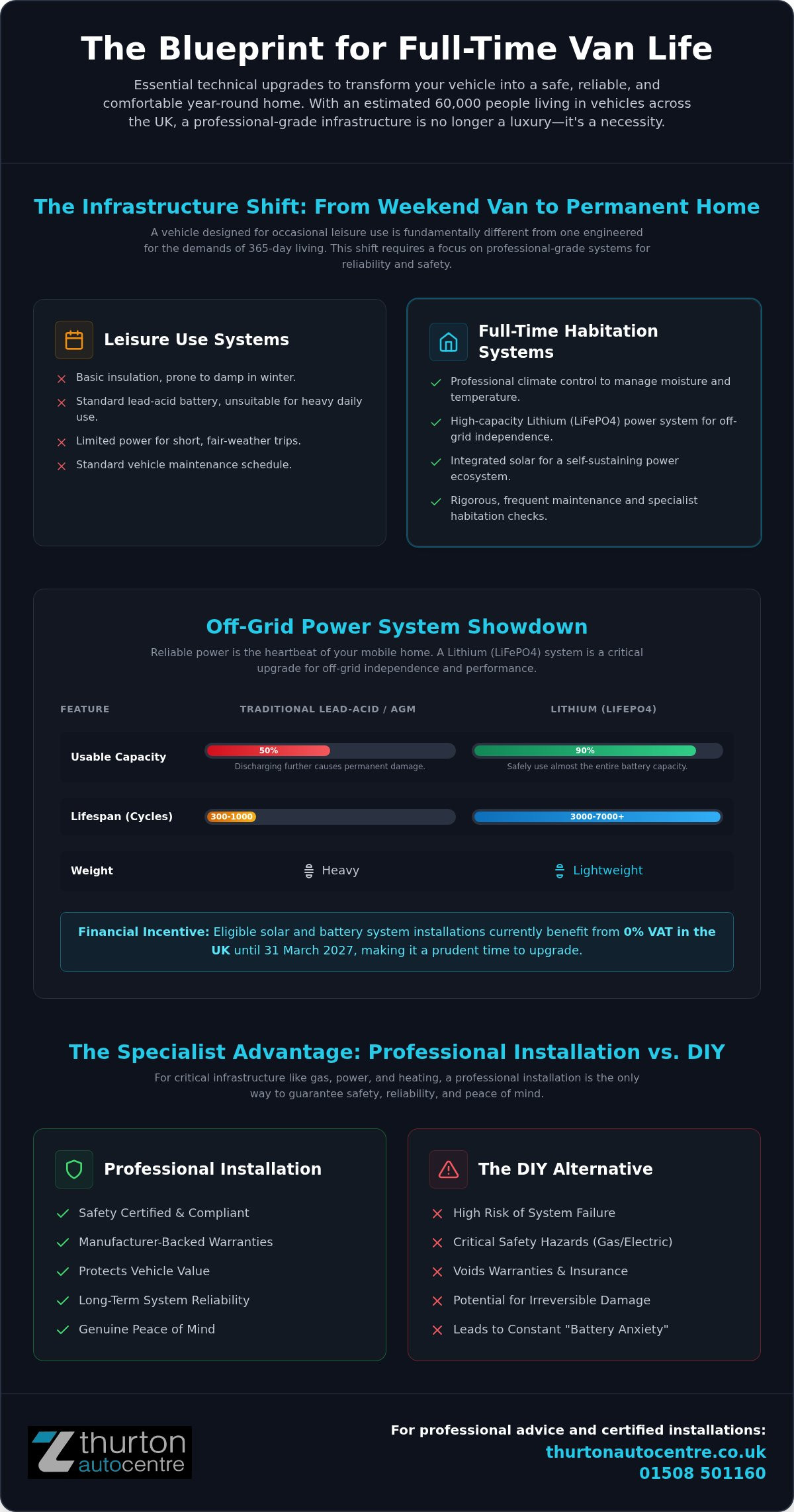
Reliable power is the heartbeat of any year-round habitation. For those seeking the best upgrades for full-time van life, transitioning from traditional lead-acid or AGM batteries to Lithium Iron Phosphate (LiFePO4) is a logical technical progression. Traditional lead-acid technology is inherently limited; it is heavy, slow to charge, and suffers permanent damage if discharged below 50% capacity. Lithium technology, by contrast, allows for a 90% depth of discharge whilst maintaining a stable voltage output. This ensures your sensitive electronics, such as laptops for remote work or CPAP machines, receive a consistent and clean power supply. Compact. Efficient. Resilient.
Establishing a daily energy budget is a prerequisite for a successful off-grid setup. A typical full-time user must account for high-draw appliances, including diesel heaters, water pumps, and induction hobs. Without a robust storage solution, these demands quickly exceed the capabilities of factory-fitted systems. Integrating a high-capacity lithium bank with a sophisticated solar array creates a self-sustaining ecosystem. It is also a financially prudent time for such installations; eligible solar and battery systems in the UK currently benefit from 0% VAT until 31 March 2027. This tax incentive provides a significant opportunity to professionalise your vehicle's infrastructure at a reduced cost.
The Technical Superiority of Lithium Upgrades
Weight management is a critical factor for any van conversion. Lithium batteries offer an exceptional power-to-weight ratio, often providing double the energy of AGM alternatives at a third of the mass. This reduction is vital for staying within your vehicle's Maximum Technical Permitted Laden Mass (MTPLM). When we perform lithium battery upgrades, we ensure the system aligns with Official vehicle electrical safety standards. Professional integration ensures that your alternator and existing mains chargers are correctly calibrated for the specific charging profile of lithium cells, preventing overheating and premature cell failure.
Maximising Solar Harvest in the UK
In the diffuse, often overcast light of Norfolk and Suffolk, panel efficiency is paramount. Monocrystalline panels are the preferred choice over polycrystalline versions due to their superior performance in low-light conditions. However, the panels are only as effective as the controller managing them. A Maximum Power Point Tracking (MPPT) controller is essential; it acts as a high-frequency DC-to-DC converter that optimises the match between the solar array and the battery bank. We recommend a solar panel installation by a specialist to ensure roof penetrations are hermetically sealed and electrical circuits are correctly fused. If you are unsure about your current power capacity, you can book a technical consultation through our online booking system to discuss a tailored energy solution.
Climate Control and Gas Safety: Professional Heating and Cooling
Maintaining a stable internal environment is one of the most significant challenges for year-round residents. In the UK, the "condensation crisis" is driven by the temperature differential between the warm living space and the cold vehicle skin. Unlike portable heaters that produce "wet" heat, integrated systems provide a consistent flow of dry, filtered air. This is why we consider professional climate control among the best upgrades for full-time van life; it preserves both your health and the vehicle's structural integrity. By stabilising the internal dew point, you prevent the mould growth that typically plagues factory-standard conversions during the winter months.
Safety remains the paramount concern for any permanent habitation. All gas installations should adhere to the BS EN 1949:2021 standard, ensuring the system is technically fit for purpose. While DIY modifications might seem cost-effective, they lack the rigorous certification required by insurers and UK government safety regulations. We provide comprehensive LPG gas testing services to verify that your system is leak-free and operating at the correct 30 mbar pressure. This methodical approach to safety is essential when your living area and sleeping quarters are in such close proximity to fuel sources.
Advanced Heating and Cooling Solutions
For compact conversions, the Truma CombiNeo installation offers a sophisticated, dual-purpose solution. It provides rapid cabin heating and hot water from a single, space-efficient unit. Whilst diesel heaters are popular for their fuel accessibility, integrated gas systems often provide a quieter and cleaner burn, which is preferable for long-term comfort. If you plan to travel through Europe during the summer, Truma air conditioning ensures your living space remains a sanctuary even in extreme heat. These systems are most effective when integrated with the lithium power banks we discussed in the previous section.
Refillable Gas Systems and Safety
Refillable systems like Gaslow are a technical necessity for international travel. They eliminate the logistical burden of searching for specific brand-name bottle replacements in different countries. Instead, you can refill at any LPG-equipped fuel station across the UK and Europe, often at a significantly lower cost per litre. This convenience is a game-changer for full-timers who don't want their travel plans dictated by gas availability. Professional installation ensures that the external fill point is securely mounted and the internal pipework is protected against the vibrations of full-time travel. Accurate. Secure. Reliable.
Protecting Your Mobile Asset: Maintenance and Damp Prevention
Water ingress is the silent killer of leisure vehicles. Whilst previous sections focused on power and climate systems, those technical investments are only as secure as the shell that houses them. For a permanent resident, a leak isn't just an inconvenience; it's a threat to your entire living infrastructure. Damp often remains invisible to the untrained eye until structural rot has already taken hold. Recognising that preventative maintenance is one of the best upgrades for full-time van life is essential for protecting your vehicle's resale value and your personal health. Systematic. Thorough. Essential.
Full-time vans require a far more rigorous inspection schedule than those used for occasional weekend trips. A standard leisure vehicle might only see 20 to 30 days of use per year, whereas a home on wheels operates under constant load for 365 days. This accelerated usage cycle places extreme stress on external seals, window bonds, and roof lights. We recommend moving beyond annual checks toward a bi-annual review of the vehicle's "envelope" to identify and rectify minor issues before they necessitate costly structural repairs. Consistent vigilance is the only way to ensure long-term viability in the wet East Anglian climate.
The Professional Habitation Check
A professional NCC approved habitation check is a comprehensive diagnostic of your living quarters. It goes far beyond a simple visual inspection. Our technicians perform a series of technical assessments, including testing for carbon monoxide levels, verifying gas system tightness, and checking electrical earthing. This process ensures your vehicle meets our "Fit for Purpose" promise, providing the technical reassurance that every system is operating within safe parameters. For those living in their vehicles, these checks are the foundation of a responsible and secure lifestyle.
Damp Surveys and Structural Repairs
Precision is key when detecting moisture. We use professional-grade moisture meters to conduct a detailed motorhome damp survey and repair service, mapping out the moisture content across your vehicle's walls and floor. If ingress is detected, immediate action is required to reseal the exterior and, if necessary, replace damaged internal timbers. Furthermore, older van conversions often require chassis maintenance to combat the effects of road salt and moisture. Our specialist welding for older van conversions ensures that your vehicle's foundation remains robust and MOT-compliant, regardless of its age.
The Specialist Advantage: Why Professional Installation Wins
The allure of the DIY build is a significant part of the van life culture, but the transition to permanent residency introduces technical complexities that standard home toolkits cannot address. When your vehicle serves as your primary residence, the cost of a technical failure is significantly higher than a simple weekend inconvenience. Professional installation provides a level of precision that ensures your systems don't just work, but excel under constant use. Identifying the best upgrades for full-time van life requires a methodical approach to integration, ensuring that your solar, lithium, and heating systems communicate perfectly without risking electrical overloads or gas leaks. Precision. Accountability. Security.
This commitment to technical excellence is a global standard; for instance, KME Vehicle Engineering provides the expert engineering and certification services required to ensure complex vehicle modifications remain safe and compliant.
Choosing a specialist installation over a self-build approach eliminates the hidden costs of DIY, such as the substantial investment in specialised tools and the risk of voiding manufacturer warranties. We focus on the "why" of every installation before applying the "how," using evidence-based methodologies to ensure your vehicle remains a reliable sanctuary. For East Anglian travellers, having local, expert support means you aren't just buying a component; you're investing in a long-term technical partnership that prioritises your safety and comfort above all else.
This technical partnership should also address the physical security of your vehicle and belongings. To ensure your home is fully protected, you can visit Safe & Sound Mobile for professional nationwide installation of advanced security and audio systems.
Security and Resale Value
A converted van with a verified, professional service history command a significantly higher market value. Insurance providers and future buyers prioritise certified work, particularly regarding gas and high-voltage electrical systems. Integrating motorhome warranties into your long-term financial planning provides an essential safety net, ensuring that your mobile asset is protected against unforeseen mechanical or habitation failures. It's about creating a transparent record of quality that protects your investment for years to come.
Expertise and Precision
Modern van builds rely on complex electronic ecosystems that require advanced vehicle diagnostics to configure correctly. We move beyond guesswork, using professional-grade equipment to calibrate your charging profiles and monitor system health. This disciplined approach is what defines the specialist advantage; we ensure every cable, fuse, and joint meets industry standards. Our team is here to provide the high-level guidance you need to make your off-grid dreams a functional reality.
For readers whose vision for a mobile lifestyle extends to developing commercial sites or permanent parking solutions for residential vehicles, it is vital to explore Transport Statements to ensure your planning application meets all necessary highways and access requirements.
If you're ready to professionalise your vehicle's infrastructure, we invite you to contact our team on 01508501160 to discuss your bespoke upgrade plan. We look forward to helping you build a safe, reliable, and truly capable home on wheels.
Building a Sustainable Life on Wheels
Transforming a standard van into a year-round residence is a significant technical undertaking that requires a shift from leisure-based thinking to professional infrastructure. We've explored how high-capacity lithium systems, integrated climate control, and rigorous damp prevention form the essential foundation for a reliable mobile home. These interventions represent the best upgrades for full-time van life, ensuring your sanctuary remains safe, dry, and powered regardless of the British weather. Technical mastery leads to genuine freedom.
As an AWS Accredited Service Centre with over 40 years of expertise, our family-owned Norfolk business provides the specialised knowledge required for these high-stakes installations. Our specialist lithium and solar technicians use precise diagnostics to deliver systems that are insurance-compliant and technically superior. We take pride in our methodical approach, ensuring every connection is secure and every system is fit for purpose. You don't have to navigate these complex technical decisions alone.
Frequently Asked Questions
Is a lithium battery upgrade worth the cost for full-time van life?
A lithium battery upgrade is highly recommended for full-time residency due to its superior depth of discharge and extended lifespan. Unlike lead-acid variants, lithium cells allow you to utilise up to 90% of their capacity without technical degradation. This efficiency, combined with significant weight reduction, makes them one of the best upgrades for full-time van life. The long-term cost-benefit is clear when considering they last up to ten times longer than traditional leisure batteries.
Can I install my own solar panels, or should I hire a professional?
You should hire a professional for solar installations to ensure the structural integrity of your roof and the safety of your electrical circuit. Professional installers use high-grade sealants and correct fusing to prevent water ingress and fire risks. Whilst DIY is possible, a specialist installation provides the technical reassurance and manufacturer warranties essential for a permanent home. It also ensures your system is correctly integrated with your vehicle's alternator and battery bank.
How often should I have a habitation check if I live in my van full-time?
We recommend a professional habitation check every six months for full-time residents. Standard annual intervals are designed for leisure vehicles used intermittently; however, permanent habitation subjects the gas, water, and electrical systems to constant stress. Bi-annual inspections allow technicians to identify early signs of wear or moisture ingress. This disciplined approach to maintenance protects your safety and ensures your vehicle remains fit for purpose throughout the challenging British seasons.
What is the best heating system for a van in the UK winter?
Integrated blown-air systems, such as the Truma Combi, are the most effective solutions for the UK's damp climate. These systems provide "dry" heat that actively reduces internal humidity and prevents the condensation associated with portable gas heaters. They are among the best upgrades for full-time van life because they offer consistent temperature regulation and hot water from a single unit. This ensures a comfortable living environment even during sub-zero Norfolk winters.
Do I need a damp survey if my van feels dry inside?
Yes, a professional damp survey is essential because moisture ingress is frequently undetectable by touch or smell in its early stages. By the time you notice a "damp" feeling or visible mould, structural damage to the internal timbers may already be advanced. Our specialists use calibrated moisture meters to map internal humidity levels accurately. Identifying these hidden issues early is the only way to prevent costly structural repairs and safeguard your health.
Will professional upgrades affect my van's MOT status?
Professional upgrades will not negatively affect your MOT status as long as they are installed according to industry standards. In fact, specialist maintenance often improves MOT outcomes by ensuring that the chassis and electrical systems are in peak condition. Our technicians ensure that all modifications, such as solar arrays or underslung tanks, are securely mounted and do not interfere with the vehicle's braking, lighting, or structural integrity during the inspection.
Can I use an air conditioning unit off-grid with solar power?
You can run air conditioning off-grid, provided your vehicle is equipped with a high-capacity lithium battery bank and a sophisticated solar setup. Modern 12V or 230V units, like those from Truma, are highly efficient but still demand significant current. We calculate your energy budget to ensure your system can support the cooling load whilst maintaining enough power for other essentials. This methodical planning is vital for comfortable travel through hotter European regions.
What are the legal requirements for LPG gas systems in a converted van?
LPG installations must be technically sound and should ideally adhere to BS EN 1949:2021 standards for leisure vehicles. Whilst self-installation for personal use is permitted if you are competent, most insurance providers require a professional gas safety certificate. If you intend to rent your vehicle out, a professional inspection by a Gas Safe registered engineer with an LPG qualification is a mandatory legal requirement. We provide the rigorous testing needed to ensure full compliance.
Disclaimer
Terms and Conditions
Who we are and how to contact us
https://wwwthurtonautocentre.co.uk is a site operated by Thurton Auto centre. We are a limited company registered in England and Wales under company number 15780586 and have our registered office at The Garage, Norwich Road, Thurton, Norwich, Norfolk, NR14 6AW. Our main trading address is The Garage, Norwich Road, Thurton, Norwich, Norfolk, NR14 6AW.
To contact us, please email info@thurtonautocentre.co.uk or telephone our customer service line on01508 501160or write to us at The Garage, Norwich Road, Thurton, Norwich, Norfolk, NR14 6AW
Information on this site
The content on our site is provided for general information only. It is not intended to amount to advice on which you should rely. You must obtain professional or specialist advice before taking, or refraining from, any action on the basis of the content on our site.
Although we make reasonable efforts to update the information on our site, we make no representations, warranties or guarantees, whether express or implied, that the content on our site is accurate, complete or up to date.
Any descriptions or illustrations on our site are for illustrative purposes only, and are published for the sole purpose of giving an approximate idea of the vehicles described in them. They will not form part of any contract or have any contractual force. We have made every effort to display the colours accurately, but we cannot guarantee that a device's display of the colours accurately reflects the colour of the vehicles.
We reserve the right to amend the specification of any vehicle described on this site if required to do so by any applicable statutory or regulatory requirement, to implement minor technical adjustments and improvements, or if the amendment will not materially affect its nature or quality.
Our site is only for users in the UK
Our site is directed to people residing in the United Kingdom. We do not represent that content available on or through our site is appropriate for use or available in other locations. You may use this site to reserve a vehicle or test drive from an address outside the United Kingdom, but we do not deliver vehicles outside the United Kingdom, and any test drives must take place at the address in the United Kingdom which we specify.
Events outside our control
We will not be liable or responsible for any failure to perform, or delay in performance of, any of our obligations under the Contract that is caused by any act or event beyond our reasonable control (Event Outside Our Control).
If an Event Outside Our Control takes place that affects the performance of our obligations under the Contract, we will contact you as soon as possible to let you know and we will take steps to minimise the effect of the delay. We will arrange a new date for the test drive after the Event Outside Our Control is over. Provided we do this we will not be liable for delays caused by the event, but if the Event Outside Our Control has continued, or seems likely to continue, for more than 30 days, you may contact us to cancel the Order and receive a refund of any reservation or booking fee you have paid.
How you may use material on our site
We are the owner or the licensee of all intellectual property rights in our site, and in the material published on it. Those works are protected by copyright laws and treaties around the world. All such rights are reserved.
You may print off one copy, and may download extracts, of any page(s) from our site for your personal use and you may draw the attention of others within your organisation to content posted on our site.
You must not modify the paper or digital copies of any materials you have printed off or downloaded in any way, and you must not use any illustrations, photographs, video or audio sequences or any graphics separately from any accompanying text.
Our status (and that of any identified contributors) as the authors of content on our site must always be acknowledged.
You must not use any part of the content on our site for commercial purposes without obtaining a licence to do so from us or our licensors.
You print off, copy or download any part of our site in breach of these terms of use, your right to use our site will cease immediately and you must, at our option, return or destroy any copies of the materials you have made.
We are not responsible for websites we link to
Where our site contains links to other sites and resources provided by third parties, these links are provided for your information only. Such links should not be interpreted as approval by us of those linked websites or information you may obtain from them.
We have no control over the contents of those sites or resources.
Our responsibility for loss or damage suffered by you
Whether you are a consumer or a business user:
We do not exclude or limit in any way our liability to you where it would be unlawful to do so. This includes liability for death or personal injury c