
Imagine you’re driving through the Norfolk countryside when a small warning light begins to flicker on your dashboard. It’s a moment most drivers dread, especially when the advice from generic garages feels a bit uncertain. Identifying the early symptoms of a failing wet belt is the best way to protect your car and your wallet from a potentially catastrophic engine replacement bill. We understand the worry that comes with these complex engines, and as your local independent specialists, we’re here to provide the friendly, expert guidance you deserve.
We agree that your car is more than just a way to get from A to B; it’s a vital part of your daily life. That’s why we’ve put together this helpful guide to show you exactly what to look out for, from subtle engine noises to the hidden dangers of oil contamination. By the end of this article, you’ll have a clear list of warning signs and the confidence to know when it’s time to seek a professional opinion from a team that truly understands the technical nuances of your vehicle.
Key Takeaways
- Understand why wet belts in Ford EcoBoost and PureTech engines are prone to chemical degradation and why early detection is your best defence against engine failure.
- Learn to identify the specific symptoms of a failing wet belt, including unusual whirring noises from the timing cover and noticeable drops in throttle response.
- Discover the "Rubber Snow" effect and why a flickering oil pressure light often signals a blocked oil pump strainer rather than a simple sensor fault.
- Review the updated, industry-standard service intervals that prioritise engine safety over the original, often optimistic, manufacturer recommendations.
- Find out why a professional wet belt replacement requires specialist tooling and a methodical sump-cleaning process that generic garages often overlook.
Table of Contents
- Understanding the Wet Belt System: Why Early Detection is Vital
- Primary Symptoms of a Failing Wet Belt: What to Listen and Look For
- The Hidden Danger: Oil Pressure Warnings and Sump Contamination
- Assessing the Risk: When to Seek a Professional Wet Belt Inspection
- Professional Wet Belt Replacement at Thurton Auto Centre
Understanding the Wet Belt System: Why Early Detection is Vital
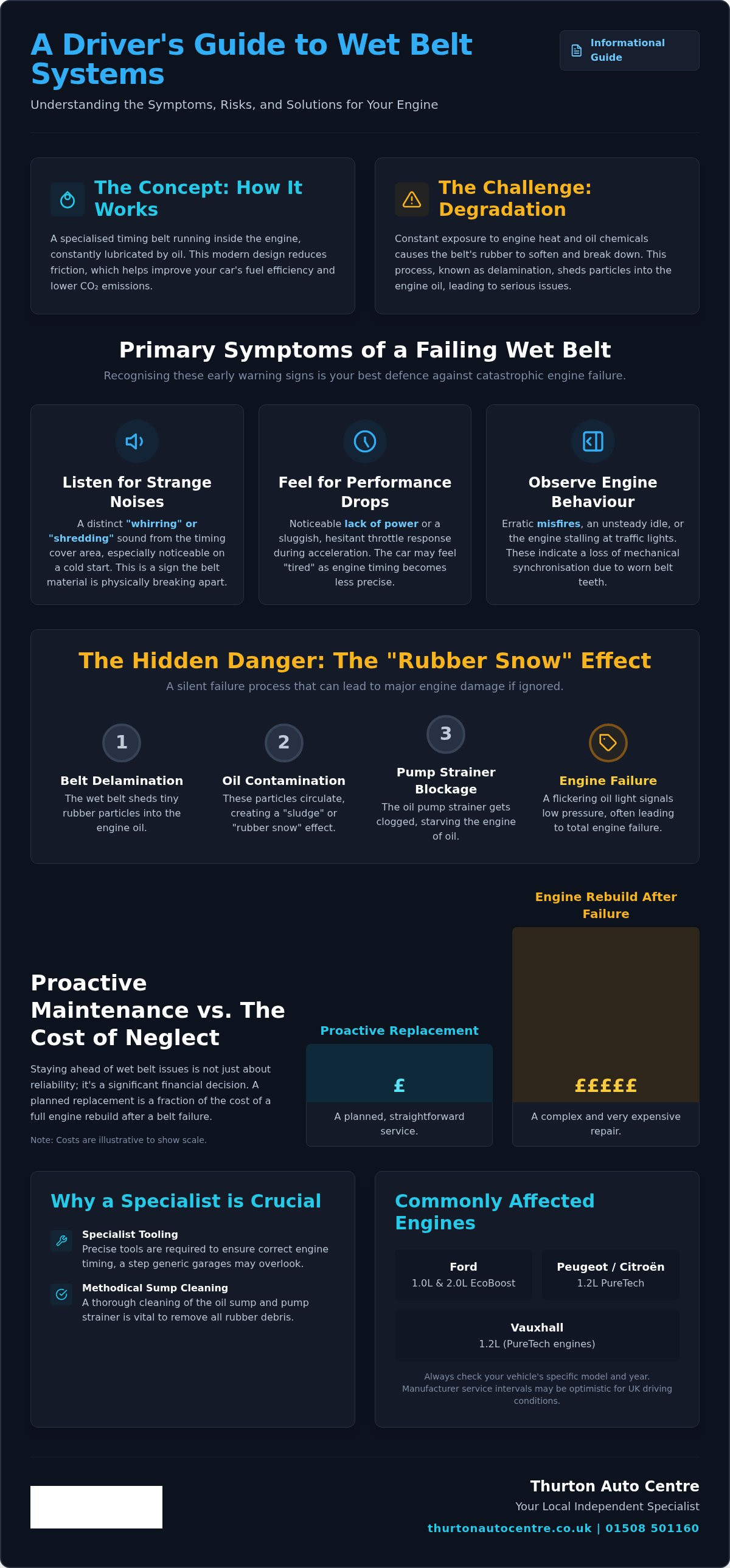
At Thurton Auto Centre, we believe that understanding your car’s technology shouldn't be complicated. Most traditional engines use a timing belt system located outside the engine, kept dry and away from oil. However, many modern vehicles now use a "wet belt" design. This is a specialised timing belt that runs directly through the engine oil. It’s a clever bit of engineering designed to reduce internal friction, which helps your car achieve better fuel efficiency and lower CO2 emissions. It’s a great idea in principle, but it does introduce a unique set of maintenance needs that we’re always happy to help you manage.
The main challenge with this system is chemical degradation. Over time, the heat of the engine and the chemicals in the oil can cause the rubber belt to soften and break down. This leads to a process called delamination, where the belt starts shedding tiny bits of rubber into your oil. The tricky part is that this is often a "silent failure." Your car might feel perfectly normal to drive whilst the belt is slowly losing its structural integrity. This is why knowing the early symptoms of a failing wet belt is so important; it’s about catching the problem before it turns into a major headache.
Which Engines Use a Wet Belt System?
You’ll mostly find this system in the popular Ford 1.0L and 2.0L EcoBoost engines, as well as the 1.2L PureTech engines used by Peugeot, Citroen, and Vauxhall. These engines are fantastic performers, but they do require a more disciplined maintenance routine than older designs. We’ve found that the original service intervals suggested by manufacturers can sometimes be a bit optimistic for the type of stop-start driving we often do here in Norfolk. Our friendly team is always on hand to help you figure out if your specific model is due for a check-up.
The Cost of Neglect vs. Proactive Maintenance
We always prefer "prevention over cure" because it saves you money and stress in the long run. A proactive wet belt change is a straightforward, planned service that keeps your car on the road. On the other hand, if a belt is neglected and eventually snaps, it usually leads to a complete engine rebuild, which can be quite a shock to the wallet. We take a methodical approach to protecting engine integrity, using our specialist knowledge to spot wear early. By staying ahead of the game, you can enjoy your car with total peace of mind, knowing the heart of your vehicle is in safe hands.
Primary Symptoms of a Failing Wet Belt: What to Listen and Look For
Whilst we’ve discussed how wet belt wear can often be a silent process, there are specific physical symptoms of a failing wet belt that eventually surface as the belt loses its integrity. We want to help you stay one step ahead of these issues. Recognising these warning signs early is the best way to keep your car running smoothly and avoid the stress of an unexpected breakdown on a busy Norfolk road.
Auditory cues are often your first red flag. A distinct "whirring" or "shredding" sound coming from the timing cover area is a common indicator that the belt is beginning to struggle. This isn't the usual hum of a healthy engine; it’s a sign that the belt's material is physically changing. You might also notice a slight lack of power or a sluggish throttle response whilst you’re accelerating. This happens because the internal timing of the engine is no longer as precise as it should be, making the car feel a bit "tired" or hesitant.
As the belt loses its rubber teeth, the engine’s internal components can fall out of sync. This often leads to erratic misfires or the car stalling whilst you’re waiting at a set of lights. If your engine struggles to maintain a steady idle, it’s a clear signal that the mechanical synchronisation is under threat. These aren't just minor quirks; they are your car’s way of asking for a professional check-up.
Identifying the 'Shredding' Sound
It can be tricky to tell the difference between a belt noise and a failing alternator or water pump. In our experience, the specific "shredding" noise of a wet belt is usually most noticeable during a cold start when the engine is first warming up. Because this sound suggests the belt is physically breaking apart, it’s something we take very seriously. We always recommend a professional vehicle diagnostics session to confirm exactly what’s going on. It’s the quickest way to get an accurate answer and protect your engine from further damage.
Misfires and Timing Slip
The technical side of your engine is incredibly precise. If even one tooth is missing from the belt, the camshaft position changes slightly, which often triggers the "Check Engine" light on your dashboard. You might find fault codes like P0011 or P0014 stored in the car's computer, which point toward timing issues. We strongly advise against ignoring a misfire in an EcoBoost or PureTech engine. It’s rarely a simple spark plug fix and is often a sign that the belt needs urgent attention. If you’re worried about a new noise or a change in how your car feels, you can easily book an inspection online and our friendly team will take a look for you.
The Hidden Danger: Oil Pressure Warnings and Sump Contamination
Whilst noise and performance loss are the most apparent symptoms of a failing wet belt, the most lethal damage occurs deep within the engine's lubrication system. As the belt material breaks down, it creates what technicians often refer to as the 'Rubber Snow' effect. Tiny particles of rubber delaminate from the belt and mix with the engine oil, eventually settling in the sump. This contamination isn't merely a nuisance; it's a structural threat to every moving part within the engine block. The accumulation of these particles creates a sludge that standard oil changes cannot fully remove.
The primary point of failure in this process is the oil pump strainer. This fine mesh component is designed to catch debris before it enters the engine's vital galleries, but it quickly becomes overwhelmed by the sheer volume of rubber fibres. Once the strainer is blocked, the oil pump can no longer pull sufficient lubricant from the sump. This leads to immediate oil starvation. Lubrication. Cooling. Protection. All three essential functions vanish the moment the flow is restricted, putting the entire engine at risk of seizure.
The Oil Pressure Light: A Final Warning
The appearance of the oil pressure light on your dashboard is a critical emergency that requires you to stop the vehicle immediately. Often, you might notice a subtle flicker of the warning light at low RPM or once the engine has reached its full operating temperature. This occurs because warm oil is thinner, making it significantly harder for the pump to pull it through a clogged strainer. A methodical expert knows that this isn't a sensor glitch or a minor electrical fault. You must never simply 'top up' the oil to solve this issue, as the underlying mechanical blockage remains. Oil pressure failure is usually the result of a blocked pickup pipe.
Secondary Component Failure
Before the main engine bearings seize, secondary components often fail due to their extreme sensitivity to oil pressure drops. The turbocharger is frequently the first victim of this process. Its internal bearings spin at incredibly high speeds and require a constant, high-pressure film of oil; without it, the unit will overheat and fail within seconds. Similarly, the vacuum pump can seize, leading to a sudden and dangerous loss of brake assistance. Our clinical diagnostic process involves a physical inspection of the oil filter for rubber particles. This provides the evidence-based proof needed to confirm that the belt is the root cause of the pressure loss.
Assessing the Risk: When to Seek a Professional Wet Belt Inspection
Assessing your vehicle's risk involves more than just waiting for the symptoms of a failing wet belt to manifest. It requires a disciplined review of your service history and a realistic understanding of the environmental stressors unique to East Anglian driving. Whilst many drivers rely on the original manufacturer handbooks, those documents often fail to account for the accelerated degradation caused by real-world conditions. Proactive vigilance is the only way to ensure your engine remains within safe operational parameters.
The 2026 Reality of Service Intervals
By August 2026, the automotive industry has reached a clear consensus: the original 10-year or 150,000-mile service claims were dangerously optimistic. Recent data indicates that 98% of failures occur well before these milestones. For Ford 1.0L EcoBoost engines, the recommended interval has been officially reduced to 6 years or 100,000 miles. Stellantis has followed suit for the 1.2L PureTech engine, advising replacement at 6 years or 62,000 miles. Additionally, the use of incorrect oil grades remains a primary cause of premature belt failure. Strict adherence to mandatory specifications, such as the FPW9.55535/03 (5W-30) for PureTech units, is essential for maintaining the chemical integrity of the rubber belt.
Professional Inspection vs. Visual Guesswork
A common misconception amongst Norfolk drivers is that a visual check through the oil filler cap provides a complete picture of engine health. In reality, this only reveals approximately 10% of the belt's surface. A belt can appear structurally sound from the top whilst the teeth on the underside are already delaminating or "shredding" into the oil supply. Our diagnostic process utilizes a specialised "Go/No-Go" gauge to measure belt width. As the belt absorbs oil, it expands; if the belt has swollen beyond the gauge's tolerances, it is a definitive sign of saturation and imminent failure. However, the only way to truly guarantee engine safety is through a methodical "Sump Drop" diagnostic. This allows us to physically inspect the oil pump strainer for the debris that a simple visual check would miss.
Environmental factors also play a critical role in belt longevity. Short journeys prevent the engine oil from reaching temperatures high enough to evaporate fuel contaminants. This leads to fuel dilution, which significantly accelerates the softening of the belt material. If your daily driving involves frequent stop-start cycles in Norwich or local commutes across Norfolk, your vehicle is at a higher risk of premature wear. Taking a "prevention over cure" approach is the most cost-effective way to avoid a catastrophic repair bill.
Professional Wet Belt Replacement at Thurton Auto Centre
Successfully identifying the symptoms of a failing wet belt is only the first step toward securing your vehicle's future. The actual replacement is a complex, high-precision operation. It requires a level of technical mastery far beyond the scope of a standard service. At Thurton Auto Centre, we don't just change a part. We restore the structural integrity of your engine through a disciplined, multi-stage methodology. Generalist garages often lack the specific manufacturer-grade tooling and the rigorous cleaning processes required to ensure these engines run reliably for thousands of more miles.
Our approach is built on accountability and evidence. We understand that for drivers in Loddon, Poringland, Beccles, and Norwich, reliability isn't optional. It's a necessity. This is why our 'Fit for Purpose' Promise underpins every repair. We ensure your car leaves our facility meeting the highest professional standards, providing an emotional sense of security that generic providers simply cannot match. Disciplined. Transparent. Sophisticated. This is the specialist alternative your vehicle deserves.
Our Process-Driven Methodology
We follow a clinical, step-by-step process to ensure total system decontamination. Our technicians never take shortcuts because we know that even a small amount of residual debris can lead to future oil starvation. The process includes:
- Step 1: We perform a deep diagnostic check followed by a comprehensive oil system flush to remove loose rubber debris from the engine's internal galleries.
- Step 2: Our specialists set the engine's internal timing with absolute precision using manufacturer-grade tools, ensuring the camshaft and crankshaft are perfectly synchronised.
- Step 3: We verify the oil pressure under load and conduct a final system test to guarantee the engine's long-term health and performance.
This systematic approach includes the mandatory removal of the engine sump and the thorough cleaning of the oil pump strainer. This is a critical step often overlooked by less methodical operations, yet it's the only way to ensure the "Rubber Snow" effect doesn't return to haunt your engine later.
Book Your Specialist Service Today
Choosing an independent, family-run specialist offers the perfect balance of technical expertise and approachable service. We provide the transparency you need to make informed decisions about your vehicle's maintenance. If you're concerned about engine noise or performance, don't leave it to chance. You can access our online booking system to secure an appointment with our specialist team. For detailed technical enquiries or to discuss your specific vehicle requirements, please contact our office line on 01508501160. Peace of mind is just a phone call away.
Secure Your Engine’s Future with Expert Care
Protecting your vehicle from catastrophic failure requires more than just following outdated manufacturer handbooks. It demands a systematic, evidence-based approach to maintenance. By identifying the physical symptoms of a failing wet belt early, you can choose a controlled preventative repair over the financial shock of a total engine rebuild. Whether you've noticed a subtle whirring noise or a flickering oil light, immediate technical intervention is essential for your peace of mind.
As a specialist wet belt replacement centre serving Norfolk and Suffolk, we provide the technical mastery and disciplined methodology your car requires. Disciplined. Transparent. Precise. Our family-run team prioritises clarity and technical competence, ensuring your engine remains reliable for the roads ahead. If you have any concerns about your Ford EcoBoost or PSA PureTech engine, our experts are available on 01508501160 to provide direct, professional support.
Taking action today ensures that your vehicle remains a safe and reliable investment for years to come.
Frequently Asked Questions
Which car engines are most affected by wet belt failure?
The Ford 1.0L and 2.0L EcoBoost units and the 1.2L PureTech engine found in Peugeot, Citroen, and Vauxhall models are the most commonly affected. These designs rely on a rubber belt running through the oil, which makes them vulnerable to chemical degradation. Whilst other manufacturers use similar technology, these specific units are the primary focus for specialist technicians due to their high failure rates in real-world driving conditions across the United Kingdom.
Can I drive my car if the oil pressure light flickers?
No, you should stop driving immediately if your oil pressure light flickers or remains illuminated. This is a critical mechanical emergency indicating that your engine is suffering from oil starvation. Because the primary symptoms of a failing wet belt include a blocked oil pickup pipe, continuing to drive will cause the engine to seize within seconds. Secure your vehicle in a safe location and seek professional recovery to prevent total, irreversible engine loss.
How much does a wet belt replacement typically cost in Norfolk?
The cost of a wet belt replacement is determined by the specific engine configuration and the labour hours required for a methodical cleaning of the lubrication system. This is a complex, multi-stage procedure that involves removing the sump and clearing the oil pump strainer. Because every vehicle's condition is different, we provide tailored, evidence-based quotes. Contacting our team directly ensures you receive accurate pricing based on your vehicle's unique service history and technical requirements.
What is the difference between a cambelt and a wet belt?
A traditional cambelt operates in a dry environment outside the engine block, whilst a wet belt is immersed in engine oil. Both components synchronise the crankshaft and camshaft, but the wet belt design aims to reduce friction and improve fuel efficiency. However, the wet belt's constant exposure to oil means it requires specific chemical properties in the lubricant. This prevents the rubber from softening and eventually disintegrating, which is the root cause of failure.
Is it possible to see the wet belt without taking the engine apart?
It is only possible to see a small fraction of the belt through the oil filler cap, which represents about 10% of its surface area. This limited view is often misleading. The belt may appear healthy from the top whilst the teeth on the underside are already failing. A professional diagnostic involves measuring the belt width with a specialised gauge. This systematic approach identifies swelling that a simple visual check would miss entirely.
What happens if my wet belt snaps whilst driving?
If the belt snaps whilst you are driving, the internal synchronisation of your engine is lost instantly. The pistons will collide with the valves, causing catastrophic internal damage. This typically results in a complete engine failure that requires a full replacement, often costing upwards of £4,000. Identifying the symptoms of a failing wet belt before this happens is the only way to avoid such a significant and stressful repair bill.
Does regular oil changing prevent wet belt failure?
Regular oil changes are helpful, but they don't guarantee prevention against belt failure. The specific grade and quality of the lubricant are far more critical than the frequency of the changes. Using an incorrect oil can accelerate the chemical breakdown of the rubber material. To maintain engine integrity, you must use the exact manufacturer-specified oil and adhere to the updated service intervals that prioritise safety over the original, often optimistic, handbook claims.
Why does a failing wet belt affect my car's brakes?
A failing wet belt affects your brakes because the vacuum pump, which provides braking assistance, relies on a constant oil supply. When rubber debris from a disintegrating belt blocks the internal oil galleries, the vacuum pump can seize. This leads to a sudden loss of power-assisted braking. The brake pedal will feel exceptionally hard to press; this significantly increases your stopping distance and creates a dangerous situation for you and other Norfolk road users.
Disclaimer
Terms and Conditions
Who we are and how to contact us
https://wwwthurtonautocentre.co.uk is a site operated by Thurton Auto centre. We are a limited company registered in England and Wales under company number 15780586 and have our registered office at The Garage, Norwich Road, Thurton, Norwich, Norfolk, NR14 6AW. Our main trading address is The Garage, Norwich Road, Thurton, Norwich, Norfolk, NR14 6AW.
To contact us, please email info@thurtonautocentre.co.uk or telephone our customer service line on01508 501160or write to us at The Garage, Norwich Road, Thurton, Norwich, Norfolk, NR14 6AW
Information on this site
The content on our site is provided for general information only. It is not intended to amount to advice on which you should rely. You must obtain professional or specialist advice before taking, or refraining from, any action on the basis of the content on our site.
Although we make reasonable efforts to update the information on our site, we make no representations, warranties or guarantees, whether express or implied, that the content on our site is accurate, complete or up to date.
Any descriptions or illustrations on our site are for illustrative purposes only, and are published for the sole purpose of giving an approximate idea of the vehicles described in them. They will not form part of any contract or have any contractual force. We have made every effort to display the colours accurately, but we cannot guarantee that a device's display of the colours accurately reflects the colour of the vehicles.
We reserve the right to amend the specification of any vehicle described on this site if required to do so by any applicable statutory or regulatory requirement, to implement minor technical adjustments and improvements, or if the amendment will not materially affect its nature or quality.
Our site is only for users in the UK
Our site is directed to people residing in the United Kingdom. We do not represent that content available on or through our site is appropriate for use or available in other locations. You may use this site to reserve a vehicle or test drive from an address outside the United Kingdom, but we do not deliver vehicles outside the United Kingdom, and any test drives must take place at the address in the United Kingdom which we specify.
Events outside our control
We will not be liable or responsible for any failure to perform, or delay in performance of, any of our obligations under the Contract that is caused by any act or event beyond our reasonable control (Event Outside Our Control).
If an Event Outside Our Control takes place that affects the performance of our obligations under the Contract, we will contact you as soon as possible to let you know and we will take steps to minimise the effect of the delay. We will arrange a new date for the test drive after the Event Outside Our Control is over. Provided we do this we will not be liable for delays caused by the event, but if the Event Outside Our Control has continued, or seems likely to continue, for more than 30 days, you may contact us to cancel the Order and receive a refund of any reservation or booking fee you have paid.
How you may use material on our site
We are the owner or the licensee of all intellectual property rights in our site, and in the material published on it. Those works are protected by copyright laws and treaties around the world. All such rights are reserved.
You may print off one copy, and may download extracts, of any page(s) from our site for your personal use and you may draw the attention of others within your organisation to content posted on our site.
You must not modify the paper or digital copies of any materials you have printed off or downloaded in any way, and you must not use any illustrations, photographs, video or audio sequences or any graphics separately from any accompanying text.
Our status (and that of any identified contributors) as the authors of content on our site must always be acknowledged.
You must not use any part of the content on our site for commercial purposes without obtaining a licence to do so from us or our licensors.
You print off, copy or download any part of our site in breach of these terms of use, your right to use our site will cease immediately and you must, at our option, return or destroy any copies of the materials you have made.
We are not responsible for websites we link to
Where our site contains links to other sites and resources provided by third parties, these links are provided for your information only. Such links should not be interpreted as approval by us of those linked websites or information you may obtain from them.
We have no control over the contents of those sites or resources.
Our responsibility for loss or damage suffered by you
Whether you are a consumer or a business user:
We do not exclude or limit in any way our liability to you where it would be unlawful to do so. This includes liability for death or personal injury c