
A failed MOT isn’t automatically a verdict on the whole car, but it does mean you need to understand the defects before deciding what to do next. If you’re asking, “what happens if my car fails its MOT”, the answer depends on the defect category and whether your previous MOT certificate is still valid.
It’s understandable to feel unsure when the test report lists faults and you’re wondering whether your car is safe or legal to drive. Start by reading the result carefully: a dangerous defect has different consequences from a major defect, and the right next step depends on what the tester recorded.
This guide explains how to interpret your result, when you may be able to drive, and how to plan repairs and a retest. A safety-led approach helps you move from the test result to a clear next step.
Key Takeaways
- If you’re wondering what happens if my car fails its MOT, check the result and the defects recorded rather than treating the failure as a verdict on the whole vehicle.
- Understand the difference between major, dangerous and minor findings before deciding what to do next.
- Whether you can drive depends on the defects and your current MOT status. Establish the safe and legal option before moving the car.
- Use the report to plan your next steps: review the findings, arrange the relevant repairs and organise a retest.
- Thurton Auto Centre carries out Class 4, 5 and 7 MOT testing and vehicle repairs. Its full-service MOT includes a free retest.
Table of Contents
What happens when your car fails its MOT?
The test result records whether your vehicle passed or failed. A failure means one or more defects found during the test fall into the major or dangerous categories. It identifies specific issues that need attention, not a blanket judgement on every part of the car. To understand what happens if my car fails its MOT, start with the defects listed on the report.
An MOT failure means one or more major or dangerous defects have prevented the vehicle from meeting the required test standard. The report records the tester’s findings, but it may not explain the underlying cause or set out every repair needed. Further inspection may be necessary to identify the right fix.
What information does an MOT failure report give you?
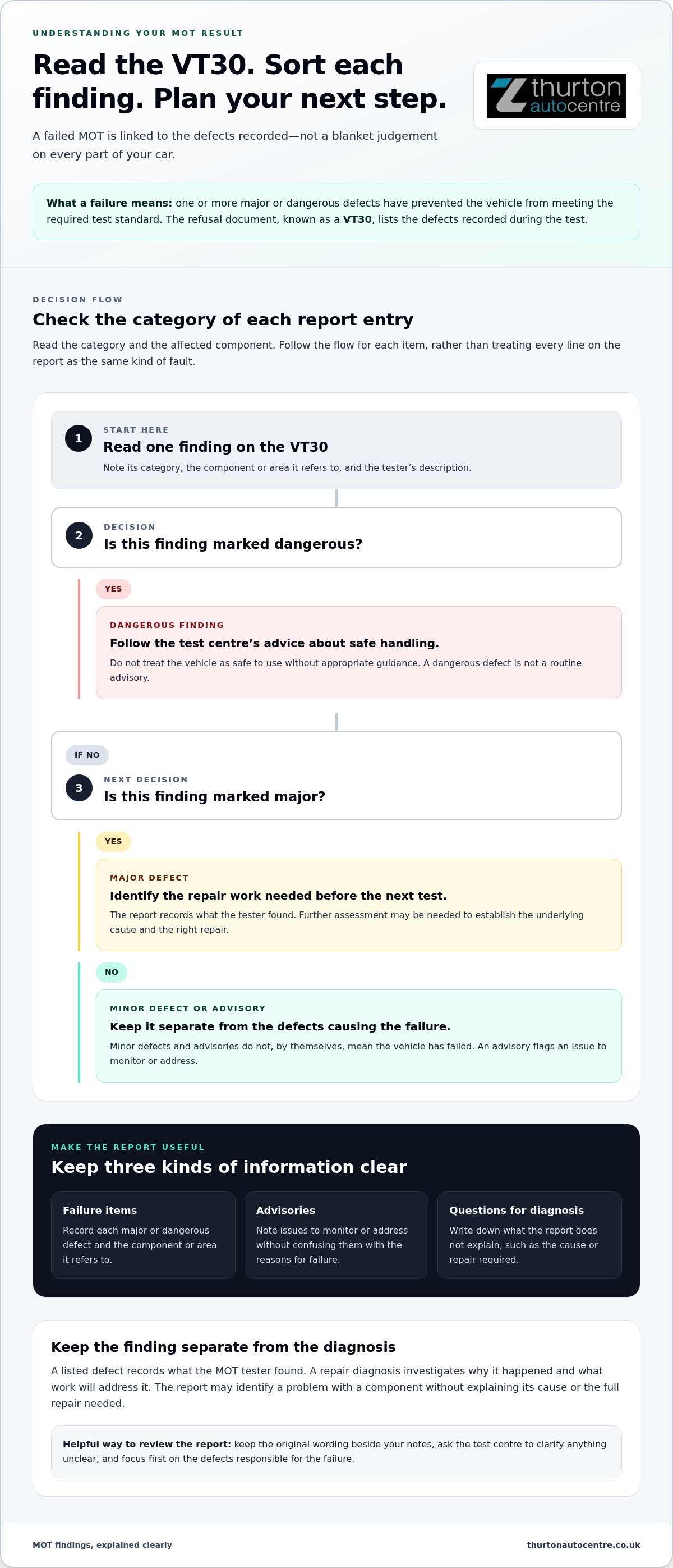
After a failure, you receive a refusal document, known as a VT30, listing the defects recorded during the test. Keep it and read each item carefully, including its category and any description of the affected component. The details give you a more useful picture than the word “fail” alone. The report records what the tester identified, but it isn’t necessarily a full diagnosis of why the fault occurred.
For example, a report may identify a problem with a component without explaining what caused it or whether another part is contributing. Use each entry as a specific finding to consider during the repair assessment, rather than assuming the wording describes the full repair. Thurton Auto Centre carries out a Class 4 MOT test.
Is a minor or advisory item the same as a failure?
No. Major and dangerous defects result in an MOT failure; minor defects and advisories are recorded differently and don’t, by themselves, mean the vehicle has failed. An advisory flags an issue to monitor or address, even though it hasn’t caused a failure in that test. Read advisories alongside the fail items so you can distinguish the findings responsible for the failure from other points to keep in mind.
The categories help you interpret the result, but they aren’t a complete repair plan. A major defect may need further assessment to determine the cause and the correct fix. A dangerous defect is a serious finding, so don’t treat it as a routine advisory or assume the car is safe to continue using. The report records the test outcome; it doesn’t give permission to drive.
For a practical first review, separate the information into three groups:
- Failure items: note every major or dangerous defect and the component or area it refers to.
- Advisories: record issues flagged for monitoring or attention, without confusing them with the reasons for the failure.
- Questions for diagnosis: note anything the report doesn’t explain, such as the underlying cause or the repair required.
This makes it easier to discuss the findings and decide what needs to happen next. Focus first on the defects responsible for the failure, then consider advisories separately as part of maintaining the vehicle.
How to understand the defects listed on your MOT result
Use the report as a working document, not just a pass-or-fail summary. Read each defect individually and note its category, the part of the vehicle it refers to and any description of the issue. If the wording is unclear, ask the centre that carried out the test to explain what the tester observed. Understanding the finding helps you decide what needs attention before planning repairs.
A listed defect records what the MOT tester found, while a repair diagnosis investigates why it happened and what work will address it. The two are related, but they aren’t always identical. The report may identify a problem with a component, for example, while further assessment is needed to establish its cause or the repair required. Keep your attention on the specific findings and the questions they raise about the work needed.
To make the information easier to act on, group the entries by priority and write down anything that needs clarification. A short description may not capture every factor behind a fault. A focused discussion of the recorded item can help distinguish the test finding from any additional diagnostic work.
How should you prioritise items on the report?
Start with any dangerous finding and follow the test centre’s advice about safe handling. Treat major defects as repair priorities before arranging the vehicle’s next test. Keep advisories visible as maintenance prompts, but don’t label them as failures. This helps you distinguish urgent safety concerns from faults to resolve for a retest and issues to monitor over time.
A simple written list can keep the next steps organised:
- Dangerous findings: record the advice given and don’t treat the vehicle as safe to use without appropriate guidance.
- Major defects: identify the repair work needed before the next test.
- Advisories: note items for monitoring or future maintenance separately from the defects that caused the failure.
If the report contains several entries, keep the original wording beside your notes rather than reducing everything to “needs work”. This makes it easier to discuss each item accurately and avoid overlooking a separate defect.
What if you think the MOT result is wrong?
If you disagree with a finding, raise the specific item with the centre that carried out the test and explain your concern. Keep the refusal document and relevant evidence, such as notes or photographs, together while the issue is reviewed. An appeal route exists, but no particular outcome can be promised. Read the appeal process before taking further action, and avoid changes that could affect the evidence until you understand your options.
Once the findings are clear, you can plan repairs and the next test with better information. You can use our online booking system to arrange a visit.
Can you drive your car after it fails its MOT?
There isn’t one answer for every failed MOT. Whether you can drive depends on the defects recorded and whether your previous MOT certificate is still valid. If you’re asking what happens if my car fails its MOT, check both before moving the vehicle. A failure alone doesn’t tell you whether it’s safe or legal to drive.
A dangerous defect is a clear stop signal: the vehicle must not be driven on a public road until the problem has been repaired and it has passed a retest. An existing certificate doesn’t make a car with a dangerous defect safe to use. If the report lists major defects only, the position may differ if the previous certificate remains valid, but you must still consider whether the vehicle is roadworthy. A valid certificate isn’t proof that a vehicle with a newly identified fault is safe.
Why does the type of defect matter?
Defect categories reflect the seriousness of the test findings. A dangerous defect means an immediate safety risk; a major defect is serious enough to fail the test. The category, certificate status and vehicle’s condition all matter, so two cars that both fail may have different circumstances. If you’re unsure how a recorded defect affects safe use, follow the test centre’s advice and refer to current official guidance before deciding.
For example, a car that fails with a dangerous defect must not be driven on a public road, even if its old MOT certificate has time remaining. If the failure is for major defects and the previous certificate is still valid, driving may be permitted, but that isn’t blanket permission to use the car as normal. If the certificate has expired, don’t assume you can drive simply because you’re taking the vehicle for repair or another test. Specific rules and exceptions depend on the circumstances.
What should you do before moving the car?
Pause and verify the details. Check the result, the date and status of your current MOT, and whether the report records any dangerous defect. Consider the vehicle’s condition alongside the test centre’s guidance. If anything is unclear or you’re not confident the car is safe, keep it off the road until you have a clear next step.
- Read the result: identify whether the report records a dangerous defect or major defects.
- Check MOT status: confirm whether the previous certificate is still valid. Don’t rely on memory or assume the failure itself answers this.
- Get clear advice: resolve any uncertainty before moving the vehicle.
- Choose a safe next step: if you’re unsure, don’t drive it; arrange an appropriate way to deal with the repairs or retest.
These checks are a practical starting point, not a substitute for applying the rules to your exact circumstances. Refer to current official MOT guidance as well as the test centre’s advice, particularly if your MOT has expired or the report identifies a safety-critical fault.
What should you do after an MOT failure?
A clear sequence helps turn the test result into a repair and retest plan. Start with the recorded findings, then establish whether the car can be moved safely and legally. The work required depends on the defect: some issues may be clear from the report, while others need further diagnosis before the right repair can be identified.
- Review the findings. Go through each failure item and note the affected component and defect category. Keep advisories separate so you can focus first on the issues that caused the failure.
- Establish safe handling. Check the vehicle’s MOT status and whether a dangerous defect is recorded. If you’re unsure whether it can be driven, keep it off the road and follow the test centre’s guidance.
- Arrange appropriate repairs. Use the report to identify the work required, but don’t assume it explains every underlying cause. Further inspection or diagnostics may be needed before the repair is agreed.
- Organise the retest. Confirm the retest process with the centre handling the vehicle, including what needs to be completed and how the vehicle should be presented.
How do you move from the test report to repairs?
Match each proposed repair to a recorded defect, and ask for an explanation if the link between them isn’t clear. Further assessment can help establish whether an underlying fault is contributing to the test finding. Not every failure follows the same repair route: a straightforward component issue differs from structural damage that needs specialist work. Thurton Auto Centre carries out welding and fabrication for MOT-failure repairs.
Before work begins, make sure you understand which defects the repair is intended to address and whether additional investigation is needed. This keeps the repair plan tied to the test findings, rather than treating a failure as a reason to repair or replace parts without an identified need.
What happens when you arrange a retest?
Retest arrangements depend on the vehicle and how the repair has been handled. Confirm what needs to be ready and how the vehicle should be returned; don’t assume the same arrangements or timing apply in every case. Thurton Auto Centre carries out Class 4, 5 and 7 MOT testing, and its full-service MOT includes a free retest.
Once the repairs are complete and the retest arrangements are clear, you can move forward with a more informed plan. Keep the test result and repair information together so the issues identified and work carried out are easy to refer to.
How Thurton Auto Centre can help after a failed MOT
If you’re considering what happens if my car fails its MOT, having a local centre that can carry out testing and vehicle repairs can help you take the next step with a clearer plan. Thurton Auto Centre is based in Thurton, Norfolk, and serves customers across Norfolk and Suffolk. The team carries out Class 4, 5 and 7 MOT testing alongside vehicle repairs.
The test result identifies the issues to address, but the repair needed depends on the defect and whether further diagnosis is required. Keep the report to hand when arranging a visit. It provides a practical reference for connecting the recorded findings with the work needed before the vehicle is presented for another test.
Which MOT service is relevant to your vehicle?
Thurton Auto Centre carries out Class 4, 5 and 7 MOT testing. The applicable class depends on the vehicle, so use your vehicle details when arranging a test rather than assuming a category from its appearance or use. The centre carries out MOT testing and repairs in Thurton.
If you’re arranging a test after repairs, keep the failure report available so the findings remain clear as you plan the visit. Thurton Auto Centre also carries out vehicle repairs. The appropriate work depends on the defect and any assessment needed, so the plan can focus on your vehicle’s recorded issues rather than assuming every MOT failure needs the same solution.
How can you arrange your next visit?
When you’re ready to arrange an MOT or relevant repair, use the online booking option. Thurton Auto Centre’s full-service MOT includes a free retest. Before a retest, make sure the arrangements are clear and the required repair work has been addressed.
A failed result can feel uncertain, but a measured process helps: understand the recorded findings, address the relevant repairs, then arrange the appropriate test. From Thurton, the centre serves motorists across Norfolk and Suffolk, including Norwich, Great Yarmouth, Diss, Dereham, Loddon, Poringland, Beccles, Bungay, Lowestoft, Acle, Blofield, Wymondham and Framlingham.
Take the next step with confidence
Understanding what happens if my car fails its MOT can turn an unsettling result into a manageable decision. Keep the report and repair information together so you have a clear record as work is arranged and the vehicle moves towards its next test. If anything remains unclear, get a straightforward explanation before deciding how to proceed.
You don’t need to resolve every question at once. Focus on making the next decision safely and with the right information in front of you. When you’re ready, Thurton Auto Centre’s online booking option lets you arrange your next visit.
Frequently Asked Questions
What is a VT30 refusal of an MOT test certificate?
A VT30 is the document issued when a vehicle fails its MOT. It records the test outcome and the defects responsible for the refusal, including their categories. Keep it with your vehicle records and refer to the specific findings when discussing repairs or a retest. It documents the test result, but further inspection may be needed to identify the precise cause of a fault.
Will an MOT failure appear in the vehicle's online MOT history?
Yes. The MOT outcome, including a failure, is recorded in the vehicle’s online MOT history. You can use the government’s MOT history service to check the result and review the defects noted for that test. This is useful if you’ve misplaced the paperwork or need to refer to the recorded findings when arranging repairs. Check the vehicle registration carefully to make sure you’re viewing the correct record.
Can a car pass its MOT with advisories?
Yes. A car can pass with advisories, as an advisory is not itself a failure item. It flags something the tester recommends monitoring or addressing, even though it hasn’t prevented a pass. An advisory may alert you to a component that could need attention in future. Keep a note of advisories and consider them when planning maintenance, rather than waiting for the next MOT to review them.
Can I have MOT failure repairs carried out at a different garage?
Yes, you can arrange repairs at a different garage. Before moving the vehicle, check that it’s safe and legal to drive in your circumstances, particularly if the report includes a dangerous defect. Establish how the retest will be arranged, as the process can depend on which test centre carries it out and how the vehicle is returned. Keep the VT30 available so the repairer can refer to the recorded faults.
How soon do I need to arrange an MOT retest?
Arrange repairs and a retest promptly, and consider when your existing MOT expires. Retest arrangements and any charge depend on where repairs are done and when the vehicle is returned. Under the stated MOT retest rules, a free partial retest is available in certain circumstances when the vehicle is left at the test centre and retested within 10 working days. The process depends on the circumstances of your test.
Does a failed MOT mean my car needs extensive repairs?
No. A failure doesn’t automatically mean the vehicle needs extensive work. The repair required depends on the specific defects recorded and whether further assessment reveals an underlying cause. Understanding what happens if my car fails its MOT starts with checking each item, rather than assuming the whole car needs attention. Ask for a clear explanation of the proposed work and how it relates to the test findings before proceeding.
Is the MOT retest free after a failure?
Not in every situation. Whether a retest is free depends on the arrangements and circumstances, so don’t assume this applies to every test or booking. Thurton Auto Centre’s full-service MOT includes a free retest. If you’re arranging a retest after another type of booking, establish the relevant process for that test.
Disclaimer
Terms and Conditions
Who we are and how to contact us
https://wwwthurtonautocentre.co.uk is a site operated by Thurton Auto centre. We are a limited company registered in England and Wales under company number 15780586 and have our registered office at The Garage, Norwich Road, Thurton, Norwich, Norfolk, NR14 6AW. Our main trading address is The Garage, Norwich Road, Thurton, Norwich, Norfolk, NR14 6AW.
To contact us, please email info@thurtonautocentre.co.uk or telephone our customer service line on01508 501160or write to us at The Garage, Norwich Road, Thurton, Norwich, Norfolk, NR14 6AW
Information on this site
The content on our site is provided for general information only. It is not intended to amount to advice on which you should rely. You must obtain professional or specialist advice before taking, or refraining from, any action on the basis of the content on our site.
Although we make reasonable efforts to update the information on our site, we make no representations, warranties or guarantees, whether express or implied, that the content on our site is accurate, complete or up to date.
Any descriptions or illustrations on our site are for illustrative purposes only, and are published for the sole purpose of giving an approximate idea of the vehicles described in them. They will not form part of any contract or have any contractual force. We have made every effort to display the colours accurately, but we cannot guarantee that a device's display of the colours accurately reflects the colour of the vehicles.
We reserve the right to amend the specification of any vehicle described on this site if required to do so by any applicable statutory or regulatory requirement, to implement minor technical adjustments and improvements, or if the amendment will not materially affect its nature or quality.
Our site is only for users in the UK
Our site is directed to people residing in the United Kingdom. We do not represent that content available on or through our site is appropriate for use or available in other locations. You may use this site to reserve a vehicle or test drive from an address outside the United Kingdom, but we do not deliver vehicles outside the United Kingdom, and any test drives must take place at the address in the United Kingdom which we specify.
Events outside our control
We will not be liable or responsible for any failure to perform, or delay in performance of, any of our obligations under the Contract that is caused by any act or event beyond our reasonable control (Event Outside Our Control).
If an Event Outside Our Control takes place that affects the performance of our obligations under the Contract, we will contact you as soon as possible to let you know and we will take steps to minimise the effect of the delay. We will arrange a new date for the test drive after the Event Outside Our Control is over. Provided we do this we will not be liable for delays caused by the event, but if the Event Outside Our Control has continued, or seems likely to continue, for more than 30 days, you may contact us to cancel the Order and receive a refund of any reservation or booking fee you have paid.
How you may use material on our site
We are the owner or the licensee of all intellectual property rights in our site, and in the material published on it. Those works are protected by copyright laws and treaties around the world. All such rights are reserved.
You may print off one copy, and may download extracts, of any page(s) from our site for your personal use and you may draw the attention of others within your organisation to content posted on our site.
You must not modify the paper or digital copies of any materials you have printed off or downloaded in any way, and you must not use any illustrations, photographs, video or audio sequences or any graphics separately from any accompanying text.
Our status (and that of any identified contributors) as the authors of content on our site must always be acknowledged.
You must not use any part of the content on our site for commercial purposes without obtaining a licence to do so from us or our licensors.
You print off, copy or download any part of our site in breach of these terms of use, your right to use our site will cease immediately and you must, at our option, return or destroy any copies of the materials you have made.
We are not responsible for websites we link to
Where our site contains links to other sites and resources provided by third parties, these links are provided for your information only. Such links should not be interpreted as approval by us of those linked websites or information you may obtain from them.
We have no control over the contents of those sites or resources.
Our responsibility for loss or damage suffered by you
Whether you are a consumer or a business user:
We do not exclude or limit in any way our liability to you where it would be unlawful to do so. This includes liability for death or personal injury c