
Could one dashboard warning mean anything from a minor fault to a problem that calls for you to stop? If you’re wondering why is my engine management light on, the light alone can’t tell you exactly what’s wrong or whether a specific part has failed. It signals that the vehicle’s system has detected an issue that needs attention.
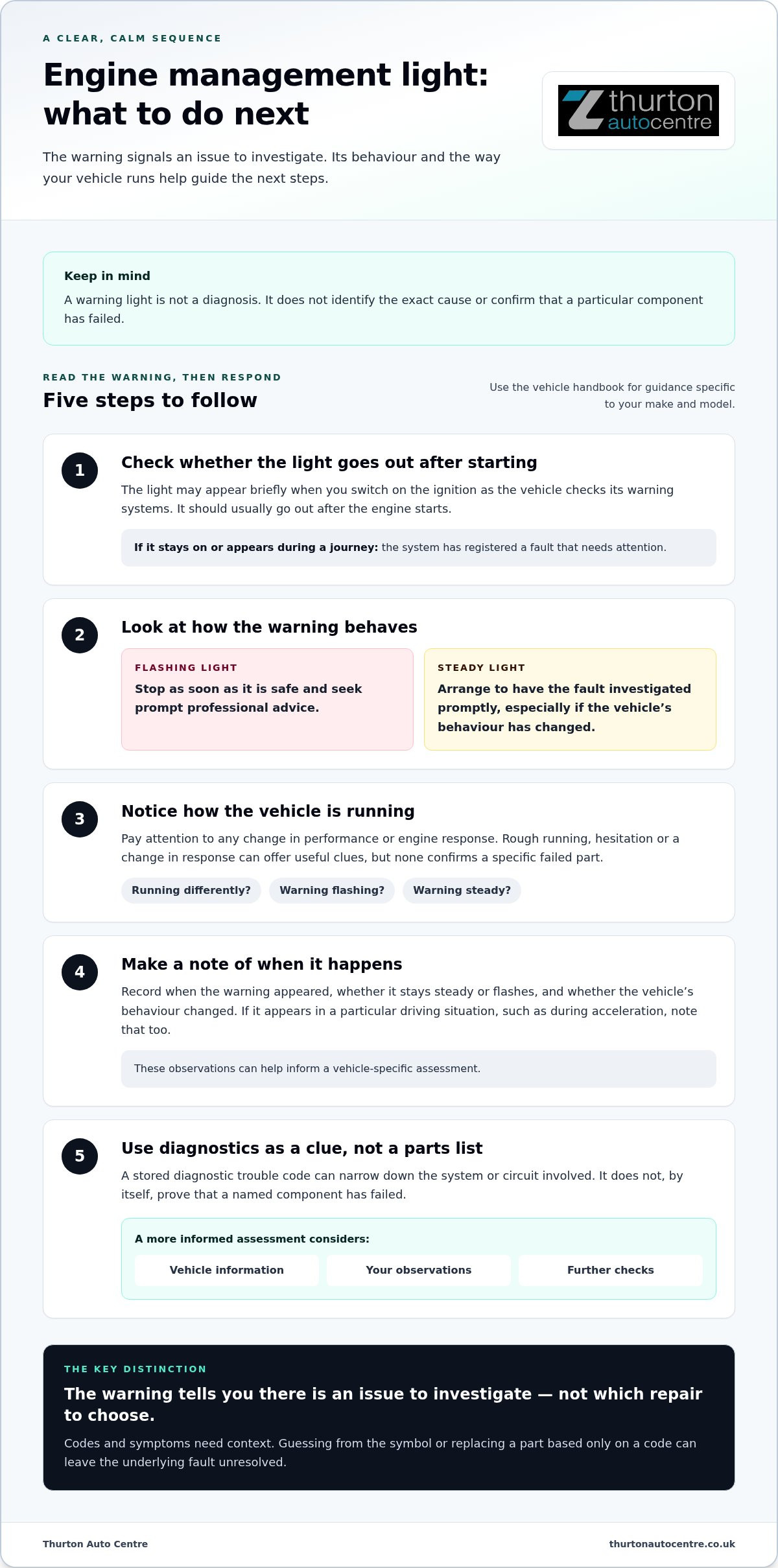
It’s understandable to feel unsure about driving on. A steady light and a flashing light can indicate different levels of urgency. If the light is flashing, stop as soon as it’s safe and seek prompt professional advice. If it’s steady, arrange to have the fault investigated promptly, especially if the vehicle’s behaviour has changed.
This guide explains what the warning can and can’t tell you, common reasons it may appear, and which symptoms warrant prompt action. You’ll also learn how diagnostic fault codes provide clues, and why investigating the underlying cause is more useful than relying on guesswork.
Key Takeaways
- Understanding why is my engine management light on starts with recognising that it signals a detected issue, not a confirmed cause.
- Possible causes can involve ignition, sensors, emissions control or the fuel system. Examples alone can’t identify your vehicle’s fault.
- Use the light’s behaviour and any changes in how the car runs to judge urgency, and follow your vehicle handbook.
- Note when the warning appears and whether it stays steady or flashes. These observations can help inform an assessment.
- Vehicle diagnostics at Thurton Auto Centre can help investigate the warning by interpreting vehicle information alongside your reported symptoms.
Table of Contents
- Why is my engine management light on, and what does it mean?
- What can cause an engine management light to come on?
- Is it safe to drive with the engine management light on?
- What should you do when the engine management light appears?
- How can vehicle diagnostics help identify the cause at Thurton Auto Centre?
Why is my engine management light on, and what does it mean?
A dashboard warning can be unsettling, particularly when the car seems to be running normally. If you’re asking, “why is my engine management light on?”, the key point is that the vehicle’s control system has detected an issue. The warning doesn’t identify the exact cause or confirm that a particular component has failed.
The light may come on briefly when you switch on the ignition as the vehicle checks its warning systems. It should usually go out after the engine starts. If it stays illuminated or comes on during a journey, the system has registered a fault that needs attention. How urgently to act depends on the light’s behaviour and how the vehicle is running.
What does the engine management warning light look like?
It’s commonly an engine-shaped symbol on the dashboard, often amber or orange, and is usually called the engine management light (EML). Some vehicles use a different display or wording, and the symbol’s appearance can vary by make and model. If you’re unsure whether you’ve spotted the EML or another warning, consult your vehicle handbook for the precise symbol and its explanation.
What is the difference between a warning light and a diagnosis?
A warning light signals a problem to investigate, not a confirmed component failure. It alerts you that the vehicle has detected an issue, but it can’t name the root cause. A stored diagnostic trouble code can narrow down the system or circuit involved. It’s a clue for investigation, not a definitive instruction to replace a part.
For example, a code relating to an oxygen sensor circuit doesn’t necessarily mean the sensor itself has failed. Wiring, a connection or another related system issue could be responsible. The code needs to be interpreted in the context of the vehicle, its symptoms and further checks. Replacing a component based only on a code can leave the underlying fault unresolved.
That distinction matters even if the car feels unchanged. The warning gives you a reason to investigate, but not enough information to choose a repair by guesswork. Make a note of when it appeared and whether the vehicle’s performance changed. These details can help guide a vehicle-specific assessment.
At Thurton Auto Centre, vehicle diagnostics help investigate the warning by combining vehicle information with your observations. This provides a more informed basis for deciding on the next step than treating the dashboard symbol as a diagnosis or assuming one familiar cause applies to every car.
What can cause an engine management light to come on?
There isn’t one universal answer to “why is my engine management light on?” The warning can relate to different systems, and the same symbol may appear for different reasons depending on the vehicle and the conditions in which it’s driven. Treat possible causes as areas to investigate, not a diagnosis or a ranked list of likely faults.
A professional assessment may consider several systems:
- Ignition and combustion: a misfire or an ignition system concern can affect how the engine runs.
- Sensors: a fault in a sensor circuit or its wiring may affect information used by the vehicle’s control system.
- Emissions control: components such as the catalytic converter may be among the areas investigated.
- Fuel system: on some vehicles, a loose fuel cap can be relevant to a warning.
Engine misfires, ignition issues and sensor faults
A misfire means the engine isn’t combusting the fuel and air mixture as expected in one or more cylinders. An ignition system issue can contribute, but the warning alone won’t establish why it has happened. Rough running, hesitation or a change in engine response can offer useful clues for a technician, but none confirms a specific failed part.
Sensors report operating information to the vehicle’s control system. If that information is outside the expected range, a warning may appear, but the sensor itself isn’t automatically at fault. A connection, wiring issue or another condition affecting the reading may also need consideration. As engine tuning and diagnostics specialists at dynogenremaps.co.uk point out, vehicle-specific checks help distinguish between these possibilities.
Emissions and fuel-system problems
Emissions control components help manage the vehicle’s exhaust output. The catalytic converter is one possible area a diagnostic assessment may investigate, but a warning doesn’t prove it needs repair or replacement. Similarly, a loose fuel cap can be relevant on some vehicles, but it isn’t a universal explanation. For complex fuel systems and diesel engines, experienced specialists like Diego's Shop emphasise using thorough diagnostic checks to identify the root cause rather than replacing parts prematurely. Check the handbook for vehicle-specific guidance rather than assuming this is the cause.
Several faults can produce the same warning, so a code needs context before a repair is chosen. Codes and symptoms need to be considered together. A component name in a code isn’t, by itself, evidence that the component has failed. Replacing parts based on a general online list can lead to unnecessary work while leaving the underlying issue unresolved.
If the warning appears in a particular driving situation, such as during acceleration, note when it happens and whether the vehicle’s behaviour changes. That information can help focus an assessment on relevant conditions instead of relying on a generic list of possible faults. You can arrange an assessment through our online booking.
Is it safe to drive with the engine management light on?
There isn’t a reliable yes or no answer based on the warning alone. A steady light with no change in how the vehicle runs calls for attention, while flashing or abnormal behaviour warrants a more cautious response. If you’re wondering why is my engine management light on, consider the light’s behaviour and the vehicle’s symptoms together rather than relying on the symbol in isolation.
| What you notice | How to respond |
|---|---|
| Steady light, car seems to run normally | Arrange an assessment promptly. Note when the light appeared and any change in performance. |
| Flashing light | Reduce risk: stop somewhere safe and seek prompt professional advice. |
| Light with severe symptoms or another urgent warning | Stop somewhere safe as soon as you can. Don’t continue driving if the vehicle is behaving abnormally. |
What should I do if the light is steady?
A steady warning still needs attention, even if the vehicle feels and sounds normal. Make a note of when it first appeared, whether it stays on throughout the journey and whether you’ve noticed any change in how the engine responds. Arrange an assessment rather than ignoring it or assuming it will clear by itself. The handbook can also explain what the warning means for your particular vehicle.
Use judgement in context. A steady light doesn’t establish that the vehicle is safe to drive, and this guide can’t set a universal distance or time limit. If other symptoms appear, reassess the situation rather than continuing simply because the light is no longer flashing.
What if the light flashes or the car feels different?
A flashing light, loss of power, severe shaking or unusual noises should prompt a more cautious response. The same applies if another urgent warning appears. Ease off where appropriate, find a safe place to stop and consult your handbook or a qualified professional. Don’t continue driving with severe symptoms in the hope that the warning will disappear.
Several signs can appear together. For example, a flashing light accompanied by shaking and reduced power is a different situation from a steady light with no noticeable change. Don’t try to diagnose the cause at the roadside or take risks to reach a particular destination. Prioritise a safe stop, then seek advice on what to do next.
Once stopped, record what you observed: whether the light was steady or flashing, any other dashboard warnings, and changes in sound, power or smoothness. Clear observations can help a technician assess the issue. If you’re uncertain about the warning or the vehicle’s behaviour, follow the handbook and seek prompt professional guidance.
What should you do when the engine management light appears?
Take a measured approach: first consider immediate safety, then preserve useful details about what happened. If you’re asking why is my engine management light on, avoid trying to answer by resetting the warning or replacing a part yourself. A clear record of the light and the vehicle’s behaviour can help inform an assessment.
- Check for urgent symptoms. Notice whether the light is steady or flashing and whether the car has lost power, is shaking severely, making unusual noises or showing another urgent warning. If it behaves abnormally, prioritise safety.
- Stop safely if needed. Find a safe place to stop if the light is flashing or serious symptoms are present. Consult the vehicle handbook and seek prompt professional advice. Don’t continue driving with severe symptoms.
- Record what you observe. Note when the warning appeared, whether it stays on or comes and goes, and what the car was doing at the time. Include any relevant changes in performance.
- Arrange an assessment. Share your observations so the warning can be investigated in context. Don’t leave it unaddressed simply because the light goes out later.
Which details should you note before an assessment?
Write down whether the light appeared at start-up, while accelerating, under load or in another specific situation. Record whether it remained on, flashed or disappeared and returned. Describe any hesitation, rough running, loss of power or unusual sounds, including when they occurred. If you recently refuelled or had repairs carried out, mention this if it was close to when the warning began.
These observations don’t diagnose the fault, but they give a technician a more useful picture than the warning alone. If you can’t remember exact timings, a straightforward description is still helpful. Avoid putting yourself at risk to inspect the vehicle or capture information whilst driving.
Why not reset the engine management light straight away?
Clearing the warning doesn’t fix whatever triggered it. The light may return if the fault remains, and resetting it before assessment can remove or alter stored information that could help with the initial investigation. The precise effect depends on the vehicle and how the warning is cleared, so preserving the information is a sensible first step.
Repeated resets can make it harder to understand when the issue began, whilst replacing parts based on a guess may not resolve it. A diagnostic assessment can interpret the available fault information alongside your observations and guide the next step. If the warning has appeared, arranging an investigation is more useful than simply trying to make the dashboard light disappear.
How can vehicle diagnostics help identify the cause at Thurton Auto Centre?
A warning light is a prompt to investigate, but it doesn’t provide enough information to choose a repair by itself. Thurton Auto Centre provides vehicle diagnostics for drivers across Norfolk and Suffolk, helping turn vehicle information and the driver’s observations into a clearer basis for deciding what to do next. Our Thurton location serves customers from across East Anglia, including Norwich, Great Yarmouth, Lowestoft, Beccles, Bungay, Dereham, Diss, Loddon, Poringland, Acle, Blofield, Wymondham, Yelverton, Framlingham and Keswick.
During an assessment, diagnostic information is considered alongside reported symptoms and when they occur. For instance, a light that appears under acceleration may need to be considered differently from one that comes on at start-up, particularly if the vehicle also hesitates or runs unevenly. These details help direct attention towards relevant systems and guide further investigation.
What can a diagnostic assessment establish?
Diagnostic information can help narrow down which system or issue needs attention. A fault code is evidence to interpret in context, not automatic proof that the component named or associated with it needs replacing. Related wiring, connections or other conditions may also need consideration. Thurton Auto Centre’s vehicle diagnostics service provides a practical route to investigating a warning without relying on a list of possible causes.
The aim is to use the available information to guide the next step, not to promise a particular finding or repair in advance. Depending on what the assessment indicates, further investigation may be needed before the underlying issue is clear. Sharing your observations, such as when the warning appears and any changes in how the vehicle runs, can provide useful context.
Professional interpretation also helps avoid treating a dashboard message as a parts list. Replacing a component simply because its name appears in a code may not resolve the cause. A considered assessment connects the diagnostic information with the vehicle’s behaviour, so decisions can be based on evidence rather than guesswork.
When should you arrange professional diagnostics?
Seek prompt professional advice if the warning flashes, returns repeatedly or appears alongside a noticeable change in vehicle behaviour. If the car loses power, shakes severely or makes unusual noises, prioritise a safe stop and follow your handbook’s guidance. A steady warning deserves investigation too, even if the vehicle seems to be running normally.
Before arranging an assessment, share whether the light is steady or flashing, when it appears and what symptoms accompany it. This doesn’t diagnose the problem, but it gives the assessment a useful starting point. If the warning persists or you’re concerned about how the vehicle is behaving, booking is a clear next step.
Take the next step with confidence
Once a warning appears, the most useful move is to replace uncertainty with a plan. Rather than keep wondering “why is my engine management light on?” or trying another reset, arrange an assessment so you can make an informed decision about what happens next.
Thurton Auto Centre’s vehicle diagnostics offer drivers in Norfolk and Suffolk a practical route to investigating the warning. Booking an assessment gives you a clear starting point, without having to choose a repair based on guesswork. If the car is showing severe symptoms or the light is flashing, prioritise a safe stop and seek prompt advice before arranging your next journey.
A measured next step can make the situation feel more manageable. You don’t need to identify the fault yourself; start with an assessment and take it one step at a time.
Frequently Asked Questions
Can the engine management light turn itself off?
Yes, it can go out if the vehicle no longer detects the condition that triggered it, but that doesn’t necessarily mean the underlying issue has been resolved. The light may return if the fault happens again, and diagnostic information may remain stored. Make a note if it goes out, including how long it was illuminated and what the car was doing. Don’t treat an extinguished warning as proof that no assessment is needed.
Does an engine management light always mean an expensive repair?
No, the warning doesn’t automatically mean a major or costly repair is needed. The cause could be something straightforward, but the dashboard light can’t tell you what work is required. The vehicle needs to be assessed before the issue can be established and a repair recommended. Avoid assuming the worst or buying parts based on a list of possible causes. The same warning can relate to different faults.
Can low oil cause the engine management light to come on?
Low oil level usually relates to an oil warning rather than directly explaining an engine management light, though the precise warnings vary by vehicle. Check the handbook for the correct way to check the oil level and understand the symbols. If an oil pressure warning appears, or the engine makes unusual noises, stop somewhere safe and follow the handbook’s advice. Don’t continue driving if you suspect the engine may not be receiving adequate oil pressure.
Can I pass an MOT with the engine management light on?
An illuminated engine management light is a major defect for applicable petrol vehicles first registered on or after 1 July 2003, and diesel vehicles first registered on or after 1 July 2008, so it will fail the MOT. The tester checks that the light illuminates with the ignition and goes out once the engine is running. If your vehicle falls outside those registration dates, check the current MOT guidance for its specific test requirements.
Can a weak battery trigger an engine management light?
It can be a factor: low or unstable voltage may affect vehicle electronics and contribute to fault information being recorded. That doesn’t prove the battery is the cause, though. If the engine turns over slowly, starting is unreliable or other electrical symptoms appear alongside the warning, tell the technician. A diagnostic assessment can help distinguish a voltage related issue from a separate fault rather than relying on the dashboard light alone.
Should I disconnect the battery to clear the engine management light?
No, disconnecting the battery isn’t a reliable repair and may erase useful diagnostic information or affect vehicle settings. The warning can return if the fault remains. Before attempting any battery work, consult the vehicle handbook, as the correct procedure can vary by model. It’s better to have the cause investigated than to clear the display and lose clues that could help identify why the warning appeared.
Can an engine management light come on when the car still feels normal?
Yes. A detected issue may not cause an obvious change in how the vehicle drives, so apparently normal performance doesn’t rule out a fault. If you’re asking why is my engine management light on, note when it appears and arrange an assessment if it persists. Whether you’re travelling near Norwich, Beccles or elsewhere in Norfolk and Suffolk, don’t wait for symptoms to become noticeable before taking a persistent warning seriously.
Disclaimer
Terms and Conditions
Who we are and how to contact us
https://wwwthurtonautocentre.co.uk is a site operated by Thurton Auto centre. We are a limited company registered in England and Wales under company number 15780586 and have our registered office at The Garage, Norwich Road, Thurton, Norwich, Norfolk, NR14 6AW. Our main trading address is The Garage, Norwich Road, Thurton, Norwich, Norfolk, NR14 6AW.
To contact us, please email info@thurtonautocentre.co.uk or telephone our customer service line on01508 501160or write to us at The Garage, Norwich Road, Thurton, Norwich, Norfolk, NR14 6AW
Information on this site
The content on our site is provided for general information only. It is not intended to amount to advice on which you should rely. You must obtain professional or specialist advice before taking, or refraining from, any action on the basis of the content on our site.
Although we make reasonable efforts to update the information on our site, we make no representations, warranties or guarantees, whether express or implied, that the content on our site is accurate, complete or up to date.
Any descriptions or illustrations on our site are for illustrative purposes only, and are published for the sole purpose of giving an approximate idea of the vehicles described in them. They will not form part of any contract or have any contractual force. We have made every effort to display the colours accurately, but we cannot guarantee that a device's display of the colours accurately reflects the colour of the vehicles.
We reserve the right to amend the specification of any vehicle described on this site if required to do so by any applicable statutory or regulatory requirement, to implement minor technical adjustments and improvements, or if the amendment will not materially affect its nature or quality.
Our site is only for users in the UK
Our site is directed to people residing in the United Kingdom. We do not represent that content available on or through our site is appropriate for use or available in other locations. You may use this site to reserve a vehicle or test drive from an address outside the United Kingdom, but we do not deliver vehicles outside the United Kingdom, and any test drives must take place at the address in the United Kingdom which we specify.
Events outside our control
We will not be liable or responsible for any failure to perform, or delay in performance of, any of our obligations under the Contract that is caused by any act or event beyond our reasonable control (Event Outside Our Control).
If an Event Outside Our Control takes place that affects the performance of our obligations under the Contract, we will contact you as soon as possible to let you know and we will take steps to minimise the effect of the delay. We will arrange a new date for the test drive after the Event Outside Our Control is over. Provided we do this we will not be liable for delays caused by the event, but if the Event Outside Our Control has continued, or seems likely to continue, for more than 30 days, you may contact us to cancel the Order and receive a refund of any reservation or booking fee you have paid.
How you may use material on our site
We are the owner or the licensee of all intellectual property rights in our site, and in the material published on it. Those works are protected by copyright laws and treaties around the world. All such rights are reserved.
You may print off one copy, and may download extracts, of any page(s) from our site for your personal use and you may draw the attention of others within your organisation to content posted on our site.
You must not modify the paper or digital copies of any materials you have printed off or downloaded in any way, and you must not use any illustrations, photographs, video or audio sequences or any graphics separately from any accompanying text.
Our status (and that of any identified contributors) as the authors of content on our site must always be acknowledged.
You must not use any part of the content on our site for commercial purposes without obtaining a licence to do so from us or our licensors.
You print off, copy or download any part of our site in breach of these terms of use, your right to use our site will cease immediately and you must, at our option, return or destroy any copies of the materials you have made.
We are not responsible for websites we link to
Where our site contains links to other sites and resources provided by third parties, these links are provided for your information only. Such links should not be interpreted as approval by us of those linked websites or information you may obtain from them.
We have no control over the contents of those sites or resources.
Our responsibility for loss or damage suffered by you
Whether you are a consumer or a business user:
We do not exclude or limit in any way our liability to you where it would be unlawful to do so. This includes liability for death or personal injury c